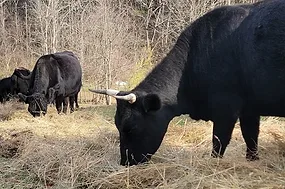
Adding nutrients, organic matter and ground cover to poorly productive lands have some raving about bale grazing. Added fertility and better water-holding capacity of soils after bale grazing is often mentioned by early adopters.

For skeptics, improved hay inventories and lower hay prices coupled with fertilizer, fuel and equipment prices that remain elevated may be the sign they needed to give it a try.
Bale grazing can look differently from farm to farm but, in essence, it is strip grazing with bales of hay set out for cattle to eat. Many times, it looks like bales set out in a grid pattern and temporary electric fence to control the allocation of hay.
Bale grazing requires planning. It is important to pick a location with good water resources, good electric fence power, windbreak or area for cattle to shelter, and land that needs additional fertility. Cows need to be well-broke to an electric fence.
To determine how many bales to set out, predict cow intake, hay waste and feeding period. A 1,300-pound beef cow will eat approximately 32 pounds of hay and waste around 8 pounds per day. So 40 pounds of hay per head per day. A herd of 25 cows will go through 1,000 pounds of hay per day. While bales of hay vary greatly in size and weight, for this example I will assume that a round bale weighs 1,000 pounds. Thus, we need to set out 30 bales for the 25-cow herd for one month of bale grazing. Most recommendations say to set out no more than 2 tons of hay to the acre, roughly four bales per acre.
From an economic perspective, savings of fuel, fertilizer and labor are an important piece of making bale grazing pay. If a round bale of hay is $50 per bale, then feed cost for the hay is $2 per cow per day. Using Illinois fertilizer prices from August 2025 and assuming a 75% capture of the nutrients in a grass-legume mix hay bale, there’s approximately $18 of fertilizer value per bale. If these nutrients are fully captured and the fertilizer value is subtracted from the hay cost, this results in a 36% reduction, resulting in hay costs of $1.28 per head per day or $32 per bale after the nutrient credit.
Wet, muddy conditions are difficult. The trample and pugging around hay bales can be detrimental to forage stands and open it up to weed pressure. There will be mud, hay waste and weeds that will fill in holes to the sod. Timely seeding is necessary to fix these high-impact areas.