Technology intersects many segments of agriculture with applications extending into animal health for prevention, detection and treatment of illness. Many of the newer tools are aimed at blending data collection, analysis and specialized interventions. By having a systematic approach, outcomes can be evaluated to make alterations that refine the process. This ability to make information-driven adaptations forms a strategy suited for individual scenarios and circumstances that change over time.

Autogenous vaccines
Most livestock producers are familiar with fully licensed, commercial vaccines, but custom-made vaccines (CMVs), also called autogenous vaccines, are another tool to use in herd health programs. While there are several similarities between the two types of products, CMVs can be modified according to the pathogens found in disease situations. In this way, CMVs offer a means to tailor protocols to the specific needs of a herd even as challenges evolve.
"Autogenous" translates as "arising from self." In the context of vaccines, this is an inactivated product manufactured from cultures of pathogens recovered through diagnostics of unhealthy animals. Many diseases are known as syndromes because more than one microorganism is involved in the infection, and genetic mutations add complexity by creating strain variation in each bacterium, mycoplasma or virus. As a result, the same strain, also known as homologous strain, contributing to the problem is included in an autogenous vaccination.
Modern techniques like the molecular applications including polymerase chain reaction (PCR) assays and whole genome sequencing (WGS) can be used to determine differences among a species of organism. The commercialization of these tests has substantially improved the accessibility and expense associated with running the analyses. This makes it relatively easy and cost-effective to compare what is found in one disease occurrence with that of another. By doing so, appropriate adjustments can be made in a vaccine formulation.
The process
While there are other components like post-additives, there are two main parts in a vaccine: antigen and adjuvant. Antigen is what the immune system is intended to recognize and produce antibodies against. It’s either the whole cell, a subunit of the infectious organism or a byproduct of growth such as a toxin. In killed products, these are treated with inactivants so they are no longer able to cause disease. To better stimulate the immune response, an adjuvant is added. The purpose of it is to help attract cells that are important for antigen presentation. Not only can the antigen be changed in autogenous vaccines, so can the adjuvant.
All autogenous products must be inactivated, but a live organism is required to start the process of vaccine development. The viability must be maintained through appropriate specimen preservation starting the moment when the initial samples are collected from a diseased animal. This includes wearing gloves and keeping supplies clean to avoid contamination. Swabs, tissues and feces should be refrigerated. When these are submitted to a lab, they should be sent as soon as possible after collection, shipped with short transit times and transported using ice packs inside an insulated cooler box. After arriving at a diagnostic facility, certain media and cell lines will be used to recover any microorganisms. If one is grown, it is referred to as an isolate and preserved in an ultra-low freezer until needed for fermentation when making the vaccine.
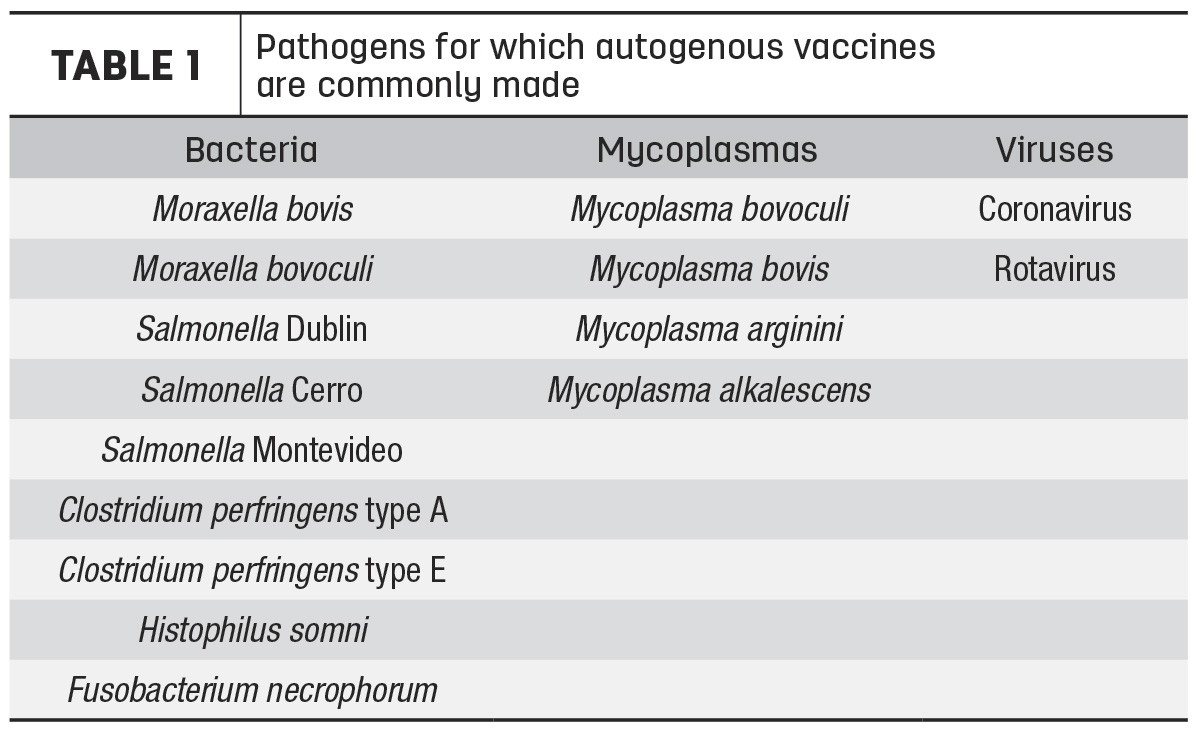
Autogenous vaccines are licensed biologics. Like commercial vaccines, they are manufactured in licensed facilities using USDA-approved Outlines of Production and have testing requirements that must be satisfied to release products for shipment. Both types must prove purity and safety. However, potency and efficacy requirements are different. Instead of those parameters being met with studies, a veterinarian uses his or her expertise and experience to determine an assessment of need. In effect, he or she makes a judgment that includes the dynamics of the disease situation, whether the isolates recovered are appropriate antigens and expectations for the vaccine.
Given the source of antigens for autogenous vaccines, it logically follows that these products would be used in the herds of origin. Since diseases may spread in many ways (aerosol transmission, contaminated equipment, animal movements, etc.), more than one herd may have the same or similar risk. A veterinarian with a valid veterinarian-client-patient relationship (VCPR) can establish an epidemiological link – that is, some factor that connects the herd of origin to adjacent herds, non-adjacent herds and herds with common ownership. Once this is documented, then a batch of vaccine can be used by multiple producers without each making an individual product.
Developing an autogenous vaccine includes the following steps:
- Contacting a veterinarian with a valid VCPR because he or she has an integral role in the entire process leading up to an order and with coordinating shipment of the finished product
- Submitting appropriate samples to a diagnostic laboratory that has capabilities to perform bacterial as well as mycoplasmal cultures and virus isolation
- Requesting transfer of isolates to the manufacturer if a lab different than the one associated with the autogenous company is used
- Determining number of doses and whether an adjuvant that requires two doses in the initial vaccination series or just one is most appropriate for the disease
Veterinarians are committed to helping address disease challenges and being able to provide autogenous products is another means by which to promote animal health. With layers of safeguards, there is assurance that best practices have been used in producing these biologics. As pathogens continue to evolve, having flexible tools that can be adapted relatively quickly is important. Following the same principles used by other technologies, informed decisions through diagnostic endeavors drives the customizable intervention strategies of autogenous vaccines, creating unique disease prevention programs aligned to specific needs.