Although some ranchers haven’t started calving yet, it’s never too early to consider what bull(s) you’re going to use during the next breeding season. These decisions can be challenging because some bull sales may occur before a ranch’s calving season begins. This makes next year’s calf crop decisions without the current year’s calving data incredibly difficult for some producers.

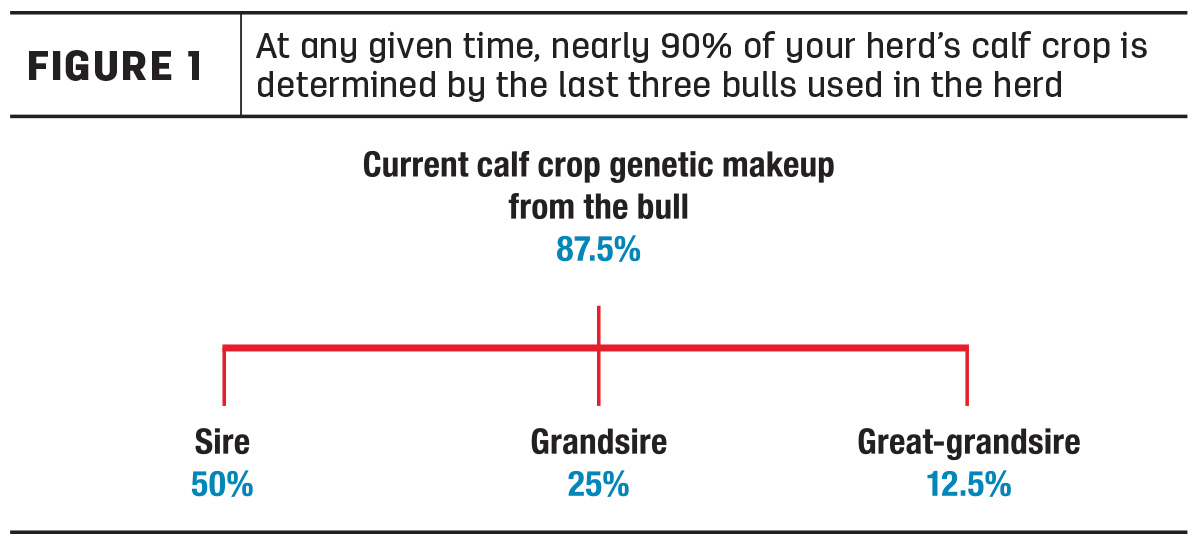
Genetically, bulls are the most important component of the herd – 87.5% of the genetic makeup of the herd is determined by the last three bulls used (Figure 1). Additionally, if using natural service, one bull can sire over 25 calves for the subsequent calf crop. If using artificial insemination (A.I.), the number of calves born to a single sire can be much greater. Therefore, making bull selection decisions is critical to the future of your cow herd.
There is no one-size-fits-all bull for every ranch; therefore, selecting a bull that meets your ranch and cow herd goals is crucial. Different bulls can be selected to meet different criteria, and some bulls will meet multiple criteria. Some ranch goals can include increasing weaning weights, improving the quality of heifer replacements or finding bulls that fit the management environment. Maintaining consistent and realistic goals can help ranchers improve year after year.
Another consideration when selecting bulls is to use both the genotype and phenotype of the bull. Genotype is the genetic makeup, and phenotype is the physical appearance and characteristics of the bull. Using expected progeny differences (EPDs) as a tool for selection can help the rancher narrow the bull selection pool. When considering EPDs, focus on those that will help you achieve your ranch and herd goals. Another consideration when looking at EPDs is the heritability of the traits; performance-based traits tend to be more heritable than reproductive-based traits.
However, don’t put all your eggs in the EPD basket and forget to look at the physical appearance of the bull, too. Additionally, if actual bodyweights are provided at the sale or in the semen catalog, don’t forget to take a look at that as well, especially actual birthweight. Ranchers work in extensive grazing systems in the western U.S., so a bull should be physically capable of putting on some miles during the breeding season. Traits that contribute to these abilities can include feet, legs and body condition.
Once the bulls are selected and/or purchased, there are a few things to consider prior to and during the breeding season. Nutrition prior to the breeding season is crucial so the bulls are in good body condition at turnout. Bulls at the beginning of the breeding season should have a body condition score (BCS) of 5 to 6. Bulls with a BCS greater than 6 may have developed fat in the scrotum, which could impact spermatogenesis. Bulls with a BCS lower than 5 may not have the energy reserves to breed cows through an entire breeding season.
Having your local veterinarian conduct a breeding soundness exam on all ranch bulls – previous and current purchases – 30 to 60 days before the breeding season can also help make bull decisions. A breeding soundness exam is an external and internal evaluation of each bull. This is crucial for the breeding season because nutrition, injury and stress all impact spermatogenesis, which is a 60-day cycle. So any negative impacts occurring may not be observed in sperm quality for up to 60 days after the event. This can be incredibly challenging should there be a negative impact immediately prior to or during the breeding season.
These are just a few considerations when selecting bulls for the ranch. Making these selections will impact the herd for years to come, so considering options early in the year can help lead to a successful calving season the following year. Establish ranch goals for the current year and following years to help in making bull selections. Whenever questions arise, reach out to local and state experts to answer those questions.