The problem of pregnancy loss
Pregnancy loss is one of the most frustrating and costly reproductive challenges in beef cattle production. Even with good nutrition, thoughtful bull selection and sound management, we still deal with open cows, early embryonic loss and the occasional unexplained abortion. In a cow-calf system, we know that every lost pregnancy represents a lost calf, a longer calving interval and reduced herd productivity.

A successful pregnancy requires many steps to go right, including proper formation of the placenta. The placenta is a highly dynamic and specialized organ responsible for hormone production, nutrient exchange, immune tolerance and fetal support. And, importantly, when pregnancies fail, the placenta could be to blame.
New technology for better research
Historically, placental research in livestock has focused on structure and anatomy. But if we want to understand why pregnancies fail, we need to examine the molecular events that occur long before any outward phenotypic signs appear.
That’s exactly what our team at Washington State University, along with collaborators at the University of Missouri and the University of Wisconsin – Madison, is tackling. We’re using advanced genetic tools, specifically single-cell “omics” approaches, to understand how the bovine placenta forms, functions and sometimes fails. These tools let us map, in extraordinary detail, how individual placental cells behave during early gestation and how small disruptions might lead to pregnancy loss.
In the past, researchers analyzed blended tissue samples, producing only an “average” gene expression profile. But pregnancy relies on specific cells doing precise jobs at exactly the right time. Single-cell omics changes the picture from a blurry overview to a clear, cell-by-cell view of what’s happening during placental development and maintenance in cattle.
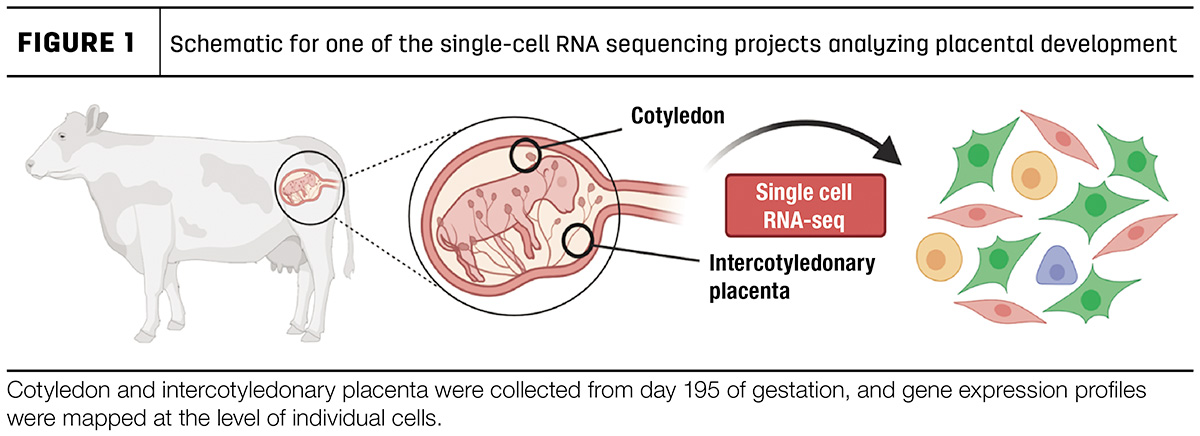
We applied these technologies to both mature placentas (days 170 and 195) and developing placentas (days 17, 24, 30, 40 and 50), giving us a detailed timeline of how placental cells grow, transition and specialize during the most critical windows of pregnancy (Figure 1). Using this timeline, we identified several populations of uninucleate trophoblast cells (UNCs) and binucleate trophoblast cells (BNCs) based on their gene expression. Our team has published three peer-reviewed manuscripts describing these findings, with additional work underway.
Using research to address the pregnancy loss issue
This work can be summarized into three primary findings:
- First, trophoblast cells exist in distinct subtypes that carry out diverse functions. We mapped how these cells grow and specialize in healthy placentas and identified key genes involved at each stage.
- Second, transcription factors, or genetic “light switches,” play crucial roles. They turn genes on or off by accessing specific regions of DNA during placenta formation, directing which genes are used and when.
- And third, gene expression timing is critical. There appears to be a narrow window in early gestation where precise gene regulation is essential. Disruptions during this period may set the stage for pregnancy loss.
In addition to understanding placental development in cattle, we also compared bovine placentas to sheep and even human samples. We found strong similarities between cattle and sheep but striking differences between cattle and humans, emphasizing the unique aspects of livestock placental development.
Although these findings are technical, they have practical applications down the road. By understanding placental function at the molecular level, we can identify exactly what goes wrong in compromised pregnancies and ultimately develop tools to detect and/or prevent those issues.
What’s next on the horizon?
We’re now expanding this work to include abnormal or compromised placental samples, including those from cows that have consistently experienced late embryonic loss. With detailed cell maps and regulatory networks already built, we hope to identify early warning indicators of pregnancies that are unlikely to succeed.
Right now, when a beef cow comes up open or loses a pregnancy, determining exactly why can be difficult. Standard reproductive tools such as ultrasound, blood tests and visual observation can only tell us if a pregnancy exists, not necessarily the intricate details of how well it’s progressing and receiving proper cellular cues. By advancing our molecular understanding, we’re learning which genes are normally active in a healthy pregnancy so that we can detect problems earlier and potentially catch losses before they occur. This information could also help us fine-tune management strategies to guide new hormonal, nutritional or environmental interventions to ensure proper placental development. Furthermore, genes involved in early placental development may eventually inform genetic tools that help us more effectively select sires and dams that maintain successful pregnancies.
The bottom line
Pregnancy loss may never be fully eliminated in beef production, but improving our understanding of the underlying biology is a major step forward. The placenta is not just a passive structure; it’s an active, highly dynamic organ that influences whether a pregnancy thrives or fails.
Single-cell omics technologies are allowing us to learn more about pregnancy at the molecular level. Even if these tools are currently research focused, they are laying the foundation for future reproductive solutions that could directly impact beef herd management.