Based on preliminary slaughter data for the month of December, the forecast for fourth-quarter 2025 beef production is raised 50 million pounds from last month. The change reflects a marginal increase in fed cattle and cow slaughter that more than offsets a decline in bull slaughter from last month’s forecast. In addition, anticipated carcass weights for December were adjusted slightly lower. As a result, total commercial beef production in 2025 is estimated to have been 26 billion pounds, a 4% decline from 2024 and an 8% decline from the record set in 2022.
2026 production higher on carcass weights
According to the latest Cattle on Feed report, published by the USDA National Agricultural Statistics Service (NASS), the Dec. 1 feedlot inventory is estimated at 11.727 million head, about 2% below the 11.982 million head estimated for Dec. 1, 2024. Feedlot net placements in November were down over 11% from last year at 1.542 million head. Marketings in November totaled 1.521 million head, down nearly 12% from a year ago.
In the three largest cattle feeding states, as of Dec. 1, the number of cattle on feed in Texas was down 9%, while Kansas and Nebraska were 1% and 3% higher than last year, respectively. However, as Figure 1 indicates, market-ready supplies in all three states were at elevated levels compared to last year. This coincides with the significant slowdown in steer and heifer slaughter and in net placements backfilling empty feedlots in 2025.
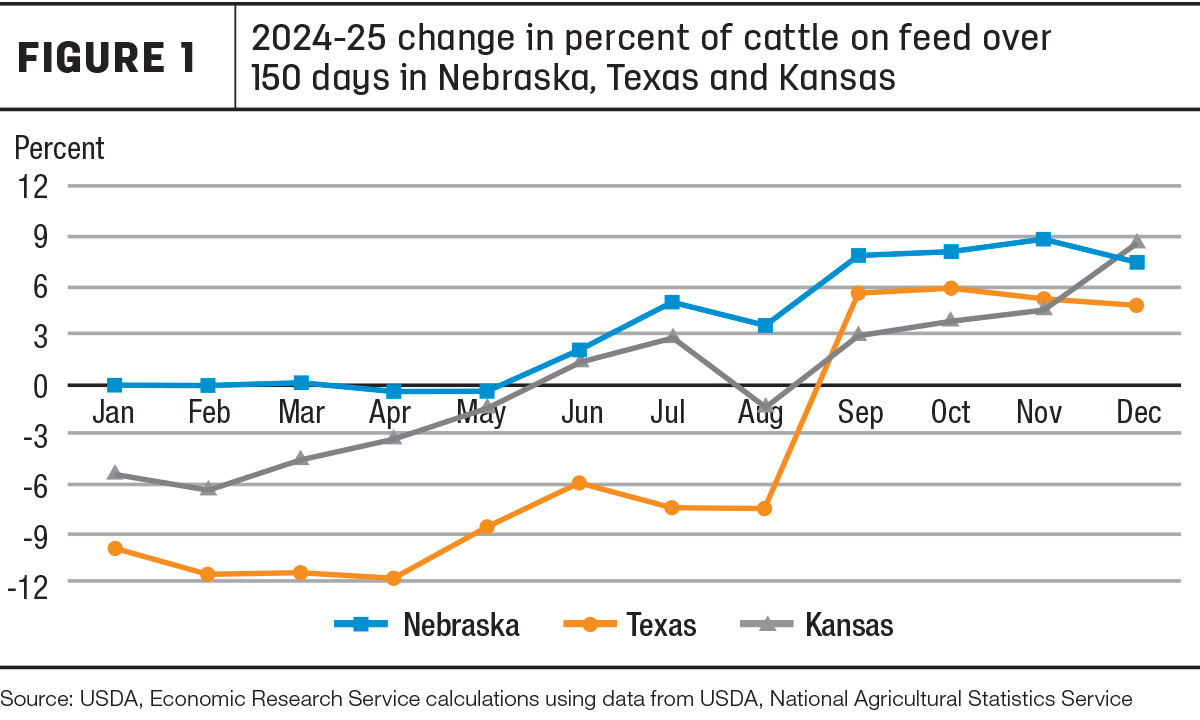
Based on the cattle feedlot placement data for November, expected placements during the fourth quarter are reduced. This might suggest reduced marketings anticipated in the second quarter of 2026, but there are 25% more cattle on feed over 150 days on Dec.1 than a year ago. For this reason, the impact on marketings in 2026 is expected to be more pronounced in the third quarter. This results in unchanged marketings in the first half of 2026 and a net decrease in the second half of the year relative to the previous month’s outlook.
Further, based on December slaughter data, expectations for average carcass weights in 2026 are raised across all quarterly forecasts. As a result, the 2026 beef production forecast is raised 10 million pounds from last month to 25.735 billion pounds, a 1% decline from 2025. Fewer anticipated marketings in the third quarter are more than offset by heavier expected carcass weights.
Looking further into 2026, the USDA NASS will release the Cattle report on Jan. 30, which will provide insights into calves available for placement in feedlots in first-half 2026.
Cattle prices show resilience after late 2025 downturn
Starting off 2026, weekly prices for slaughter steers and feeder steers have recovered more than 60% of the decline from their respective highs last year to the lows that occurred in November. Specifically, live slaughter steers sold on a negotiated basis in the 5-area marketing region topped $244.25 per hundredweight (cwt) the week ending Aug. 24, 2025, and then declined nearly $33 to $211.53 per cwt the week ending Nov. 30, 2025. Since then, prices have recovered 62% of the value lost as of the week ending Jan. 11, 2026. Based on the rebound in slaughter cattle prices in early 2026, the first-quarter price forecast was raised $2 to $232 per cwt. The third-quarter price was raised $1 on fewer expected marketings available for slaughter. The 2026 annual price forecast is raised to $235.75 per cwt, an expected 5% increase from 2025.
As for feeder steers weighing 750 to 800 pounds at the Oklahoma City National Stockyards, last year they set a top the week of Oct. 13, 2025, at $383.48 per cwt and then declined $66 over the course of six weeks to $317.71 per cwt. Based on Jan. 5, 2026, sales data, feeder steer prices were recorded at $362.34 per cwt, nearly $93 above the same week last year and a 68% recovery from the decline in late 2025. This price strength was carried over into the 2026 quarterly forecasts, which were raised $12 from last month for an annual price forecast of $357 per cwt, 11% higher than 2025.
Global beef trade policy changes
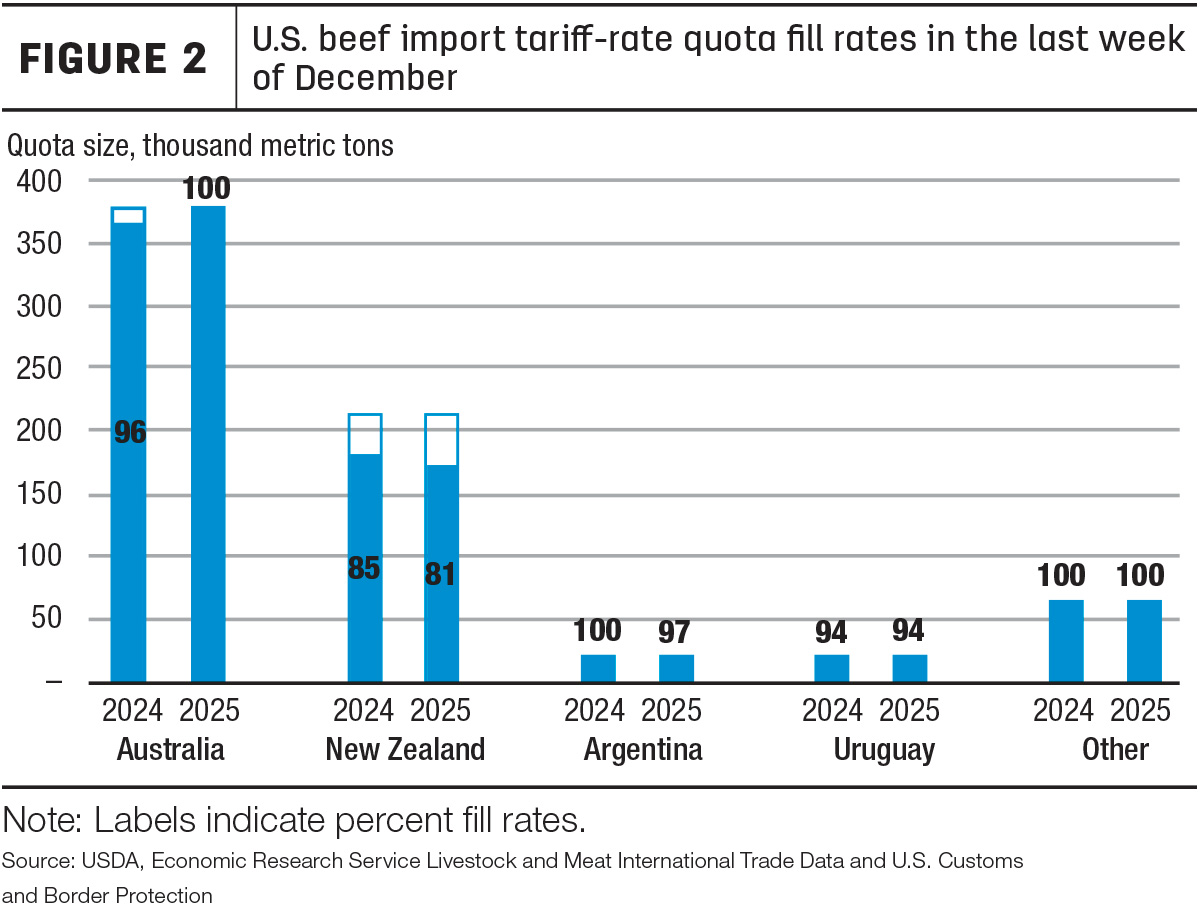
There have been a few notable developments in the global beef market over the past month. First, as of Jan. 1, 2026, the U.S. tariff-rate quota for countries without a specific quota or free trade agreement (Other) has decreased to 52,005 metric tons while a new quota has been established for the United Kingdom at 13,000 metric tons. The biggest impact this will have on U.S. beef imports is that the “Other” quota may be filled even faster this year. Figure 2 shows the quota fill rates as of the last week in December for 2024 and 2025. In 2025, both the Australia and Other quotas were filled by the end of the year, with several other quotas nearly filled. According to the U.S. Customs and Border Protection Commodity Status Report, the 2025 Other quota was filled within the first 17 days of 2025. As of Jan. 5, this year, the 2026 Other quota was already 91% filled. Once the quota is filled, imports from countries that do not have access to other quotas or trade agreements are subject to a higher out-of-quota tariff of 26.4%.
Second, China announced the results from its beef safeguard investigation and established quota allotments for most large beef exporting countries and a 55% over-quota tariff rate. This may limit beef exports to China from countries like Brazil, Australia and Argentina. While the U.S. would also be subject to a quota, the export registrations for most U.S. beef facilities expired in 2025 and have still not been renewed, meaning that minimal U.S. beef is currently being exported to China. Instead, the indirect impact of China’s safeguard announcement is that extra product from Brazil, Australia, Argentina and other global suppliers that are limited by the new quota is expected to shift to other markets such as South Korea and Japan, increasing competition for U.S. beef in those markets and putting downward pressure on U.S. exports. At the same time, these suppliers may have more product to ship to the U.S., supporting U.S. beef imports.
Finally, Mexico recently announced a new 70,000-metric-ton quota for beef imports from countries without a free trade agreement. Previously, Mexico had an anti-inflation decree that allowed certain food products, including beef, to enter duty-free even if Mexico did not have a free-trade agreement with that country. Brazil’s beef shipments to Mexico have been climbing since the end of 2023, with substantial quantities shipped in mid-2025. Mexico’s new quota may limit Brazil’s shipments to the country, which could support U.S. beef exports to Mexico. Additionally, with Brazil having limited access in both Mexico and China, more of their exports may be shifted to the U.S.
Recently released beef import and export data
The U.S. Department of Commerce, Bureau of the Census released two more months of trade data since the last USDA World Agricultural Supply and Demand Estimates (WASDE) report, including September and October. Beef exports hit a new low for the year in September after six months of consistent decline before recovering slightly in October. Exports for October were higher year over year to Taiwan, Canada, Hong Kong, Vietnam and several other smaller markets. However, exports to China and South Korea were nearly 97% and 17% lower year over year, respectively. Based on recent data, the estimate for fourth-quarter exports is lowered 10 million pounds to 590 million; the annual estimate is 2.568 billion pounds. The 2026 forecast is also lowered based on increased export competition resulting from the policies discussed above. The first- and second-quarter forecasts are down 10 million pounds each, and the third- and fourth-quarter forecasts are lowered 20 million pounds each for an annual forecast of 2.425 billion pounds.
On the imports side, October beef imports were slightly lower year over year for the third month in a row. Imports from Brazil were 62% lower year over year while imports from New Zealand were down 30%. These decreases were only partly offset by larger imports from Mexico, Canada, Australia, Nicaragua and Argentina. Imports from Mexico in October were the second-largest on record, behind May 2020. U.S. imports from Mexico have been increasing throughout the latter half of 2025. This has been supported by a combination of increased cattle supplies – resulting from the U.S. ban on cattle imports from Mexico – and higher imports from Brazil to satisfy domestic consumers, resulting in more domestic production available for export to the U.S., where demand for beef continues to support high beef prices.
Based on recent data, the fourth-quarter 2025 import estimate is increased 25 million pounds to 1.175 billion. The annual 2025 forecast is 5.369 billion pounds. The 2026 forecast is also raised due to recent global trade policy changes discussed above. The first quarter is raised 25 million pounds to 1.55 billion. The second quarter is unchanged at 1.475 billion. The third- and fourth-quarter forecasts are raised 25 million pounds each to 1.3 billion and 1.2 billion pounds, respectively. The annual forecast is 5.525 billion pounds, which, if realized, would be a 2.9% year-over-year increase.