Every farmer has a moment when the tractor doesn’t seem to perform like it used to – a little more slip in soft ground, a little more fuel burned to finish the same job. It’s easy to assume the machine is simply showing its age, but a new tractor isn’t always in the cards or the budget.

The good news? You may not need one. A smarter, more affordable path to better performance often starts where few people look first: the tires. Upgrading to modern tire technology can restore lost power, improve efficiency and reduce compaction without the cost of replacing the tractor itself.
Why better tires pay off
For many farmers, the most noticeable benefits of a tire upgrade are fuel savings and time.
At our field clinic, tire specialists demonstrated traction gains with a simple pull test. In our demonstration of a quarter-mile run, a tractor with optimized tires might gain about 37 feet. Over a mile, that becomes roughly 148 feet. Across a 70-mile workday, the tractor could complete more than 10,000 additional feet of productive work, nearly 2 more miles, without burning extra fuel.
Across a 140-day workload, that can mean:
- About 274 additional miles
- Close to four days saved
- Hundreds of dollars per day in fuel savings for larger tractors
Small daily gains build into measurable return over just a few seasons.
How to know when it’s time for new tires
Before deciding on new tires, think about how the tractor feels in daily work. Most farmers can tell when something is off – the machine slips more in soft spots, fuel disappears faster or routine tasks take longer than they should. Those frustrations often point to a tire setup that’s no longer keeping up with the workload.
Common red flags include:
- Smaller tire footprints from higher pressures
- Traction loss caused by overloading or mismatched sizes
- Compaction along heavy-use routes
- Increased slip that stretches job times
- Uneven wear that hints at ballast or inflation issues
These signs can be easy to miss day to day but become obvious over time. A tractor that struggles on inclines, burns more fuel or feels rougher in routine chores is often signaling that the tire setup is doing more work than it should.
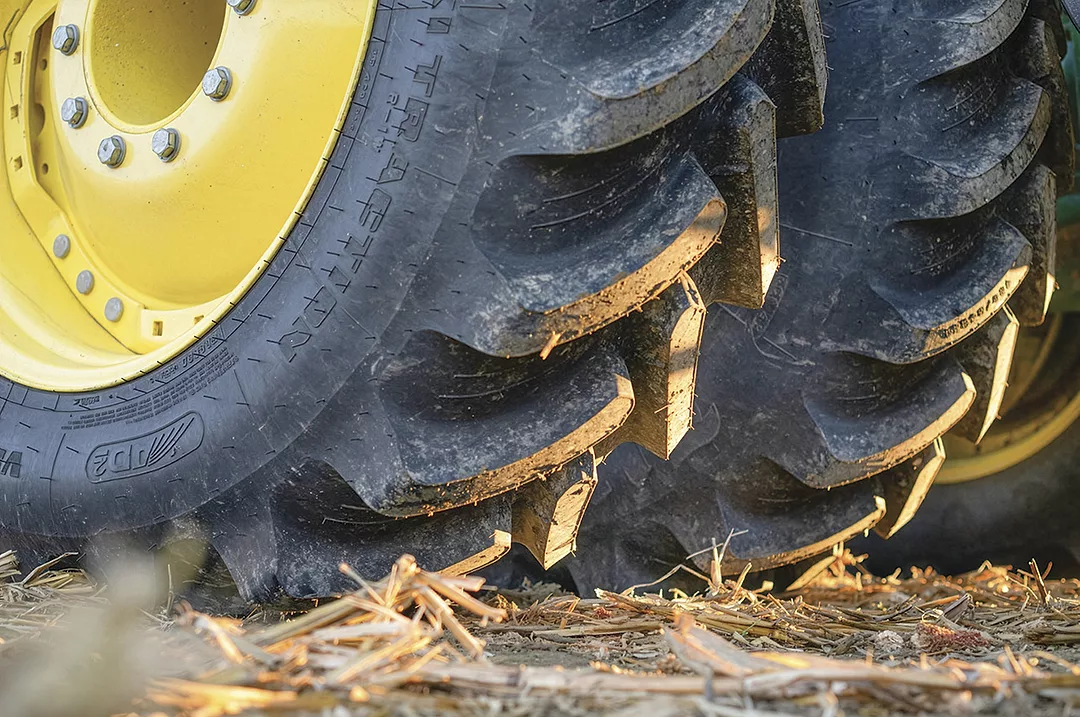
A larger footprint and the ability to run lower pressure can reduce strain on the tractor and the soil, restoring traction and improving consistency.
Why tire technology matters more than most people think
Upgrading to increased flexion (IF) or very high flexion (VF) tires can help resolve many of these challenges. Unlike standard radials that rely mostly on air pressure, IF and VF tires use reinforced sidewalls to support more load at less pressure. That design creates a larger footprint and smoother performance.
As loads increase, pressure increases too. With standard radial tires, higher pressure stiffens the tire, reduces footprint size and limits traction. The result is more compaction and higher fuel use. With IF and VF tires, the designs allow the tire to flex without depending so heavily on added pressure, letting you carry more weight at the same pressure or carry the same weight at a lower pressure.
Upgrading to IF or VF tires may be worthwhile if:
- You’ve added heavier implements
- Compaction shows up in feed alleys, field lanes or headlands
- Your current tires run near their maximum load rating
- Yield maps show drop-offs in high-traffic areas
Remember, a great tire setup isn’t just about size or brand – it’s defined by optimized footprint, soil contact. How well does the tractor transfer power to the ground? How smoothly does it move through chores, fields and tough conditions? When the tire setup is right, traction improves, slip drops and the machine responds the way it should.
Maintenance still matters
Whether you’re upgrading to new tires or looking to get more efficiency from the tires you already have, a few simple habits can help maintain traction, support fuel efficiency and extend tire life.
- Check and set inflation pressures: Underinflation stresses the casing. Overinflation shrinks the footprint and increases slip.
- Weigh your equipment: A tractor hauling feed or manure may need different pressures than the same tractor pulling tillage tools.
- Stay within load ratings: Excess weight forces the tire to flex beyond its design limits.
- Watch wear patterns: Uneven wear often points to inflation or ballast issues.
- Adjust for seasonal temperatures: Pressure drops in cold weather and climbs in heat. Small adjustments protect performance year-round.
These habits help keep the tractor efficient, reliable and ready for every job. When the right tires are on the tractor, the whole machine runs more efficiently with better traction, less fuel use and less strain on the soil. It’s proof that meaningful performance gains don’t always require new equipment; sometimes the smartest upgrade is simply smarter tires. With modern tire technology, small daily improvements can quickly add up to a noticeable return.