Last year, Dairy West, representing dairy producers in Idaho and Utah, was also approved to oversee dairy product education and promotion for producers in Washington and Oregon. The board-approved merger, a solution to address consolidation and industry needs, is an example of the ever-changing landscape of dairy product promotion for U.S. consumers.

“The dollars and cents that go into checkoff have not grown beyond production growth over time, and we need to be more efficient with the dollars and getting into the market,” says Steve Seppi, CEO for Dairy West. “Strategically, mergers such as ours serve as a way to skate where the puck is going. To modernize, be more efficient, scale programs that are working and continue to have presence in each one of the states that we represent to ensure dairy farmers’ voices are heard.”
The story of the large western organization has components that are specific to the dairy landscape across Idaho, Utah, Washington and Oregon, and also one that other organizations can relate to.
“We know farmers are changing their practices every day. They’re getting more efficient, they’re tweaking, they’re experimenting,” Jennie McDowell says. “One of my absolute favorite things about working for dairy farmers is they expect the same of us.”
McDowell is the CEO of Dairy MAX, which supports dairy farm families across eight states. The regional checkoff program was founded in 1995, representing farmers in Texas, Oklahoma, New Mexico and Kansas. From 2018 to 2019, Colorado, Wyoming, Montana and then Louisiana joined the partnership. The program represents 15% of all milk produced in the U.S., but only 10% of the U.S. population.
“In some of these consolidations, that is exactly what they’re doing,” says dairy producer Marilyn Hershey. “It’s helping the regions that are completely overpopulated.”
Hershey serves on the local board for the American Dairy Association North East and is also the chairperson for Dairy Management Inc. (DMI), which manages the national dairy checkoff.
“The story of dairy checkoff is constant change,” McDowell adds. “When we started in the ’80s, promotion was so disjointed, and it looked so different across every region, every state. If you look at it today, it would be almost unrecognizable. I think that is something so critical for us to understand why we have grown to this point, how much more efficient we’ve gotten because of it and how much more effective we’ve gotten because of it.”
The emergence of a unified effort to build trust in and demand for U.S. dairy first began in the early 1900s when the National Dairy Council (NDC) was formed. In the years that followed, the American Dairy Association and Dairy Research Inc. were founded and went on to join the NDC to create the United Dairy Industry Association (UDIA) in 1970.
By 1983, consumer demand plateaued despite monumental promotion efforts, and production continued to soar. This moment was the catalyst for farmer-led conversations of a national checkoff program that would boost dairy consumption and reduce reliance on government support by having producers give 5 cents per hundredweight (cwt) to support the national program and a remaining 10 cents per cwt for state and local promotion organizations. Fine-tuning of this concept created DMI in 1995, with continued oversight from the National Dairy Promotion and Research Board (NDB) and UDIA board members.
Today, there are 14 regional promotion and research organizations under DMI, plus 50-some more promotional programs across the U.S. that meet the qualifications of the USDA’s Dairy Act and Order.
“Every consolidation or merger that has happened across the country started with farmers having conversations with other farmers,” Hershey says.
Alex Peterson agrees, “I think inherently, farmers are really, really good about sharing ideas. … that’s where coming together makes us stronger and gives us the willpower to be able to do more.”
Peterson’s family dairy farms in Missouri, and he formerly served on the Midwest Dairy division board as well as being the chairperson for UDIA. Peterson assumed the chairperson role in 2023 at the annual meeting of NDB, UDIA and the National Milk Producers Federation (NMPF).
At that meeting and during his closing remarks, former UDIA chairperson and Texas dairy farmer Neil Hoff described the checkoff system as an Indy race car with every component critical to its high-performance capability. He referred to DMI as the chassis for the vehicle, the 15 cents as the fuel, UDIA and state and regional staff as the tires, NDB as the steering system and the skilled driver always being dairy farmers.
“It’s the dairy farmers who make sure the car drives straight, avoids potholes and handles the corners. When you put it all together, this machine can’t be stopped. It can’t be beat,” said Hoff, according to DMI’s account of events.
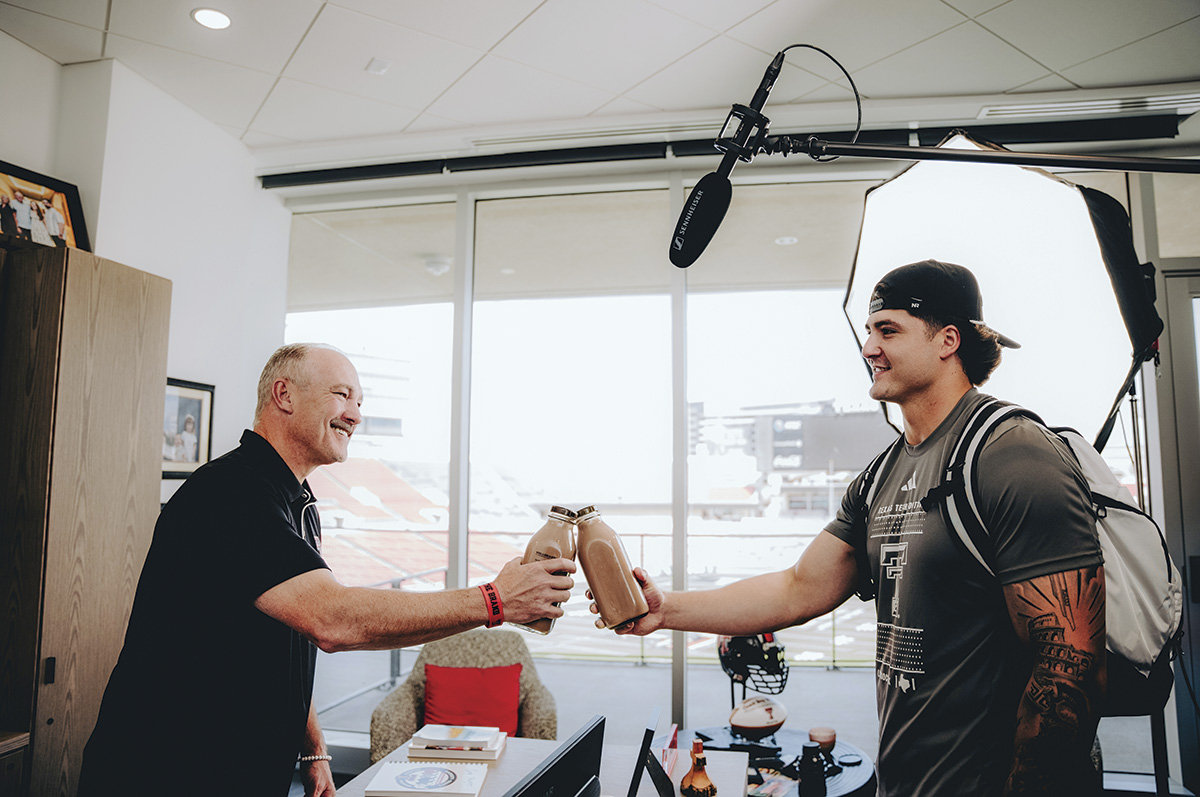
Texas Tech football coach Joey McGuire and player Jacob Rodriguez clink bottles of chocolate milk to highlight real milk as a post-workout recovery beverage. Image courtesy of Dairy MAX.
It’s always been farmer-led initiatives that have shaped the industry’s checkoff program for the betterment of the industry. That’s not to dismiss the pains that come with necessary change, especially as consumer dynamics advance quickly.
“Any time you’re bringing together different states and farmers, they represent different regions, different cooperatives. That’s their identity, and for many of these farms, it’s multigenerational and inherent to who they are,” Seppi says. “As a checkoff organization undergoing change, we’re committed to getting farmers an increased return without sacrificing something they’re passionate about.
“The consumer experience continues changing, and checkoff needs to evolve with it. … sort of that ‘rising tide lifts both boats’ mentality,” Seppi says.
Through any change that has occurred or will occur in the future, one thing is true: it’s embedded in grassroot efforts for the betterment of the dairy industry.
“It’s absolutely critical to have good leaders, spending time and effort giving guidance and wisdom,” Peterson says. “That’s the industry’s biggest challenge [with restructuring], continuing to find farmers who are willing to invest some of their bandwidth.”
So, where does the future of checkoff lie?
“I see our entire checkoff ecosystem working more collaboratively than I’ve ever seen it work before,” McDowell says. “Visions really come to life in the boardroom when farmers are willing to take off their co-op hats, their location hats and say, ‘This is what’s best for the industry.’ We’re building a culture and really thinking about who we become next.”