
When it comes to growing calves, the crude protein system doesn’t work well for cattle feeders. That’s the message Dr. Mary Drewnoski, University of Nebraska – Lincoln (UNL) professor and beef systems extension specialist, hopes beef producers understand.

Drewnoski points to data drawn from a UNL research program involving 500-pound calves – all steers – that grazed corn residue. The calves were sorted into three groups: one group grazing just corn residue, one group supplemented with 5% urea and one group supplemented with distillers grains.
“We used less DDGs (dried distillers grains) because it is more energy dense,” she says. “The DDGs group received the same amount of energy but fewer pounds due to the DDGs’ higher energy density. The key thing to note is that all supplements provided the same amount of energy.”
When looked at on a crude protein basis, the corn had less protein than the corn-urea or DDGs. But the corn-urea and DDGs groups had the same levels of crude protein. So how did the steers perform?
“Many would guess that the corn-urea group performance would be less than the DDGs group,” Drewnoski says. “And they would be correct. Performance on corn-urea was only about 1/2 pound per-day gain. The DDGs group gained 1.32 pounds per day. If you look at the difference between the two – crude protein the same, energy the same – what’s going on?”
Drewnoski explains that the difference between the two feed sources is how they are processed in the animals’ rumen.
“Urea is a rumen-degradable protein, and DDGs is a rumen-undegradable protein,” she says. “If you look at what that actually means, we need to get into a bit of basic rumen nutrition, how the protein system works.”
Basically, there are two types of rumen protein: degradable and undegradable. One type can be degraded in the rumen. It actually becomes available to microbes in the rumen. Those microbes break it down and use it to grow and multiply.
“The microbes are eventually washed out of the rumen and become a source of protein to the animal,” Drewnoski says. “They wash down the digestive tract and are absorbed as a source of protein for the animal. That happens if there’s enough energy in the system for those microbes to use the rumen-degradable protein source to grow and multiply.”
If there isn’t sufficient energy, the microbes break down the protein, use the carbon in it for energy and release nitrogen in the form of ammonia. With rumen-degradable protein, only as much microbial crude protein is available as the energy allows, relative to the amount of rumen-degradable protein.
“Add corn to the system when you don’t have enough energy,” Drewnoski says. “[That way] we can increase the utilization of rumen-degradable protein so that ammonia and corn work together to produce more microbes. So it’s all about the microbes when we think about rumen-degradable protein. The source for the animal is just the microbes.”
Undegradable protein is not degraded in the rumen. It washes through the rumen and becomes a source of amino acids or protein for the animal. If indeed the animal can utilize the protein, it will use it to grow. It can use it to make muscle, immune cells, enzymes – anything the protein is needed for – just like the microbes are used as a feed source.
“If we overfeed rumen-undegradable protein relative to the amount of energy available, the animal uses it much like the microbes do,” Drewnoski says. “They break it down and use the carbon as an energy source to grow and make more muscle, or use it as energy to maintain the body or store fat. It may also break off nitrogen and release it.”
The undegradable feed source the animal can use does not go through microbes and become a secondary type of protein source. If overfed, it can become energy.
“One reason DDGs is a high-energy source is that bypass protein is quite high in energy,” she says. “The protein available to the animal is microbial crude protein plus rumen-undegradable protein. Except for something like urea, which is typically all degradable and no undegradable protein, most feeds have both.”
Drewnoski points out that the important thing to understand is that microbial crude protein production is really dependent on the balance of rumen-available energy and rumen-available nitrogen.
“If we continue to feed high-quality alfalfa hay, dairy quality, which is 24 to 25 percent crude protein, and expect high rates of gain in calves, what may happen is that there’s actually not enough energy to make use of all that protein, so we don’t get as high a gain as expected,” Drewnoski says. “If we provide a bit more energy, such as corn, it will boost performance.
“When it comes to microbial crude protein production in a forage-based diet, it’s really hard to get enough microbial crude protein to sustain high rates of gain, especially in lighter-weight calves,” she adds.
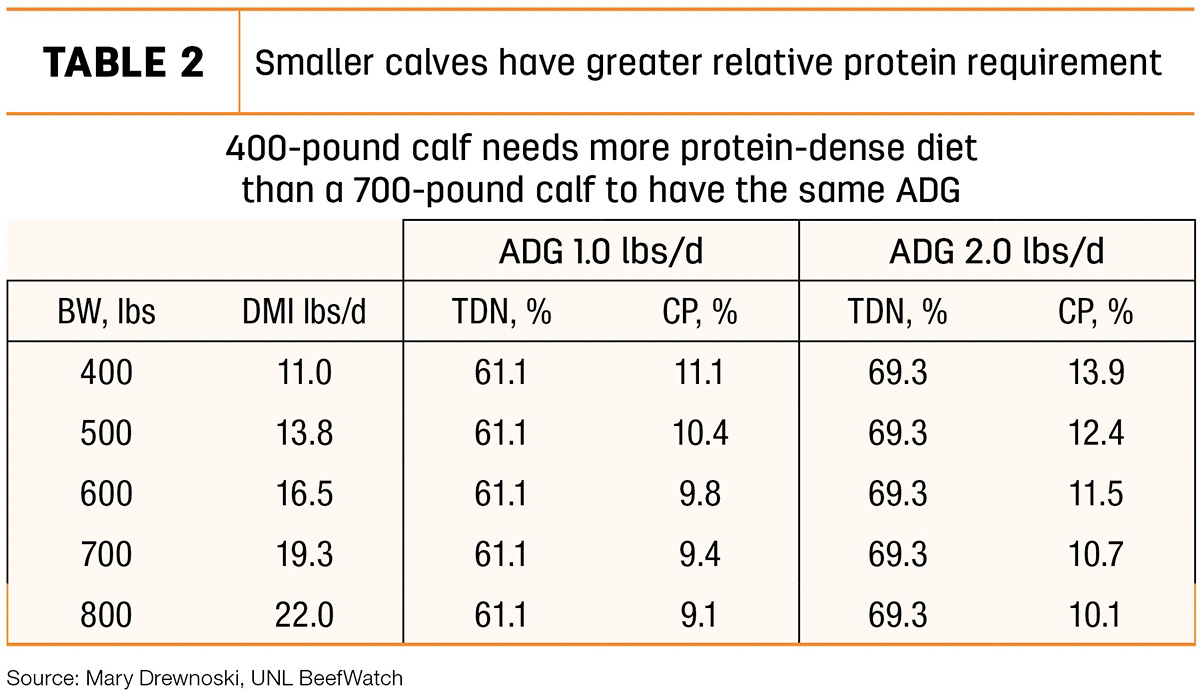
Smaller calves had a higher relative protein requirement. In contrasting 400-pound and 700-pound calves, the smaller calf has a much higher protein requirement. Once the animals reach 800 or 900 pounds, protein requirements are less.
“Undegradable protein is directly available to the animal and can be used as an energy source if fed in excess,” Drewnoski says.
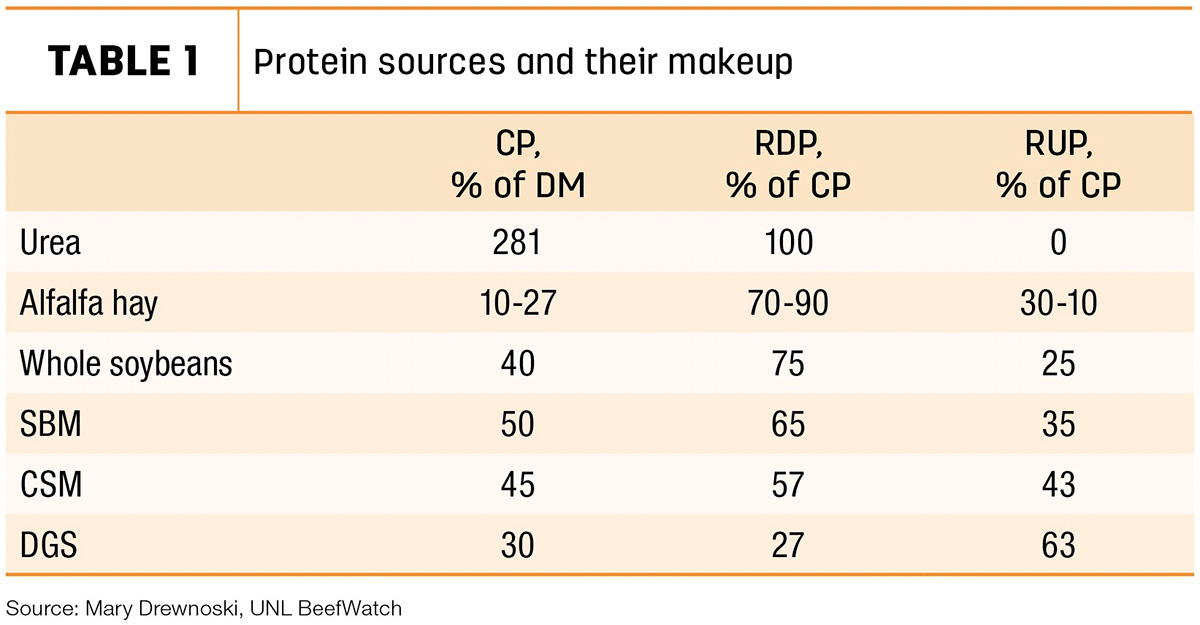
Drewnoski notes that urea is pretty much nothing but nitrogen, high crude protein, all rumen degradable, none that is bypassed or undegradable. Other typical feedstuffs found in beef systems, ranked from most to least degradable, include urea (0% rumen-undegradable protein or RUP), alfalfa hay (10%-30% RUP), whole soybeans (25% RUP), soybean meal (35% RUP) and DDGs (63% RUP).
“The rumen-undegradable portion of alfalfa does vary a bit depending on quality,” she says. “But the majority is rumen-degradable. It will feed microbes, but there’s not much to bypass and feed the animal directly.”
She notes that pretty much all forages are high in rumen-degradable protein, even high-quality grass.
“When calves [in your feedyard] are a wide range of weights, look at the relative difference in protein requirements for a 400- to 800-pound calf. Lighter weights have higher relative protein requirements than heavier calves,” Drewnoski says.
When balancing energy to protein, the heavier the calf gets, the less protein they require.
“Even the difference between a 400-pound and 500-pound calf is fairly large,” she says. “In a free-choice, good-quality meadow hay [scenario], the 400-pound calf gains 0.21 pounds per day and the 700-pound calf gains double that. The difference here is because of relative requirements. To avoid having smaller calves stay smaller and larger calves relatively larger, make sure you meet the protein requirement of the smaller calf.”
She also explains that underestimating alfalfa quality can reduce gains because the animal needs more energy relative to the amount of protein provided.
“You could adjust the ration if you knew that,” she says. “Feed less alfalfa for the same gain or add corn and boost gain even further. The bottom line is, if you want to get the most bang for your buck, use alfalfa hay or forage as the base of the diet, have it tested, and know the protein content of forage sources. It can be extremely variable and extremely valuable.”