By now, the dust has settled on the Federal Milk Marketing Order (FMMO) changes and it is possible to look back on their direct impacts.

It might be surprising that the impact on producers’ milk checks is location- and situation-dependent. Changing Class I differential by county within the federal order created a location dependency. Each federal order has a published Class I differential at a given location. For example, Order 33 publishes a Class I differential based at Cuyahoga County, Ohio. The Class I differentials were not consistently changed across orders. Furthermore, location adjustments were not consistently changed within the federal orders. The impact of the FMMO changes is also dependent on the difference between Class III and Class IV skim milk.
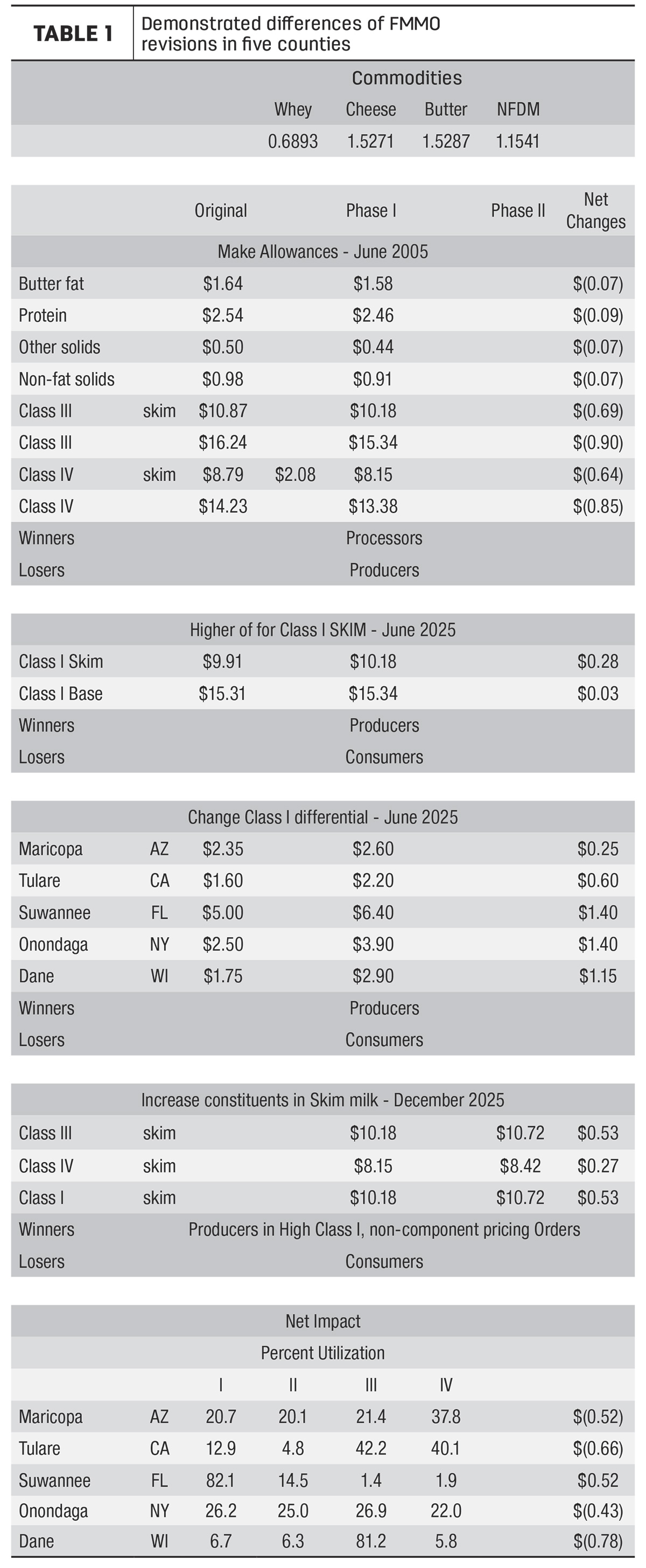
To demonstrate differences, I selected five counties across the nation representing five different federal orders. These include Maricopa, Arizona; Tulare, California; Suwannee, Florida; Onondaga, New York; and Dane, Wisconsin. Table 1 has the calculated values using the December 2025 announced component values. This table assumes that the same values are used for the advanced prices.
Make allowances
The make allowances, modified in June 2025, is the monetary conversion from commodity prices to producer component prices. By increasing the make allowance, producer components (i.e., butterfat, protein, other solids and nonfat solids) decreased in value. Class III values were reduced roughly by 90 cents and Class IV by roughly 85 cents. This change significantly benefited processors while penalizing producers.
Class I skim milk price
Additionally, the Class I skim prices changed in June 2025. In the previous system, the Class I skim price was determined by taking the average of the Class III and Class IV skim prices and then adding 74 cents. This would have yielded a Class I skim price of $9.91 per hundredweight (cwt) using the December commodity prices. The new definition is changed to the “higher of” Class III and Class IV skim prices. Using the same commodity prices, the new definition results in a Class I skim price of $10.18 per cwt, which is 28 cents better for the producer.
Based on the announced prices for December 2025, the difference between Class III and Class IV skim milk prices stands at $2.08, making the new pricing system more favorable under these conditions. However, if this differential falls below $1.48 (which is twice 74 cents), the old system becomes more advantageous. In the December 2025 scenario, while the Class I skim price increases by 28 cents, a reduction in fat value – attributable to adjustments in the make allowance – means that the overall increase in the Class I base value is limited to just 3 cents. An increase in the Class I base value benefits producers but results in higher costs for consumers. Consequently, the effects of order changes are closely linked to the spread between Class III and IV skim prices.
Recently, the market has experienced significant volatility, driven by expanded processing capacity, higher component levels (particularly fat percentage) in milk and fluctuating demand. Considering market data as of Feb. 11, 2026, the 12-month average price for Class III is $17.16 per cwt, while Class IV averages $17.28 per cwt. With such a narrow margin between Class III and IV prices, the FMMO reforms would result in a decrease of 68 cents in Class I prices relative to the previous system.
Class I differentials
The third change that occurred in June 2025 was to adjust Class I differentials. Each FMMO adds a premium to the national Class I price, and counties within the FMMO receive discounts from this premium. Some FMMOs have high Class I premiums with large county discounts. For example, Order 1 has a Class I premium of $5.10 and county discounts as high as $1.20. Other FMMOs have smaller Class I premiums with smaller county discounts. For example, Order 33 has a Class I premium of $3.80 with discounts only as large as 20 cents.
Both the FMMO premium and the county discounts were modified in the revisions, resulting in the revisions being location dependents. Using the five example locations, the change in Class I differentials benefited Suwannee, Florida, and Onondaga, New York ($1.40 each) much more than Dane, Wisconsin, or Tulare, California ($1.15 and 60 cents, respectively). The least benefit went to Maricopa, Arizona. In all regions, the Class I differential benefited the producers while penalizing the consumer. Determining the impact on demand from such a change will require more time. As an anectdote, a gallon of whole milk at our local grocery store has increased 10% in the last 60 days.
Composition of skim milk prices
The final modification to the FMMO was enacted in December 2025. This revision enhanced the composition of skim prices: Class III skim saw its protein content rise from 3.1% to 3.3%, and other solids increased from 5.9% to 6%. For Class IV skim, nonfat solids were raised from 9% to 9.3%. Utilizing December commodity prices, the Class III skim milk price rose by 53 cents, while the Class IV skim price increased by 27 cents. For farms within FMMOs featuring component pricing, these adjustments will only affect the proportion of milk classified as Class I, as this is the sole skim milk price employed in payment calculations. These farms already receive compensation for all protein and other solids produced. By contrast, FMMOs without component pricing (such as Orders 5, 6 and 7) will benefit across their entire skim milk output. As the Class I skim milk price now operates under the “higher of” rule, the advantage from increased components depends on which class skim price prevails; producers realize the greatest benefit when Class III exceeds Class IV.
The impact
The net effect on producer milk checks varies by FMMO and shipping county. FMMOs with higher Class I utilization gain the most. Based on December 2025 prices, Florida producers saw a 52-cent gain, while others faced losses. Wisconsin lost 78 cents due to high make allowance and limited utilization benefits, and Arizona had the smallest change at a loss of 52 cents.