INCREASING WEED MANAGEMENT CHALLENGES IN THE NORTHEAST
Weed control is becoming increasingly challenging for field crop producers across the Northeastern United States, including New York (N.Y.). Several factors are driving this trend, including the introduction of new and invasive weed species, the growing prevalence of herbicide resistance, increasing cost of herbicide premixes, and unpredictable weather that often limits timely field operations. Together, these challenges are making traditional weed management programs less reliable and ineffective.
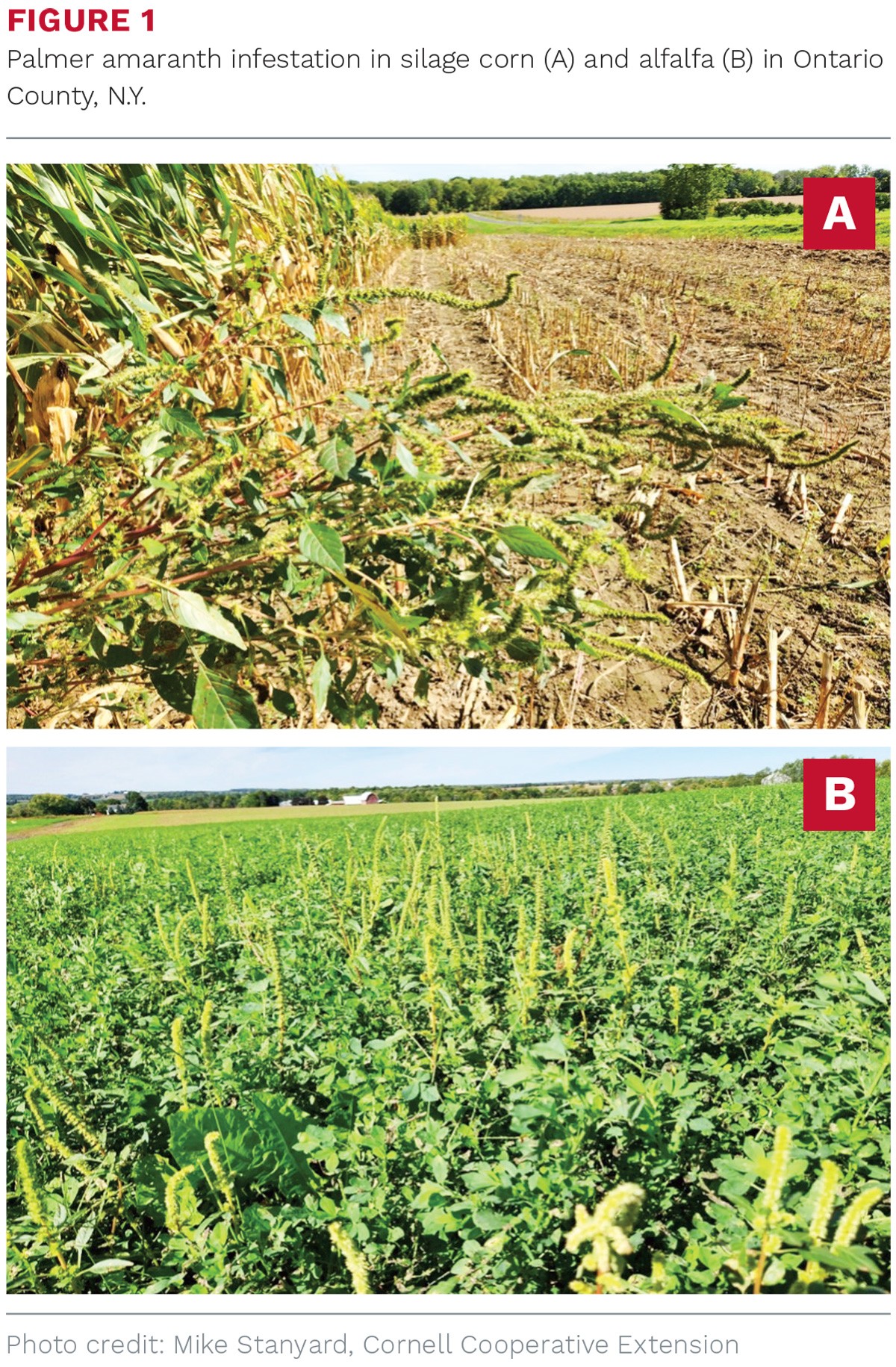
In recent years, the rapid spread of pigweed species like Palmer amaranth (Amaranthus palmeri) and waterhemp (Amaranthus tuberculatus) has emerged as one of the most serious weed management concerns in the region. Once largely confined to the Midwest and Southern United States, these aggressive pigweed species are now well-established in parts of N.Y. and continue to expand throughout the Northeastern U.S. Both species grow exponentially, compete aggressively with crops, and can cause severe yield losses in corn and soybeans in absence of effective management strategies.
In addition, johnsongrass (Sorghum halepense), a perennial invasive grass weed species traditionally found in the Southern U.S., has recently invaded and become established in south central N.Y., further complicating weed management for producers. According to John Jennings, University of Arkansas Cooperative Extension, johnsongrass can produce prussic acid (hydrocyanic acid) or can accumulate nitrate, both of which can be very toxic to livestock under drought conditions.
Studies show that presence of annual weeds can reduce alfalfa yield and feed quality. For instance, field trials conducted in Idaho have shown that poor weed control, especially with weaker herbicides, can lead to lower protein, higher fiber, and reduced feed value. In contrast, effective herbicide programs greatly reduced weed biomass, and alfalfa quality declined steadily as weed content in the hay increased (Montgomery et al., 2023).
HERBICIDE-RESISTANT WEEDS IN THE REGION
Research conducted at Cornell University has confirmed that some Palmer amaranth populations in N.Y. and Connecticut (C.T.) are resistant to several commonly used herbicides, including glyphosate (Roundup or similar brands), atrazine (AAtrex), and mesotrione (Callisto), with suspected resistance to Group 2 herbicides (Aulakh et al., 2024; Rieley et al., 2025). Similarly, glyphosate-resistant waterhemp has recently been documented from soybean fields in N.Y. and corn fields in C.T. (Aulakh et al., 2025; Kumar et al., 2025). Furthermore, several waterhemp populations collected from seven N.Y. counties have shown multiple herbicide resistance to glyphosate, atrazine, mesotrione, and thifensulfuron/chlorimuron (Synchrony). Glyphosate-resistant horseweed (Conyza canadensis) is now widespread across the Northeast, including N.Y. and other neighboring states. More recently, Italian ryegrass (Lolium multiflorum) resistant to glyphosate has been confirmed in N.Y., with suspected resistance to nicosulfuron and other commonly used ALS-inhibiting herbicides (Heap 2025). The majority of these resistant weed populations have been identified from corn, soybean, and wheat fields.
The increasing spread of herbicide-resistant weeds presents a serious challenge for field crop producers across the region. In many fields, relying on the same herbicides year after year is no longer effective and has increased the risk of crop failures (Tugoo et al., 2025). This problem is further compounded by the limited availability of alternative effective herbicides, as several products are not registered for use in N.Y. field crops compared to other states, further complicating the problem of managing herbicide-resistant weeds in the region (Tugoo et al., 2025).
Collectively, these issues underscore the importance of diversified weed management programs. Integrating multiple herbicide modes of action with timely applications, along with cultural and mechanical control practices, is essential for managing resistant weeds, protecting crop yields, and maintaining long-term field productivity and sustainability.
ROLE OF FORAGE CROPS IN DIVERSIFIED WEED MANAGEMENT
Among various cultural practices, integrating forage crops into annual crop rotations can be an effective strategy to manage soil seedbanks of herbicide-resistant weeds by disrupting their life cycles. Both annual forages (e.g., triticale or sorghum-sudangrass) and perennial forages (e.g., alfalfa) can suppress weeds through early harvests, competitive growth, and physical removal via mowing or grazing.
These practices reduce weed seedbank replenishment by preventing seed production and, in some cases, by depleting underground reserves of perennial weeds. Perennial forages such as alfalfa are particularly effective because repeated mowing prevents most annual weeds from setting seeds and helps exhaust root reserves of many perennial weeds. For example, a survey of Canadian grain fields found that a wide range of weed species were less abundant when grain crops followed alfalfa compared with when they followed another grain crop (Ominski et al., 1999).
More recently, research conducted at the University of Wisconsin demonstrated that including alfalfa in corn-soybean rotation can significantly reduce soil seedbanks of herbicide-resistant waterhemp and giant ragweed (Ambrosia trifida) while improving overall weed management (Goplen et al., 2017).
Several characteristics contribute to alfalfa’s weed-suppressive ability, including early spring green-up, rapid canopy closure, high stem density, and multiple harvests per season. Collectively, these factors limit opportunities for annual weeds to produce seeds and replenish the soil seedbank. Research further showed that a four-year rotation consisting of three years of alfalfa followed by corn reduced overall herbicide input costs for weed management ($35 to $45 per acre) compared with corn-corn or corn-soybean rotations, which averaged $70 to $80 per acre (wicst.wisc.edu).
PRACTICAL CONSIDERATIONS FOR NORTHEAST GROWERS
While forage crops, especially alfalfa, can provide weed management benefits, their success depends on careful planning and management. Growers in the Northeast should consider the following factors when integrating forages into their crop rotations:
- Field selection: Choose well-drained fields with manageable perennial weed pressure. Poor drainage or soil compaction can limit forage establishment and reduce longevity.
- Rotation planning: Forages fit best where livestock, manure nutrients, or nearby forage markets are available. A multi-year commitment is often needed to achieve meaningful reductions in weed seedbanks. Herbicide carryover from previous crops can significantly affect establishment (especially in alfalfa), so plant-back restrictions and label instructions must be carefully followed.
- Establishment management: Successful forage establishment requires good seed-to-soil contact, proper fertility, disease management, and early-season weed control. For perennial forages, poor establishment in the first year can limit long-term benefits.
- Timely harvests: Frequent mowing or harvest is critical for preventing weed seed production. Delayed harvests allow weeds to escape and reduce the weed-suppressive benefits of forage crops.
- Termination timing: Proper termination of perennial forages before planting corn or soybean is essential to avoid early-season crop competition and manage potential volunteer regrowth.
- Equipment and labor: Multiple harvests increase labor and equipment demands. Growers should evaluate whether their current resources can support forage management or if custom harvesting operations are available and affordable.
- Weather variability: Wet springs and short harvest windows common in the Northeast can complicate forage management, making flexibility and timely decision-making especially important.
When integrated thoughtfully, forage crops can play a valuable role in diversified weed management programs by reducing reliance on herbicides, managing herbicide-resistant weed populations, and improving long-term field productivity under Northeast growing conditions. This cultural approach complements other integrated weed management (IWM) tactics, such as cover cropping and harvest weed seed control (HWSC) that can provide more comprehensive and sustainable weed control.
 |
This article appeared in PRO-DAIRY's The Manager in March 2026. To learn more about Cornell CALS PRO-DAIRY, visit PRO-DAIRY. |