As heat events become more frequent and more intense, dairy producers are reevaluating when – and how – they cool their cows. Fans and traditional timed soaker systems remain common in barns across North America, but growing concern about water use, manure management and long-term cow comfort is pushing the industry toward more precise, animal-driven cooling strategies.

Heat stress is not a marginal issue. Research consistently shows that even short periods of elevated temperature and humidity can suppress feed intake, reduce milk production, impair fertility and compromise immune function.
Cows can begin experiencing heat stress at temperatures as low as 18°C (65°F) in humid conditions, which is well below what many people consider extreme heat. Once a cow’s ability to dissipate body heat is exceeded, the physiological consequences can linger long after temperatures drop.
The impacts are not limited to lactating animals. Heat stress plays a role throughout every stage of an animal’s life, including during gestation. Exposure to heat stress during pregnancy has been linked to developmental challenges in calves that can affect lifetime performance, reinforcing the idea that cooling strategies are a long-term investment in herd health, not just a short-term production tool.
Cooling earlier, cooling smarter
That broader view of cow comfort is influencing how producers think about cooling infrastructure. Rather than focusing exclusively on the holding area or peak-lactation cows, attention is shifting toward systems that support comfort consistently – and efficiently – wherever cows naturally congregate.
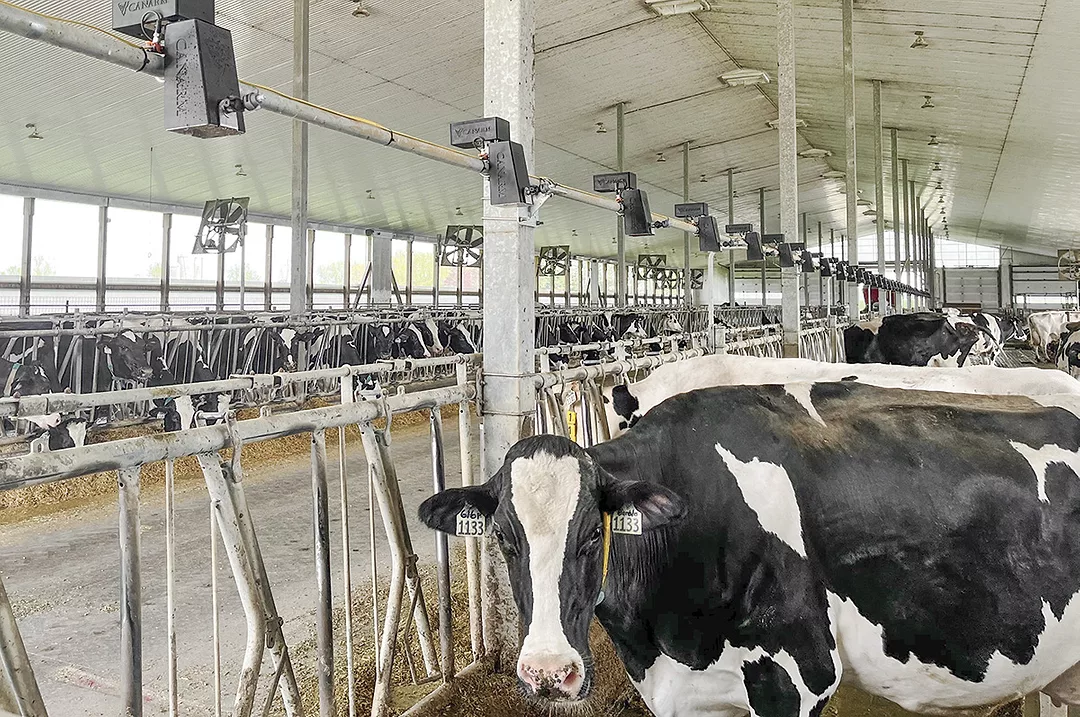
One approach is targeted soaking or misting at the feedbunk. Cows generate significant metabolic heat while eating, and they naturally return to the bunk multiple times per day. Cooling cows where they already want to be can reduce heat load without disrupting normal behaviour or soaking large areas of the barn.
Unlike traditional timer-based systems that spray on a fixed schedule, newer precision approaches rely on cow presence to trigger cooling. Water is applied only when a cow is actively at the bunk, typically in short, controlled bursts directed at the animal’s back and shoulders. This delivers evaporative cooling where it is most effective while keeping feed alleys, scrape lanes and resting areas drier.
Why timing matters more than volume
In many barns, conventional soaker systems are activated based on air temperature alone. While simple, this approach can be inefficient. Water is sprayed whether cows are present or not, which often means cooling only a fraction of the herd during any given cycle and adding unnecessary moisture to the barn.
Cow-activated or presence-based cooling flips that model. Each cow receives cooling at the bunk rather than relying on chance timing. The result is more uniform cooling across the herd without increasing overall water use.
From a management perspective, this also reduces common side effects of overwatering: slippery floors, flooded scrape alleys, wet bedding and feed contamination. Keeping water focused on the cow and not the barn supports both animal comfort and facility cleanliness.
Water use, manure management and robotics
Precision cooling matters for more than just cow comfort. Excess water from traditional soaker systems can create downstream challenges, particularly in barns using automated manure handling systems.
Automated scrapers and collectors rely on steady manure consistency to operate efficiently. Too much water can cause robots to run more frequently than necessary, increasing wear, energy consumption and maintenance costs. In conventional barns, excess water causes the liquid manure pit to fill more rapidly, increasing hauling frequency and diluting nutrient value.
By limiting water application to moments when cows are present and standing, targeted cooling systems help maintain a more stable barn environment. Feed alleys stay drier, scrape lanes flood less often and bedding areas remain cleaner. For farms paying per load for manure hauling, reducing unnecessary water can also translate directly into lower costs.
Considerations for well water and limited-supply farms
For farms relying on well water or operating in regions with limited water availability, efficiency is especially critical. Overuse during peak summer demand can strain wells, reduce pressure elsewhere in the system and increase long-term risk to water supplies.
Precision cooling aligns well with sustainability goals in these operations. Using water only when cows are present – and only in the quantity needed to achieve evaporative cooling – helps balance animal welfare with responsible resource use. It also reduces the risk of running out of water during extended heat events, when cooling is most critical.
From a sustainability standpoint, water saved at the barn level also reduces the energy required for pumping, handling and manure storage, further improving the overall environmental footprint of the operation.
How to tell when cows need cooling
Identifying when cooling is needed is just as important as how it is delivered. Producers should monitor both environmental conditions and cow behaviour.
Common indicators of heat stress include:
- Increased respiration rate or panting
- Cows bunching together instead of lying down
- Reduced feed intake or shorter feeding bouts
- Increased standing time, particularly in stalls
- Elevated water consumption
Environmental indicators such as the temperature-humidity index (THI) provide useful benchmarks, but behaviour often offers earlier warning signs. If cows are reluctant to approach the bunk or are standing idle during warm periods, it may indicate that existing cooling strategies are insufficient or poorly targeted.
Practical guidance on placement and duration
For targeted sprinkler systems, placement matters. Spray heads should be positioned to wet the cow’s back and shoulders without soaking her head, ears or the feed itself. Water contacting the head can discourage feeding and increase stress rather than relieve it.
Short, repeated spray cycles are generally more effective than long, continuous soaking. This allows water to evaporate between cycles, which is what actually removes heat from the cow. Oversoaking reduces evaporative efficiency and increases runoff.
Producers should also coordinate sprinkler use with airflow. Fans help move humid air away from the cow’s body, improving evaporation and overall cooling effectiveness.
Looking beyond today’s heat
As climate variability increases, the dairy industry’s approach to heat stress management will continue to evolve. No single system replaces the need for good ventilation, shade and sound barn design. However, precision-cooling technologies offer an increasingly valuable tool – one that emphasizes efficiency, animal-driven response and sustainability.
The broader takeaway is that cooling is no longer just about reacting to hot days. It is about designing systems that protect cow comfort, productivity and long-term health while managing water and infrastructure responsibly.
As producers plan for future summers, systems that respond to the cow – rather than the clock – may play a central role in building resilient, sustainable dairy barns.