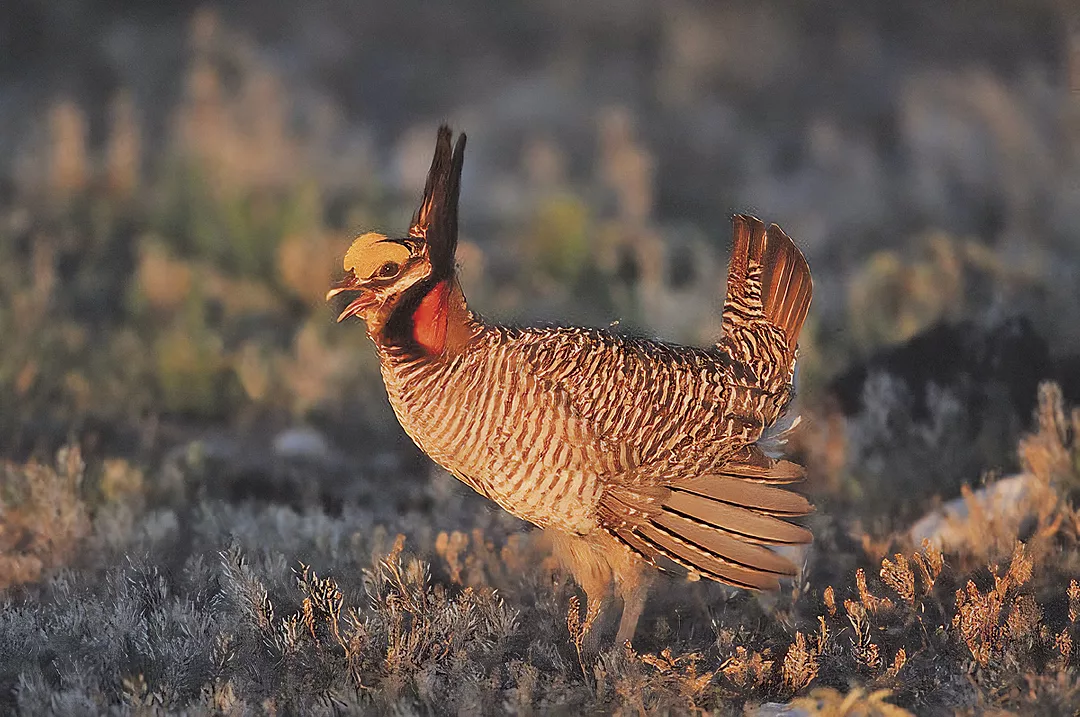

On Feb. 26, the U.S. Fish and Wildlife Service (FWS) finalized removal of protections for the lesser prairie chicken under the Endangered Species Act (ESA), putting into effect a ruling made in a U.S. district court in Texas in August 2025. The ground-dwelling bird, known for its elaborate mating dances, has since 2022 been listed as threatened in the northern parts of its range in Kansas, Oklahoma, Texas and Colorado, and as endangered in a “distinct population segment” farther south on either side of the border between New Mexico and the Texas Panhandle. Prior to that, in 2015, a federal judge in Midland, Texas, reversed the species’ threatened status.
The 2022 listing prompted a lawsuit by the attorneys general of Kansas, Oklahoma and Texas, and industry groups including the National Cattlemen’s Beef Association (NCBA) and the Public Lands Council (PLC), citing a lack of scientific justification to support FWS’s classification of the lesser prairie chicken into two distinct populations and saying FWS failed to consider the economic implications of the bird’s listing. In the case before U.S. District Judge David Counts, FWS conceded that the agency had erred in classifying the bird into the northern and southern population segments.
“The ESA listing of the lesser prairie chicken, coupled with the designation of critical habitat across cattle country, created an unnecessary and unlawful burden for ranchers,” Gene Copenhaver, a Virginia cattleman and NCBA president, said in a statement. “Established science has repeatedly proven that healthy rangelands maintained by cattle grazing is exactly where the lesser prairie chicken thrives. … NCBA engaged with multiple administrations, Congress and the federal court system for years to defend cattle producers from this overreaching, unscientific rule, and we are glad it is finally removed.”
“Ranchers are the primary caretakers of a wide variety of landscapes that provide important habitat for species like the lesser prairie chicken through voluntary conservation work,” said PLC President and Colorado rancher Tim Canterbury. “This delisting is welcome news for ranchers across the region, and we will continue to work with our state and federal partners to create and conserve habitat.”
Some wildlife conservation groups point to the decline in the lesser prairie chicken’s population – estimated to have possibly been in the millions historically but now around 30,000 – as a reason for its federal protection. However, Counts said in his ruling that any “disruptive consequences” of removing protections “are short-lived and minimized by the 16 existing voluntary conservation programs and efforts in place across the range of the lesser prairie chicken.”