The year 2026 will be marked by the revision of the Canada-United States-Mexico Agreement (CUSMA) (or a renegotiation, who knows?) – a loud saga that will, among other things, focus on supply management. This situation requires a step back and even a deep breath: The process will be winding, bumpy and worrying. The status quo is highly unlikely, but ambient noise is likely to be disproportionate with regards to its impact on the system. We will also look at CUSMA from the standpoint of exporting sectors, namely beef. Beef prices have had a major impact on the milk sector in recent years, through cull cattle and small dairy calves.

The ABCs of tariff rate quotas
The American dairy lobby is powerful and has the White House's ears. The pivotal status of Wisconsin and the desire of the Trump administration to remain in the graces of the agricultural community are contributing factors. The requests of the National Milk Producers Federation concern existing tariff rate quotas (TRQs).
A TRQ refers to a quantity of product (milk, butter, ice cream, etc.) that can be imported into Canada duty-free. They are import permits. Once the volume is entered, any additional imports are subject to over-quota tariffs. These tariffs are prohibitive – high enough to block imports in most situations. In Figure 1, TRQs are illustrated by doors in the tariff wall.
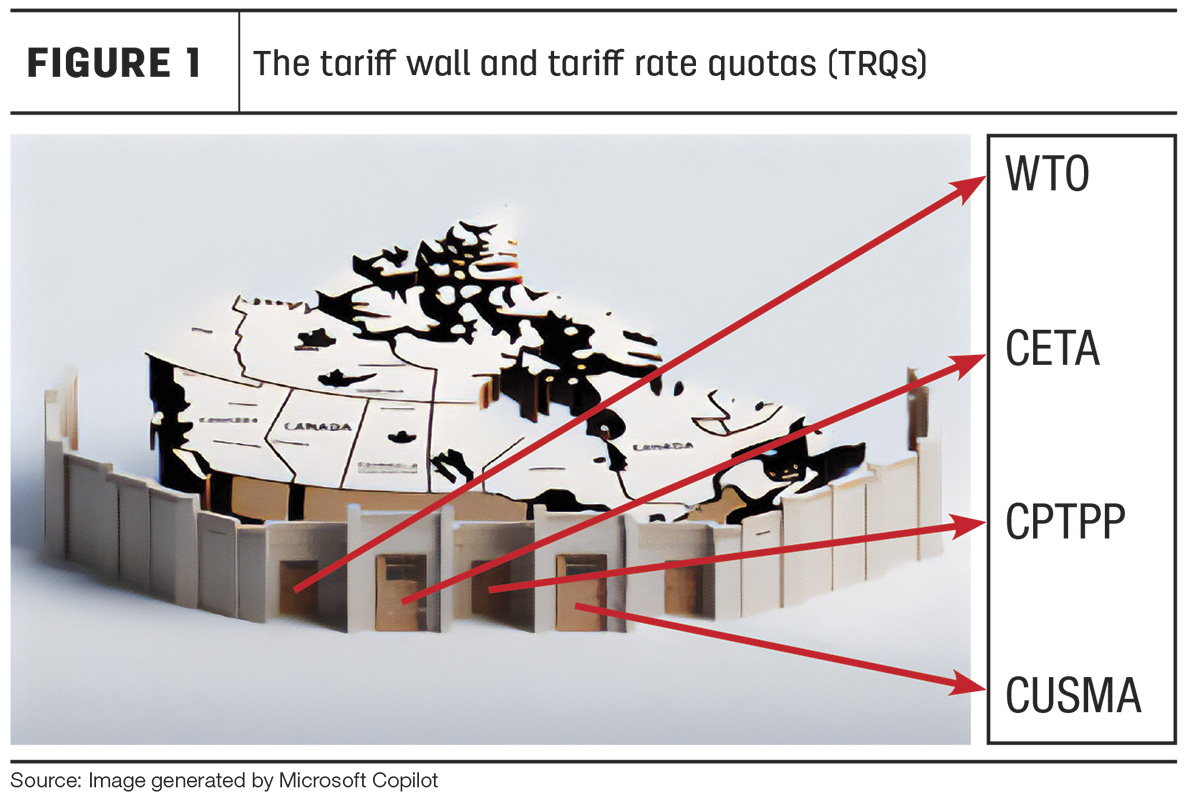
Canada has granted TRQs under various trade agreements, including the World Trade Organization (WTO), the Comprehensive Economic and Trade Agreement (CETA, Europe), the Global and Progressive Trans-Pacific Partnership (CPTPP) and CUSMA. Adjustments to 1TRQs granted under CUSMA are central to the complaints of the U.S. dairy lobby.
The U.S. dairy industry maintains that "Canada's sustained and longstanding efforts to undermine access to its market (...) continue to cause serious concern.” In fact, the average filling rate for existing quotas has varied between 27% and 39% over the past three years. Why? The Canadian price of certain products subject to TRQs is based on U.S. and/or world indexes. Without a profit linked to the transaction, no one will be surprised that these products do not enter Canada.
The U.S. lobby is also openly advocating for TRQs be granted to distributors/retailers rather than dairy processors, who currently hold them. Could TRQs change hands? Predicting the outcome of negotiations is perilous, but it cannot be ruled out. Such an approach raises two questions (among others). First, to what extent would holding TRQs by distributors/retailers increase their already large market power with processors? Also, what reputational risk would distributors/retailers be exposed to by spreading dairy products of U.S. origin on their shelves? Even if these products were to sell, what effect would this have on their banner?
First conclusion: TRQs will be the subject of fierce discussions, which will likely lead to higher filling rates. TRQs granted under CUSMA are equivalent to some 3.5% of the Canadian market. In the event that their filling rate were to increase significantly, it can be estimated that quantities equivalent to some 2% of the Canadian market would enter the country within a visible horizon. One can therefore expect that they capture a portion of the growth of the Canadian market, slowing down quota growth for local dairy farms.
The complaints of the U.S. dairy lobby allow us to draw a second conclusion: Since no request has been received, the tariff wall (rates reaching around 300% depending on the various products under supply management) is not at risk.
Tariffs on Canadian agri-food exports entering the United States?
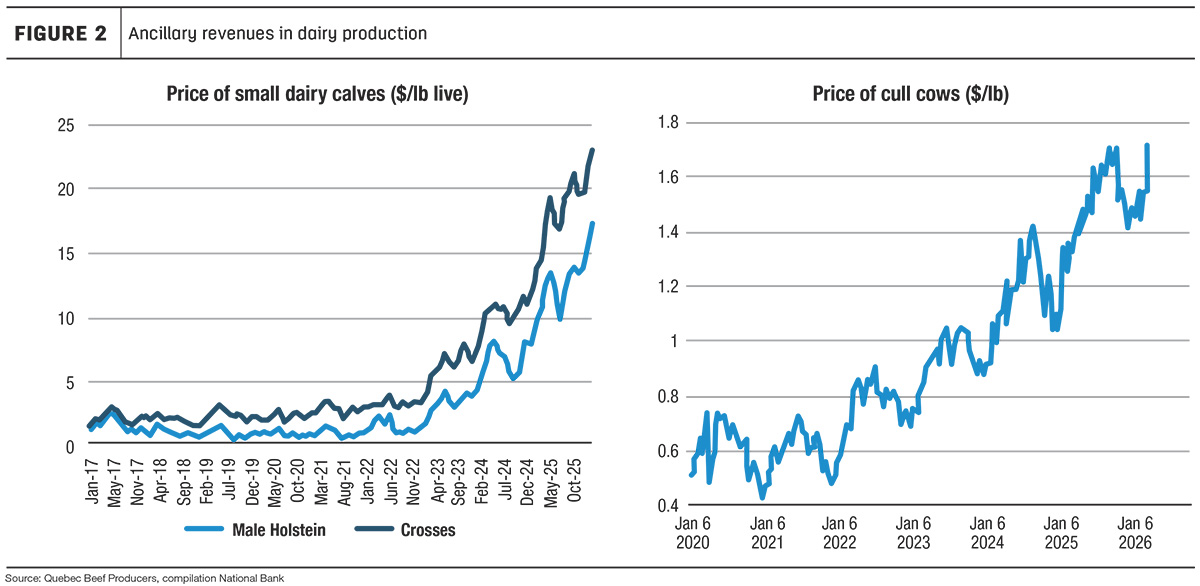
The negotiations on CUSMA could also have an impact on other agricultural products that affect the dairy industry, namely beef. For several years, sharp increases in cull cattle and small dairy calves prices have boosted ancillary income on dairy farms (Figure 2). Of course, these revenues have a downward impact on the cost of milk production, which is reflected in annual adjustments to farmgate milk prices.
In the fall of 2025, the Trump administration vilified the American beef community, urging it to lower its prices to relieve consumers. Carrying out a threat then mentioned, Donald Trump recently signed an executive order quintupling the quota for Argentinian beef imports into the U.S. This increase won’t have any material effect on the market though, as the quantities involved are insignificant compared to the 13 million tons of beef consumed annually in the U.S.
This episode provides the opportunity to refine our understanding of the risk at which Canadian exports (beef, pork, canola, maple syrup, etc.) are exposed. To what extent should we fear that our exports will be subject to tariffs? With the midterm elections approaching – polls are predicted to be particularly difficult for the Republicans – this risk is clearly lower than it was a year ago.
The review of the CUSMA is likely to dominate the news in 2026. Few issues are affecting all agricultural production sectors, those under supply management and open to world markets. Uncertainty seems to be the word of the hour, but in agriculture, pawns are gradually being placed, and the level of uncertainty is unquestionably lower than a year ago.