What the heck is a carbon credit?
Nicki Nimlos, a doctoral student at the University of Wyoming, says that’s a question she’s heard often over the last couple of years. Around 2023, when Nimlos was beginning her Ph.D., carbon market programs were becoming more widely available to ranchers.
As interest in the programs grew, Nimlos and her adviser, Derek Scasta, began receiving frequent questions from producers trying to understand how the programs worked and whether they made sense for their operations. That interest motivated Nimlos to focus her research on the topic.
“Ever since I started working with carbon markets, I probably get phone calls or emails every other week from a producer having questions,” Nimlos says. “There’s just so much interest around them and so little work that has been done from a source that’s not trying to sell you something.”
How it works
Nimlos explains the topic simply, saying that carbon markets generally fall into two categories: regulatory and voluntary.
Regulatory markets, such as California’s cap-and-trade system, require companies to offset emissions above certain limits. Voluntary markets, however, operate differently.
“The voluntary carbon market is where companies are choosing to buying carbon credits to offset their emissions so they can appear more environmentally friendly,” Nimlos says.
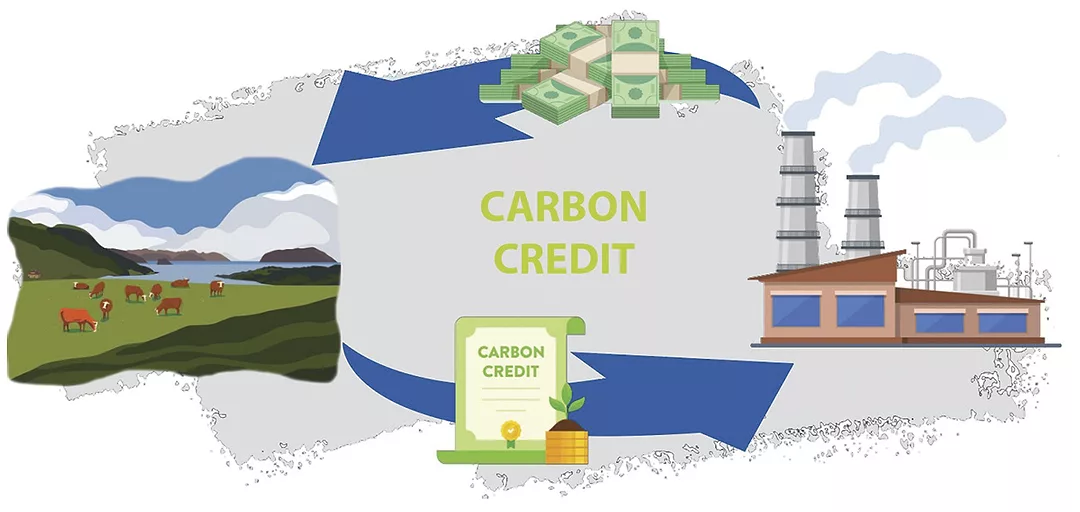
In these programs, ranchers generate carbon by implementing management practices that increase soil organic carbon. The stored carbon is then converted into “credits” that corporations can purchase to offset their own emissions.
To participate, producers must adopt practices that go beyond their current management systems.
“That’s probably the biggest point I would hit,” Nimlos says. “You have to do something additional to what you’re already doing.”
For cattle operations, that would likely look like adjusting grazing management to increase carbon sequestration, usually subdividing large pastures to implement rotational grazing and allow longer rest times for the ground.
Crop producers can also participate by adopting practices such as reducing nitrogen fertilizer use, incorporating compost or organic amendments, planting cover crops or adjusting crop rotations.
Shopping around
When considering participation in a carbon program, Nimlos advises taking time to research available companies and contracts.
“There are a variety of carbon companies out there,” she says. “One of the best tips I have for landowners is shop around.”
Several companies currently offer voluntary carbon programs for ranchers and farmers, including Grassroots Carbon, Agoro Carbon Alliance, Indigo Agriculture and Cultivo. These companies act as carbon credit brokers, working with producers to measure soil carbon levels, verify management changes and sell the credits produced by ranchers to companies seeking to offset their emissions.
Because programs vary widely, Nimlos says producers should talk with multiple companies and compare contracts before making a decision.
“Just because you get approached by one company doesn’t mean you should sign up with them,” she says.
Contract length can also vary significantly. Some agreements may last as little as five years, while others can extend decades into the future, making these programs a significant commitment.
“It’s kind of like shopping for a house,” she says. “That’s a big investment. You’re not going to choose the first one you see. You’re going to look at a few and consider all your options.”
One of Nimlos’ strongest recommendations for producers considering carbon markets is to avoid investing their own money in a project. Enrollment fees, soil sampling, verification and project administration costs can add up quickly. Nimlos says those expenses should always be covered by the carbon company.
“I cannot emphasize that enough,” she says. “You should not be investing your own money into this market.”
Once a contract is signed, the work begins. Representatives with the carbon company will come out and gather soil samples from across a producer's land to determine how much carbon is currently stored in the soil.
“They take soil samples before you’ve made any management changes to establish your baseline soil organic carbon,” Nimlos explains.
After a rancher adopts new management practices, the company returns periodically, typically every three to five years, to collect additional soil samples. If the amount of soil carbon has increased, the difference can be converted into carbon credits.
“If you started with 20 tons of soil organic carbon per acre in your baseline year, and then five years later you have 23 tons, you’ve accumulated 3 tons,” Nimlos says. “That’s equivalent to three credits.”
Those credits can then be sold, with some of the profits returning to the rancher.
Return on investment
Potential payments vary widely depending on location, soil type and climate conditions. Credits are sold by the ton, with contract prices often ranging around $10 to $20 per ton. However, the amount of carbon a ranch can accumulate depends heavily on environmental conditions.
“That’s the big question,” Nimlos says. “How many tons can you accumulate per acre?”
Rainfall plays a major role in determining how much carbon can be stored in soil. In regions with higher precipitation and longer growing seasons, vegetation growth can lead to greater carbon accumulation. In drier regions, the potential may be more limited.
“If you live in Wyoming, you are not going to accumulate as much carbon as someone in Georgia where they get 40 inches of rain,” she explains.
Payments are typically distributed after soil samples confirm carbon gains, which means producers may receive compensation only every few years. And overall, Nimlos says returns may be modest. But even if financial returns are limited, many carbon-friendly management practices can bring additional benefits to ranch operations.
“There are other benefits to a carbon project other than getting paid,” she says. “Research suggests that there are a lot of environmental benefits that can come from moving your cattle more frequently and resting pastures longer, like improved nutrient cycling, improved groundwater recharge, more forage production and more biodiversity.”
Those improvements can contribute to long-term ranch productivity and resilience. And Nimlos points out that while there is some risk involved, it’s fairly negligible. As long as the rancher doesn’t violate the terms of the contract through tillage, overgrazing, etc., they are not responsible for any carbon lost from the soil.
“If you have a wildfire, a drought or a grasshopper infestation and soil carbon is lost, you are not responsible to pay that back,” Nimlos says. “The only time a landowner is responsible to pay back is when they deliberately engage in negligence.”
Ultimately, Nimlos believes carbon markets are a useful opportunity for some producers, on a case-by-case basis. She encourages producers to first carefully evaluate whether the management changes align with their goals as an operation. If a producer has already been thinking about subdividing pastures or using virtual fencing, carbon companies will pay for that startup cost, which is a significant benefit.
“I don’t think you should necessarily go into this thinking you’re going to make a bunch of money,” she says. “But if you're willing to commit to a long-term contract, they are paying you to improve your ranch.”