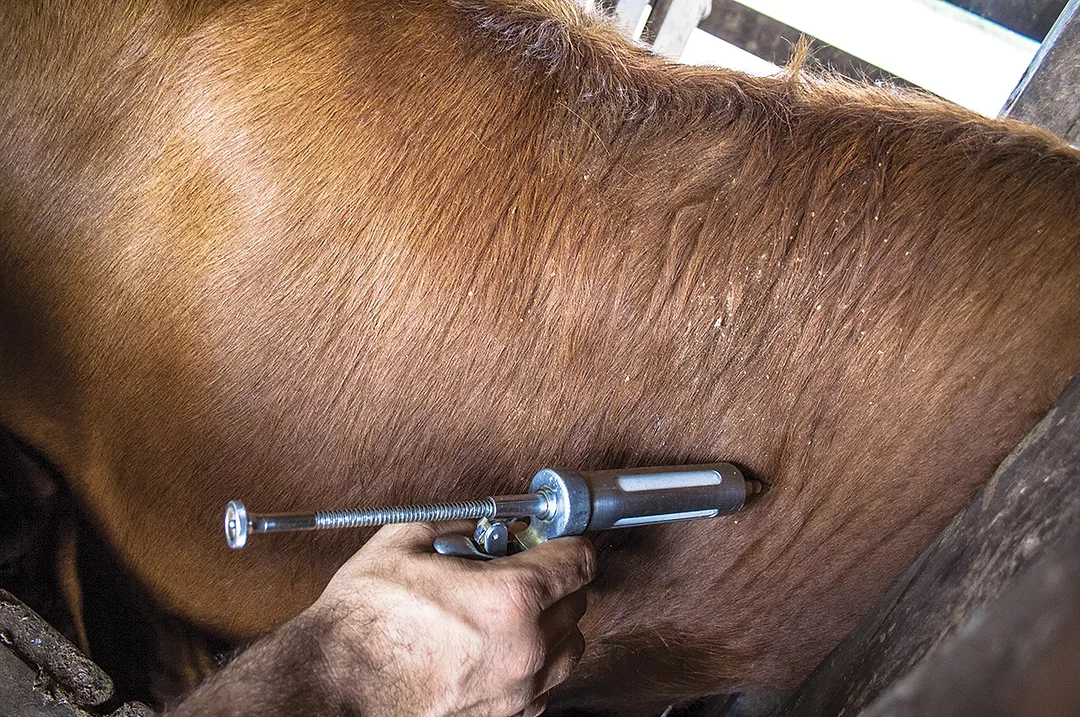
As producers and veterinarians consider vaccination programs, it’s important to understand the key differences between autogenous and commercial vaccines.

Commercial vaccines, or “brand name” vaccines, are available for general use across farms and animal populations in accordance with license requirements. Before these vaccines are ever approved, they must undergo years of rigorous efficacy testing. This is the biggest, and arguably most important, differentiator between commercial and autogenous vaccines.
Efficacy is the ability to provide protection against disease-causing agents. Disease challenge models are used to establish commercial vaccine efficacy, and licensed commercial vaccines must requalify periodically.
In addition, each commercial vaccine, by serial production, must meet specific purity, potency and safety requirements prior to being offered for sale:
- Purity – Sterility testing to ensure no contaminating microorganisms
- Safety – Ensures the product does not cause adverse effects
- Potency – Confirms the product performs as intended with approved laboratory metrics
Autogenous vaccines are promoted for the ability to provide a more customized approach to creating immunity and are developed based on potential pathogens isolated from a specific farm or herd. This involves collecting samples from an infected animal or animals, growing the potential pathogens in a lab and then inactivating those potential pathogens to create vaccine components (antigens) for inclusion in the autogenous vaccine designed specifically for the herd.
Because there are no efficacy trial requirements for autogenous vaccines, they can be created in a much shorter time frame than commercial vaccines, usually within a few months after initial sample collection.
Although they still must meet some of the safety and purity standards mentioned above, it is not required that autogenous vaccines are tested for potency, and there is no requirement to supply efficacy data prior to being offered for sale. This means that efficacy profiles are essentially established on a case-by-case basis, in the veterinarian’s and producer’s experience.
A working veterinarian-client-patient relationship (VCPR) is recommended with any herd health program, but as you can imagine, it becomes even more imperative to the success of an autogenous vaccine program. It is a requirement to have a documented VCPR when working with autogenous vaccines.
Which type is best for your herd?
There is no one-size-fits-all approach to herd health programs, and the right vaccination program for your cattle operation will depend on several factors. When deciding between vaccine programs, here are some questions to consider:
- Is the pathogenic mechanism(s) of the bacteria or virus built into vaccine design? While commercial vaccines are often strategically designed to counteract the pathophysiology of major disease-causing pathogens, autogenous vaccines are more strain-focused and typically offer less mechanism-specific protection than commercial vaccines. Autogenous vaccines are also limited to inactivated, adjuvanted products.
- What safety profiles and efficacy data do you want? Commercial vaccines are based on years of safety and efficacy research and have stringent testing protocols. This helps provide greater confidence in your cattle vaccination program compared to autogenous vaccines that do not require data to prove efficacy.
- Is the vaccine readily available when you need it? A key benefit of commercial vaccines is they are made widely available once they are brought to market. This allows for a more proactive approach to disease management. In other words, you do not have to wait for a disease to impact your cattle before administering a preventive vaccination for that disease. Autogenous vaccines have a much quicker turnaround time, but there is still a waiting period to create the vaccine, usually at least four to six weeks from the time the sample was collected from an infected animal.
- What kind of support do you expect from your vaccine supplier? Service and support can vary widely across vaccine manufacturers. At Zoetis, we make it a priority to continue investing in product research to ensure the solutions we bring to market continue to meet the needs of today’s cattle producers. We also take pride in our team of experts who work closely with producers and veterinarians to determine the root cause of disease and fine-tune management practices – not just vaccination program adjustments – to better manage disease challenges. Sometimes, this might mean further diagnostic testing, looking into the feed regimen, animal handling techniques to reduce stress and prevent diseases like BRD or biosecurity practices to minimize disease exposure.
If you’re struggling with BRD or another disease challenge, reach out to your local veterinarian to design a prevention program and determine the vaccination strategy that makes sense for your herd.