As we look to the second quarter of 2026, dairy markets have improved and margins are historically strong with forecasts playing in producers’ favors, particularly with incremental improvements in Class III and Class IV. While there is an abundance of milk from key global players, U.S. dairy’s competitive pricing, quality products and developing international relations have created promising headwinds for U.S. dairy prices in the months ahead.

Yet, the war in Iran and consequential closure of the Strait of Hormuz has caused massive concern in the feed markets and uncertainty with the U.S. crop growing season on the horizon. HighGround Dairy noted, “These are the kinds of exogenous shocks that can compress markets quickly and without warning, exactly the environment where risk management earns its keep.”
Here’s Progressive Dairy’s look at important dates, reports and advice affecting risk management decisions, as well as information that will affect dairy producers.
Dairy Margin Coverage (DMC)
January’s feed cost rose 11 cents as the cost of dairy-quality alfalfa hay was higher from the month prior, but it was the disappointing milk price that influenced the income over feed cost margin. At a Dairy Margin Coverage (DMC) margin of $7.81 per hundredweight (cwt), operations enrolled in both Tier I and Tier II will receive indemnity payments based on the selected coverage level. (Read: January DMC margin lands at $7.81 per cwt)
Dairy margins improved over the course of February with milk prices rising, particularly for Class III and Class IV markets, offsetting an also strong feed market. As of end of day March 24, the DMC margin forecast for February sits at $8.86 per cwt with the all-milk price rising more than $1 from the month prior and feed costs growing less than 10 cents. If realized, this margin would still trigger indemnity payments in Tier I under both the $9.50 and $9 per cwt coverage level. The actual February DMC margin will be announced March 30 following the release of the USDA Ag Prices report.
The remainder of 2026 does look promising, with margins improving substantially. In March, the DMC margin forecast is at $9.41 per cwt, and the average for the year is to settle at $10.44 per cwt. Although, it’s important to remember markets are not guaranteed.
Dairy Revenue Protection (Dairy-RP)
Dairy producers managing risk through Dairy-RP are eligible to cover revenue quarterly, up to five nearby quarters. In April, Dairy-RP coverage is available for the third quarter of 2026 (July through September) through the third quarter of 2027.
“Futures as of March 17, 2026, from March 2026 onward, are presenting favorable margins, ranking above the 83rd percentile compared to the last 10 years … Just three months ago, the outlook was the opposite. … Producers with unhedged exposure in Q2 through Q4 2026 should be having conversations with their adviser today about locking in coverage while the opportunity exists,” reports HighGround Dairy.
The market changes daily and Dairy-RP endorsements must be purchased between the Chicago Mercantile Exchange (CME) market closing and the next CME opening. Dairy-RP is also not available on days when applicable futures contracts move limit-up or limit-down, or on days when CME trading is closed due to holidays.
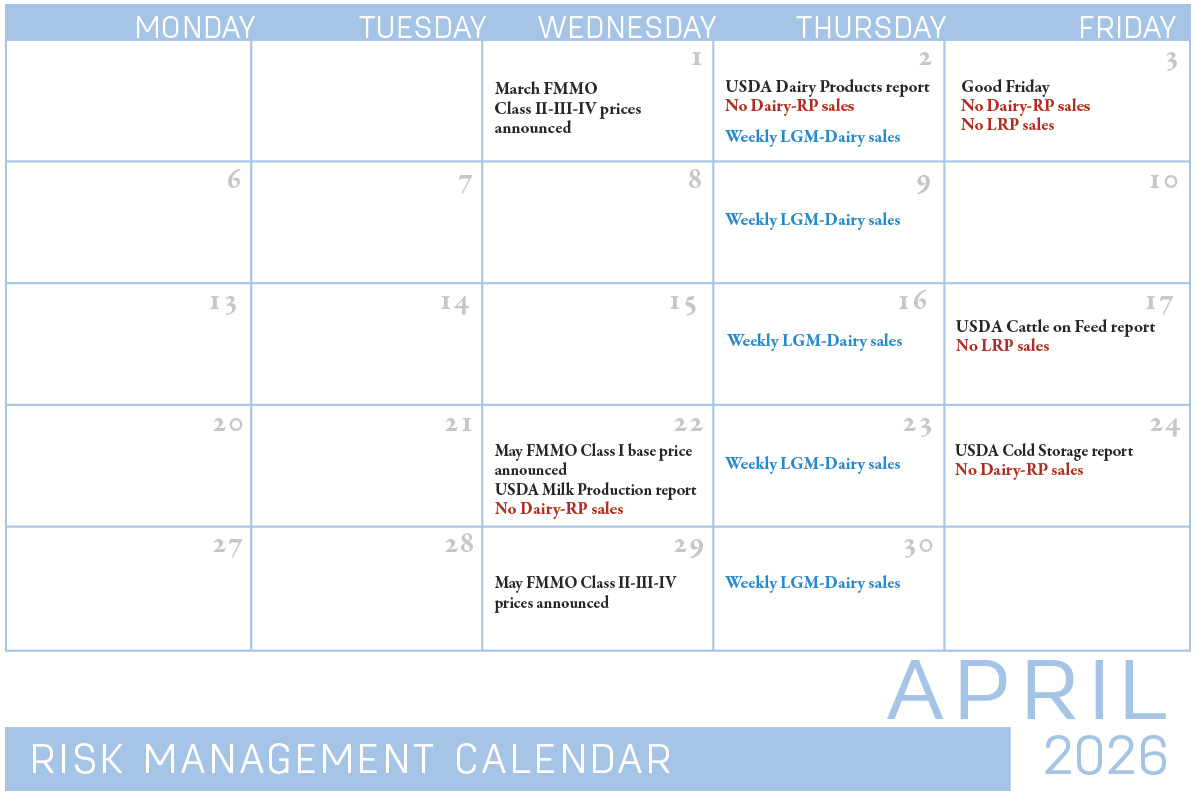
Also, typically Dairy-RP coverage cannot be purchased on days when major USDA dairy reports that could impact markets are released. This includes Milk Production, Cold Storage and Dairy Products reports (see Calendar).
Livestock Gross Margin for Dairy (LGM-Dairy)
LGM-Dairy is a subsidized insurance program administered by the USDA Risk Management Agency (RMA).
LGM-Dairy provides protection when feed costs rise or milk prices drop, and can be tailored to any size farm. The program uses futures prices for corn, soybean meal and milk to determine the expected gross margin and the actual gross margin. LGM-Dairy is similar to buying both a call option to limit higher feed costs and a put option to set a floor on milk prices.
Coverage for LGM-Dairy can be purchased on expected milk marketing over a rolling 11-month insurance period. So the coverage period during April includes the months of May 2026 through March 2027. Sales periods for the LGM-Dairy program are open on a weekly basis. Unlike Dairy-RP, LGM-Dairy is available even if a sales period falls on the day of a USDA report.
Livestock Risk Protection (LRP)
LRP is another subsidized insurance program administered by the RMA. The program is a valuable tool for dairy producers as beef-on-dairy and strategic culling decisions are key parts of herd management and business decisions. For dairy producers, LRP coverage is available as LRP-Feeder Cattle (beef-on-dairy calves) and LRP-Fed Cattle (cull cows) with four additional options to select the appropriate coverage, including head count, targeted marketing weight, and coverage length and level. No more than 12,000 head can be covered in a specific coverage endorsement with an annual limit of 25,000 head per farmer per crop year (July 1 to June 30).
The sales period for LRP coverage is open each afternoon after futures prices are settled and closes the following morning. Similar to Dairy-RP, LRP is not available on days when CME trading is closed due to holiday or when major USDA reports impacting prices are released, such as Cattle on Feed. The RMA also has the right to close sales at their discretion.
Production and price outlooks
- Kansas, California and Texas were among the 20 states to boost milk production in February. Despite a decrease in total milk production from the month prior, February’s total was up 2.9% from USDA’s estimates a year ago. (Read: Milk production climbs as dairy herd expands in February USDA estimate)
- Quarterly average prices for dairy heifer replacements in January fell to $2,860 per head, down 9% from the last report, according to estimates from the USDA. (Read: Dairy replacement cow prices fall back to last spring)
- As anticipated, the Federal Milk Marketing Order (FMMO) advanced Class I base price was boosted in April. The price increased $3.19 per cwt from March. (Read: Economic Update: April Class I base milk price gets a boost to $18.66 per cwt)
- Government-assisted purchases of dairy products strengthened Class III and IV prices to improve the overall milk price landscape in February. (Read: February gives glimmer of optimism with FMMO price improvement)