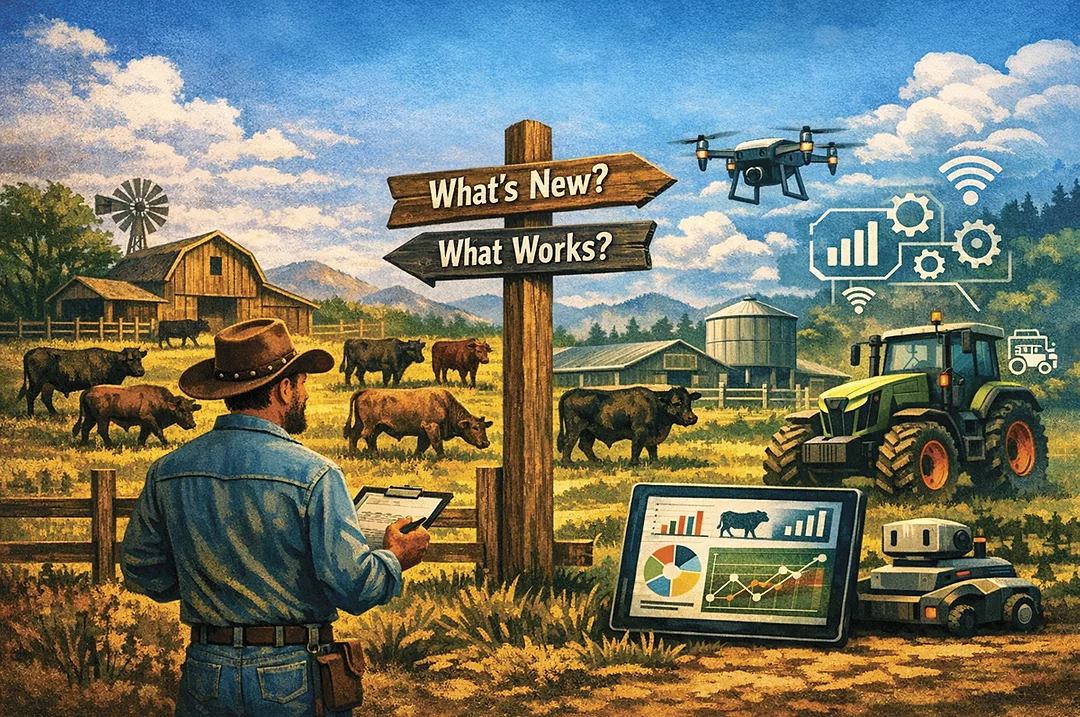
Every day, new technologies such as artificial intelligence (AI), sensors and data platforms emerge with the promise to increase efficiency and improve the performance of production operations. However, many farmers and ranchers face the dilemma that “just because something is new does not mean it fits my operation,” which complicates decision-making related to the adoption and use of technology on their ranches. Strategically selecting the right technology for an operation not only reduces the risk of economic losses but also fosters local economic development and lowers the likelihood of failed adoption.

Why do many technologies end in failed adoption?
Although many technologies have been developed with the intention of benefiting ranchers, provided they are used appropriately, the majority fail due to rancher-level factors, operational constraints and/or contextual conditions of the operation.
First, many innovations require high levels of investment, which poses a challenge for operations where return on investment is uncertain. Once the technology is acquired, producers and ranchers often face connectivity limitations and a lack of technical support, both of which are necessary to ensure the sustainability of these technologies.
This challenge is particularly evident in technologies that did not incorporate ranchers’ knowledge and experiences during the design process, which exacerbates the mismatch between technological complexity and the day-to-day realities of ranch operations. For this reason, the decision not to adopt a technology is, in many cases, a rational choice rather than simple resistance to innovation or technological progress.
How to decide whether a technology is right for your ranch
First, identify the problem, not the technology. Each technology is designed to address a specific failure or operational pain point; however, it will not be effective if that issue has not been clearly identified within the production cycle. To do so, it is useful to ask practical questions such as: What decision am I struggling to make? What activity is taking me the most time and/or money? Where do errors or losses occur most frequently?
When the answers to these questions can be addressed through a technology, that is when the process of identifying the appropriate tool should begin, always with the understanding that technology itself is not a solution but rather a decision support tool.
What characterizes a technology that is a good fit for a ranch?
Typically, a suitable technology requires a detailed analysis of the production operation; it is not as simple as applying a one-size-fits-all approach. When attempting to solve an operational problem using technology, priority should be given to solutions that integrate efficiently into existing practices, as these are more likely to reduce costs and/or improve efficiency. In contrast, technologies that require drastic changes to daily operations tend to be less effective, especially if they fail to account for local conditions such as herd size or labor availability.
Research and learn from others before deciding
Many ranchers end up purchasing innovations that generate more information but do not deliver concrete solutions. To avoid unnecessary purchases, learning from others’ experiences is essential. No one can provide a better assessment than another rancher who has already used the technology. When peer learning is not an option, seeking support from local extension services and/or other government agencies is recommended, as they can offer guidance and help identify appropriate options and vendors.
Test before you buy
Most providers of ranch-relevant technologies offer opportunities to conduct on‑ranch trials, often accompanied by demonstrations under real production conditions, typically at little to no cost. This type of field testing is an indispensable tool, as it not only allows evaluation of the technology’s performance within the ranch’s production and management cycle but also helps identify training and support needs to ensure effective implementation and achievement of desired results.
Don’t forget your employees
Employees are an essential part of the innovation process. Technologies become unnecessary and ineffective if the personnel expected to use them are not adequately prepared. Training and support systems, often provided by vendors, are just as important as the quality of the sensors or software being implemented. Successful technology adoption depends directly on employees’ capacity to implement and integrate it into daily operations.
Invest smartly, not quickly
Finally, newer and more expensive is not always better. When making technology decisions, what matters most is not how much is invested but whether the operation can absorb the risk and maintain sufficient liquidity to continue operating while the investment proves its value. Ensuring this condition not only allows the operation to continue functioning normally but also guarantees that the economic conditions necessary for the technology to demonstrate its true value are in place.
New technologies offer significant potential for the livestock industry. However, not all innovations are necessary or efficient for every ranch or type of operation. Prior information gathering and on‑farm experimentation are critical during the decision-making process. At the same time, other ranchers and trusted advisers play a key role in adoption, as they can share their insights and experiences to help ensure successful implementation. Finally, labor must be properly prepared to integrate technology into the operation, or it may become the primary factor leading to failure.
In today’s environment, where new technologies emerge daily, ranchers must move from “What’s new?” to “What works?”