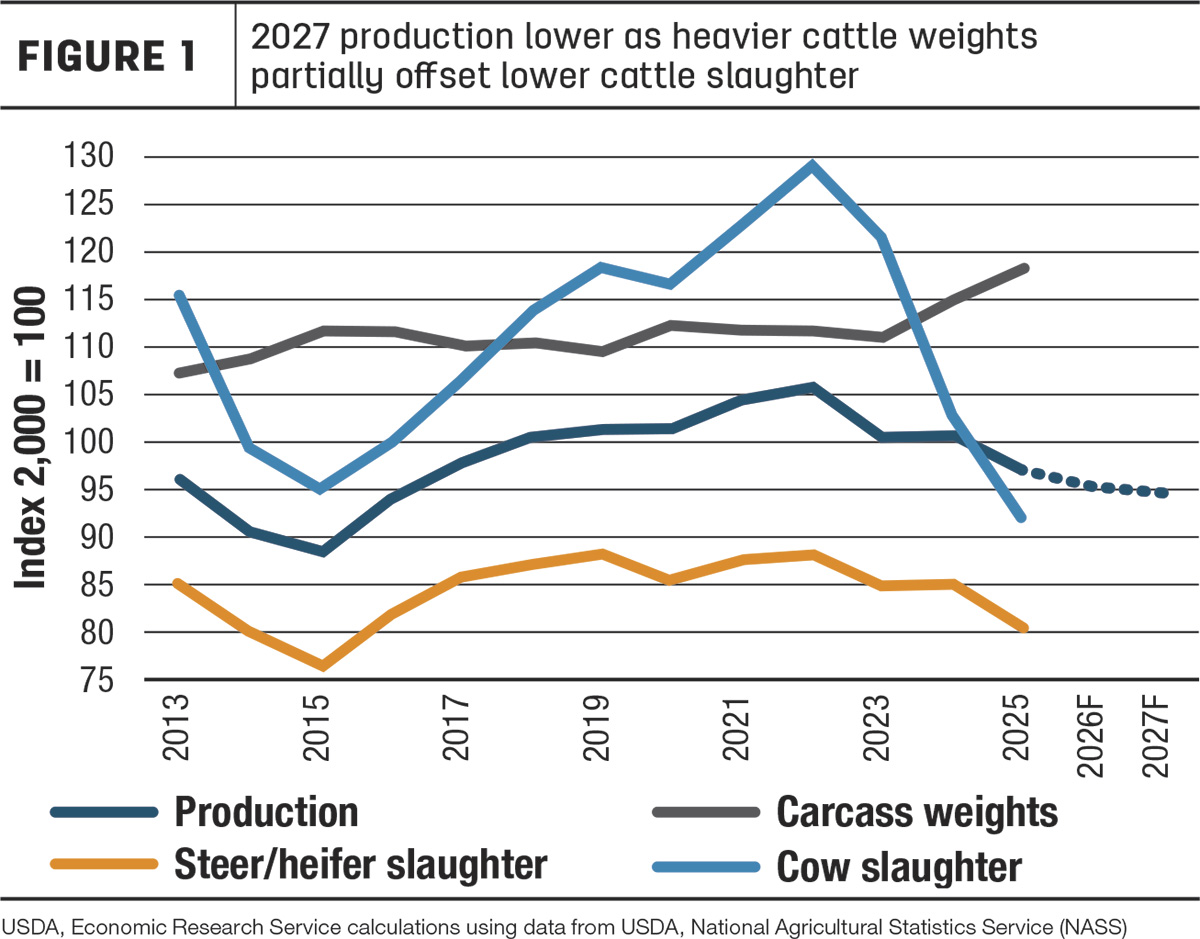
The outlook for beef production in 2027 is forecast at 25.31 billion pounds, a 0.9% decline from 2026. A slight decline in production next year is based on fewer cattle slaughtered that is only partially offset by heavier anticipated carcass weights. This expected decline in cattle slaughter next year is predicated on seven years of declining beef cow inventories (2020-26), which have led to smaller calf crops each year. This leaves cattle producers a smaller pool of calves from which to designate for the breeding herd or the beef value chain.
More specifically, in January, the USDA National Agricultural Statistics Service (NASS) estimated that producers retained more heifers for their breeding herds entering 2026 than the prior year. Higher heifer retention is likely to carry over with the 2026 calf crop, which is expected to be smaller. An overall small calf crop and increased heifer retention for breeding will further constrict calf supplies available for placement in feedlots in late 2026 and the first half of 2027. This supports fewer feedlot cattle marketed for slaughter in 2027.
In 2027, cow slaughter is also expected to decline as producers are anticipated to favor beef cow retention over culling from historically low beef cow inventories. This situation also supports a lower beef production forecast in 2027.
For a historical perspective, the Figure 1 indexes annual commercial beef production, steer and heifer slaughter, cow slaughter and average carcass weights to the estimates in 2000. According to Figure 1, 2027 production is forecast to be almost 11% lower than the record set in 2022 and at the lowest volume since 2016.
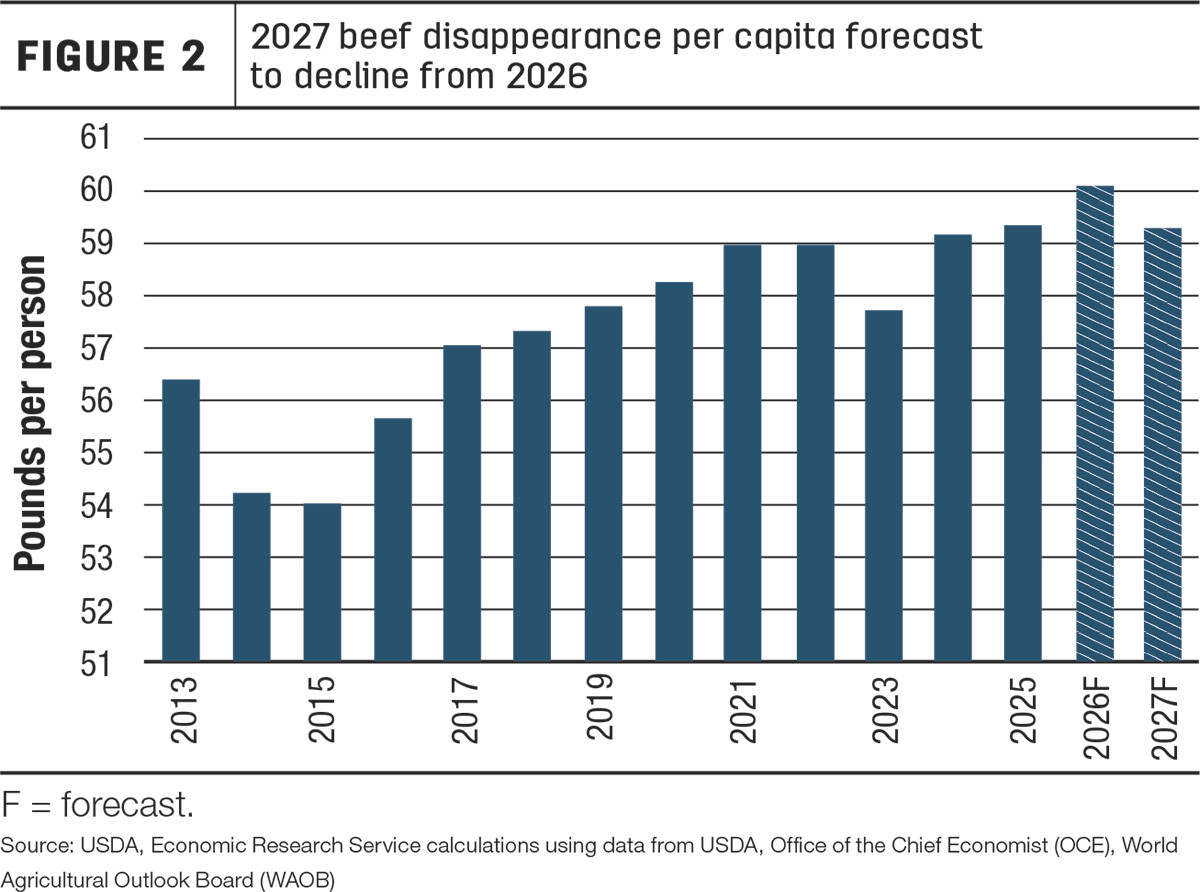
Further, Figure 2 shows per capita disappearance on a retail weight basis from 2013 to 2027. The disappearance of beef on the domestic market is calculated as the volume of production that remains for domestic use, including grocery stores and restaurants, after adding net trade and changes in cold storage volumes. Along with production declines forecast in 2027, exports are forecast to drop to their lowest level since 2015. The effect of lower production on domestic disappearance will be partially offset by lower exports and relatively large beef imports, the level of which is second only to the record import forecast for 2026. As a result, per capita disappearance in 2027 is forecast at 59.2 pounds, a 1.3% decline year over year but above the 10- and 20-year averages.
2026 beef production lowered on slower pace of marketings
Since last month’s report, steer and heifer marketings for slaughter have slowed below expectations as feedlots still appear willing to add weight to cattle while awaiting higher bids from packers. To the extent that the pace of marketings is slower than previously expected throughout the rest of the year, the outlook for 2026 beef production is lowered by 243 million pounds to 25.547 billion pounds, a 1.8% decline from last year.
The latest USDA NASS Cattle on Feed report showed the April 1 feedlot inventory at 11.576 million head, 0.5% below the 11.638 million head in the same month last year. Feedlot net placements in March were more than 7% lower year over year at 1.659 million head. Following a very slow pace of marketings in February, marketings in March were 1.632 million head, up about 10% when accounting for an additional weekday available for slaughter compared to March 2025. The slower pace of marketings has kept the percentage of cattle on feed over 150 days historically elevated.
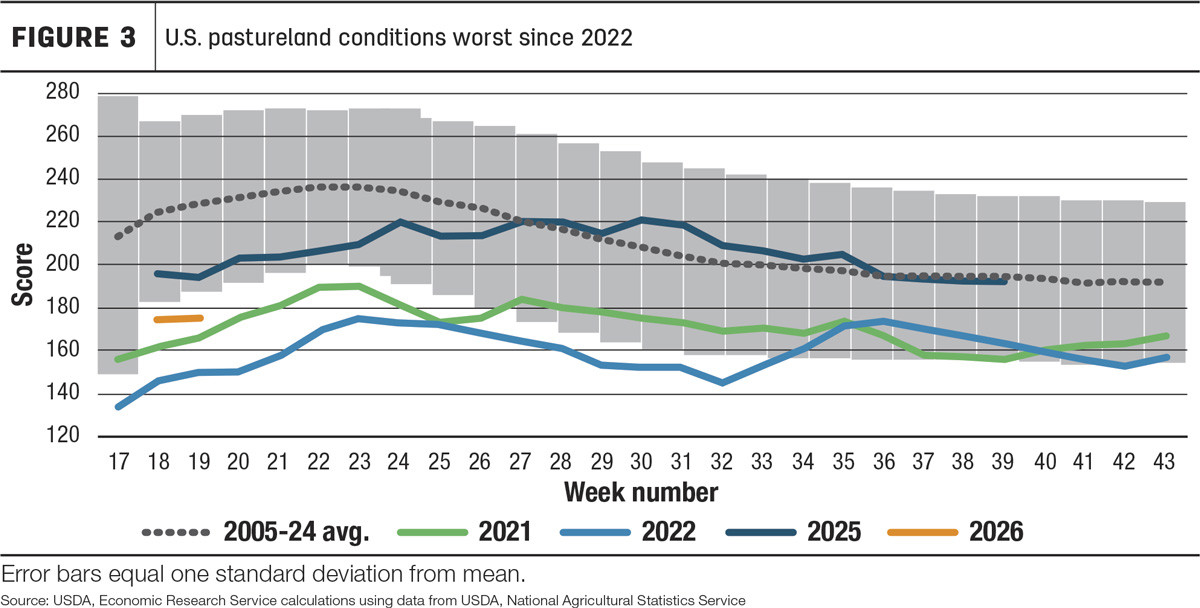
With respect to cow slaughter, current pastureland conditions are the worst and the most widespread since the last drought period in 2021-22. In Figure 3, weekly pastureland conditions are given a score to provide an overall value. A relatively low or declining score suggests that pasture conditions are weakening.
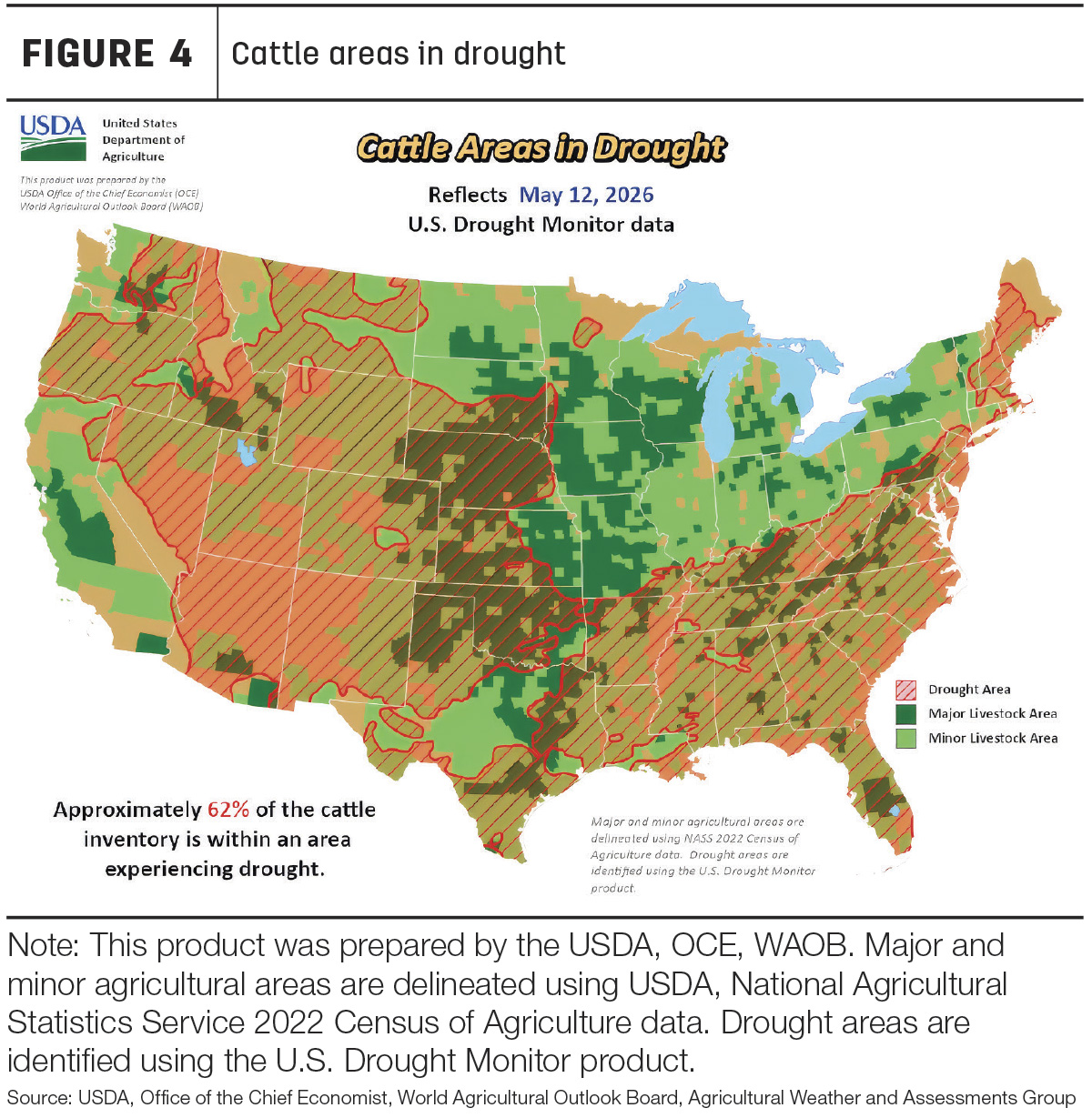
Further, Figure 4 shows that on May 12, 62% of the cattle inventory was in an area experiencing drought; this is compared to 29% the same week last year and 55% in 2022. This may hamper hay production and forage conditions, limiting producers’ ability to expand their herds. While the current forecast assumes normal weather conditions over the summer months, more cows could enter the slaughter mix if drought conditions persist or worsen from the current situation.
Cattle prices to extend upward trend through 2027
Cattle prices in 2027 are expected to be modestly higher than the records currently forecast for 2026. This is based on a smaller anticipated calf crop in 2026 and more heifers retained for breeding to further tighten supplies available for placement in feedlots and for slaughter in 2027. The forecast for feeder steers weighing 750 to 800 pounds at the Oklahoma City National Stockyards is $382 per hundredweight (cwt), a 1% increase from 2026. The forecast for slaughter steer prices in the 5-area marketing region is $253.75 per cwt, a year-over-year increase of 2%.
2026 cattle prices set new record highs
Since the previous month’s outlook report, the weighted-average price for feeder steers between 750 and 800 pounds at the Oklahoma City National Stockyards set two new all-time highs: first, at $383.69 per cwt during the second week of April and then at $388.06 per cwt during the first week of May. As a result, the weighted-average price for feeder steers in April was recorded at $377.07 per cwt, about $79 above April 2025. During the first two weeks of May, feeder steer price averaged $380.42 per cwt, showing continued year-over-year strength. Based on recent price data and tight calf supplies, the second-quarter forecast is raised by $12 to $379 per cwt; the third and fourth quarters are raised by $13 and $15, respectively, to $380 and $384 per cwt. The 2026 annual feeder steer price is forecast at $377.22 per cwt, a 17% increase from 2025.
Weekly slaughter steer prices also established several new records from last month’s report. This resulted in the April average price for slaughter steers in the 5-area marketing region reaching $249.05 per cwt, a record for any month. Further, in early May, weekly prices climbed above $258 per cwt. Based on April and early May price data and feedlots slowing the pace of marketings, the 2026 price forecast is raised $8 from last month, with the annual price projected at $249.66 per cwt, 11% higher than in 2025.
Beef exports
March exports totaled 207 million pounds, 19% lower year over year. Exports to nearly all major markets were lower year over year, including China (-97%), Japan (-18%) and Mexico (-14%). Exports for the first quarter totaled 586 million pounds, 18% below a year ago. As Table 1 shows, exports to Taiwan through March were up 3 million pounds (8%) while exports to Hong Kong were up more than 20 million pounds (110%). Exports to the rest of the world are also up 13%. The export forecasts for the remainder of 2026 are unchanged from last month with the annual forecast totaling 2.361 billion pounds which, if realized, would be an 8% decrease year over year.
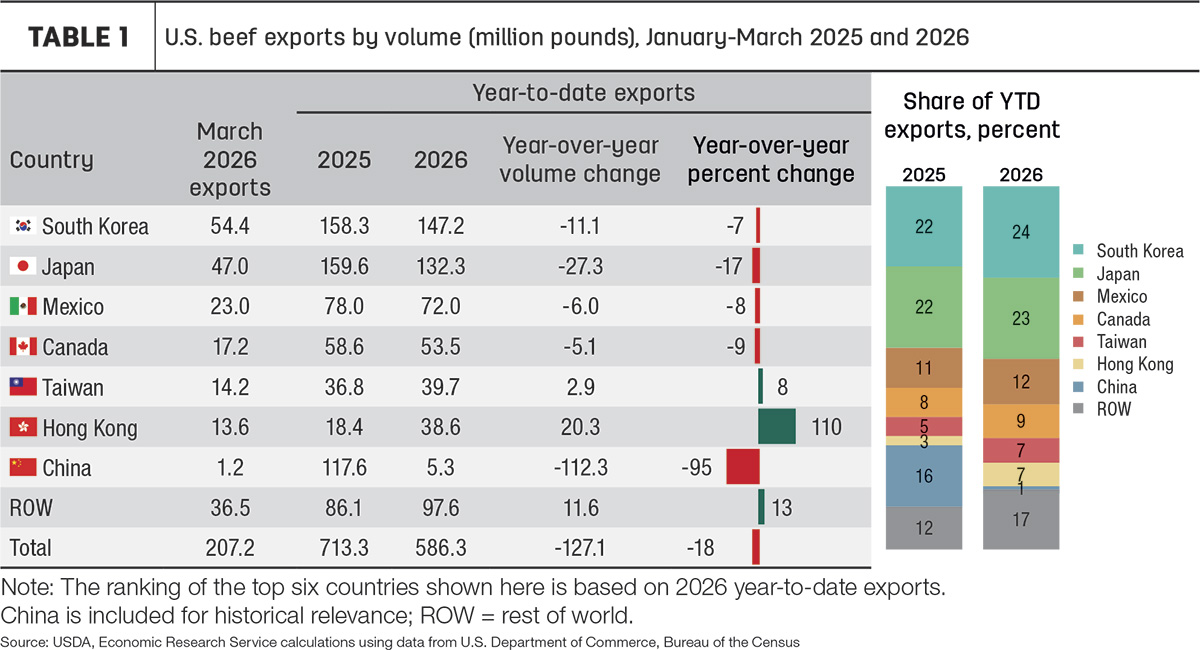
Beef exports as a percent of domestic production is a metric often used to discuss the export forecast. Over the last 10 years, exports have been consistently around 10% to 12% of domestic production. There are a wide variety of cuts and products produced by each individual beef carcass; several cuts are either not desired by U.S. consumers or are more highly valued in foreign markets (i.e., short plate cuts). Therefore, the expected level of domestic beef production is an important factor in the forecast for beef exports, in addition to anticipated price competitiveness and foreign beef demand.
Looking to 2027, U.S. beef production is forecast to decline just under 1%. The annual forecast for beef exports is 2.335 billion pounds, which would account for about 9.2% of production. For 2026, exports as a percent of production are also forecast around 9%, while the five-year average is about 11%. The 2027 annual export forecast would be about 1% lower compared to the 2026 forecast and would be the lowest annual exports total since 2015.
Beef imports
March imports surged to 599 million pounds, a year-over-year increase of 19%. Contributing to the large year-over-year increase were imports from Brazil (26%), Mexico (39%), Australia (23%) and Uruguay (36%). Imports from Mexico reached over 75 million pounds, a record monthly high for that country.
First-quarter imports totaled 1.709 billion pounds, a year-over-year increase of 15%. Table 2 shows the largest contributor to the year-over-year increase in first-quarter imports was from the combined countries outside the top five, including Paraguay (51 million pounds), Argentina (29 million pounds), Uruguay (28 million pounds) and Nicaragua (27 million pounds). Imports from Brazil, Australia and Mexico also contributed to the increase, while imports from Canada and New Zealand were slightly lower year over year.
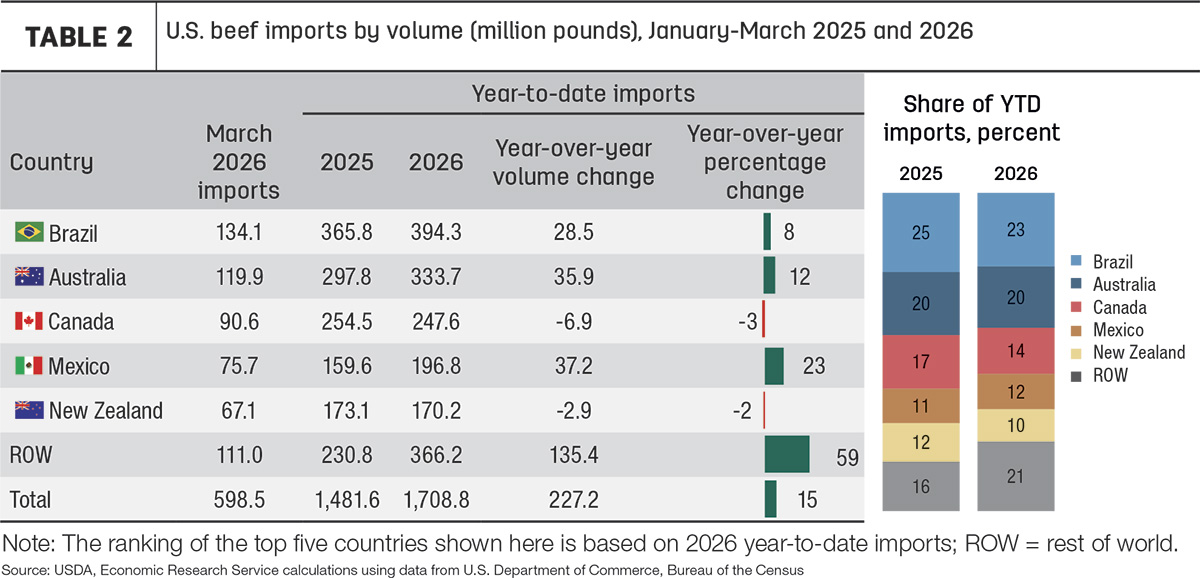
Reported exports to the U.S. from the major suppliers continue to indicate strong imports in the coming months. Weekly imports through April were also above a year ago according to the USDA Agricultural Marketing Service Weekly Imported Meat Passed for Entry in the U.S. report. Due to the continued strong pace of imports and demand for lean processing beef, the second-quarter import forecast is raised 150 million pounds to 1.625 billion. The third- and fourth-quarter forecasts are also raised 50 million and 35 million pounds, respectively. The annual forecast for 2026 is 6.109 billion pounds, a 12% increase year over year.
The 2027 import forecast is 6 billion pounds, which would be a 2% decrease year over year. The main reason for an expected decrease in imports – despite lower domestic production – is the availability of global beef supplies. Several major beef suppliers are expected to slow their expansions or contract in their respective cattle cycles during 2026, resulting in fewer exportable beef supplies available in 2027. High U.S. beef prices and sustained strong demand for imported lean processing beef will continue to pull product in and keep imports at a historically high level.