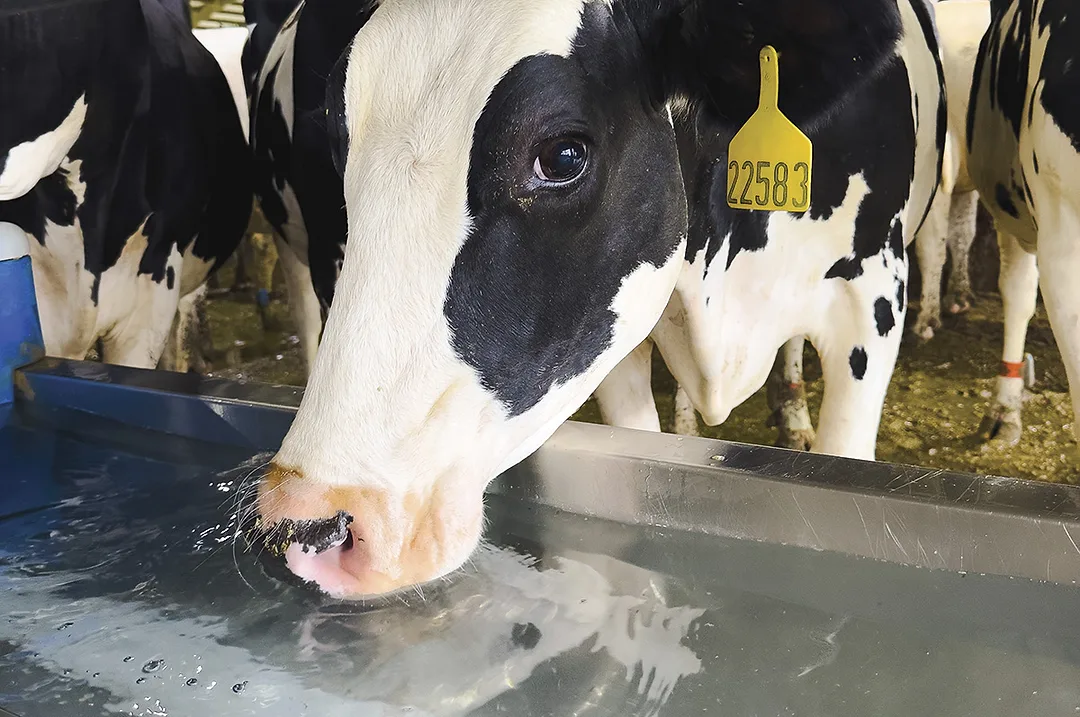
Water is one of the most important and most often overlooked nutrient for dairy cows. On average, cows drink 115 to 190 litres (30 to 50 gallons) of water each day, with high-producing cows consuming more. Water drives every major biological process, from rumen fermentation to milk production and temperature regulation. Needless to say, ample amounts of clean water is important.

Water can be an issue, however, because it is such a good carrier of debris and organisms – it is like a train everyone wants to be on. Water has unique chemical and physical properties that gives it the ability to transport dissolved and suspended materials. These properties make it essential for life. Water is ideal for spreading positive elements like nutrients but can also spread harmful organisms like pathogens.
What is your water carrying?
Because water is such an effective transport mechanism, we can’t assume that all water is created equal. We need to know what it carries.
When we talk to nutritionists, they are adamant that water be tested twice each year: Once during a low flow state (winter) and once when it is in a high flow state. Test results let your nutritionist know what nutrients are in the water so they can balance your ration accordingly. This is especially important for transition rations where a negative dietary cation-anion balance is necessary to prevent metabolic disorders. It is important to know if water is high in chloride, which carries a negative charge, or potassium, which carries a positive charge, so the ration can be adjusted to achieve the desired outcomes.
A test will also identify the presence of bacteria. Bacteria love water because water provides hydration, nutrients and mobility to enable survival. Water also creates moist surfaces which, in the presence of nutrients, allows bacteria to attach and build protective biofilm slime layers. Those layers are hard to get rid of and create an ideal home for pathogens.
Treatment
Once we know what the water supply contains, we can create a treatment process to help make it as safe as possible.
There are two reasons to treat water: to reduce levels of minerals and other elements and to improve hygiene.
Water softeners, iron filters and other non-chemical-devised filters remove calcium, magnesium and other elements that can reduce the effectiveness of detergents and sanitizers. If wash water wasn’t run through a water softener, more chemicals and hotter water would be needed to get equipment clean and sanitized.
A hog or poultry operation understands the importance of treating water to improve hygiene. Nearly every hog and poultry barn is built with a water treatment system either in place or able to be added. Conversely, there are very few dairy facilities built with this adaptation in mind.
Manage the biofilm
If you have a water quality issue on your dairy, you’ll know it by the biofilm buildup in water lines, water troughs and traps. Milking equipment, bulk tanks and cooling systems are logical areas where biofilms can reside, but an effective clean-in-place (CIP) and sanitation program should prevent these films from getting established.
There are plenty of areas on a dairy where moisture is present but no daily sanitation process is in place. Anywhere cows drink water is a prime area for biofilm establishment and buildup.
Treatment systems should be dynamic because few dairy farms are located in ideal environments with the same temperature every day of the year. A dairy producer on the East Coast has different challenges with temperature, sunlight, dust, algae and other factors than a dairy producer on the prairies, and both face different adversity in the summer compared to winter.
Chemical treatments normally include chlorine, hydrogen peroxide or chlorine dioxide. Chlorine and hydrogen peroxide are broad disinfectants and can work at basic cleaning processes. However, they only work in a narrow pH range and are generally neutralized by organic matter. Chlorine dioxide, on the other hand, works within a much wider pH range and remains active in the presence of organic matter. It is also able to penetrate and oxidize biofilm, even in the presence of high organic load. Mixing technology is available now that makes chlorine dioxide easier to handle and add into water systems.
Determine efficacy
Regardless of the product used to treat water, it is important to know if the treatment is actually working. It is a good idea to sample your water troughs and calf pails. You can either have your veterinarian take a sample to grow a culture, or you can use a tool called an ATP meter. This is a handheld tool that provides a rapid indication of microbial contamination by measuring bioluminescence, where higher light levels indicate greater contamination. The ATP test won’t tell you what specific pathogens are present, but it can tell you if there is a problem. It is a great tool for use in the calf facility to know if hard surfaces like buckets, nipples or bottles are contaminated.
One other resource to use is an oxidation reduction potential (ORP) meter. This measures the speed at which a solution will kill a microbe, so a higher number means a faster kill. An ORP test can determine if a treatment is mixed properly, and it can validate that a treatment is effective in the trough. Our goal is to have a water trough with about half the parts per million level of chlorine dioxide or less and an ORP of 550 or higher.
Water is a critical nutrient needed to support the basic elements of life while delivering nutrients that can enhance health and performance. But, just as easily, water can also carry products that can reduce health and performance and cause illness and mortality. It is critical to know what is in your water and devise a treatment and monitoring system to ensure its safety.