I spent a week at the beginning of February with more than 60 bright young dairy leaders from across the country who were excited to sharpen their skill sets and polish their advocacy skills. The Holstein Foundation’s Young Dairy Leaders Institute (YDLI) Class 14 is impressive. While some were a little nervous (especially for the impromptu on-camera media interviews), what stood out to me was how willing they were to push the limits of their comfort zones to get closer to their goals.

That quality is also evident in many top dairy owners and managers. Taking the next step often involves an investment – in time, energy and sometimes money. While many dairy producers interviewed for this year’s State of Dairy articles are concerned about financial margins and their bottom line, they also have an eye on the future and are investing in their operations in ways that make it an attractive option for the next generation. I also talked with many younger producers who are excited about the future of the industry and are thrilled to step up into leadership positions on and off the farm (hear from a few of them in this article).
While none of us know what the industry will look like 10 years from now, many producers are taking steps now to set their operations up for success. Several industry leaders from Idaho to the Southeast told me they expect that dairy in their region will continue to grow. Non-traditional dairy states like Nebraska are also making strides to attract more dairy farms and processors.
When comparing the results of the Center for Dairy Excellence’s 2025 and 2020 farm surveys, more dairy farmers indicated they already invested in the past five years or were planning to invest in the next five years in several aspects of their operations, including cow comfort improvements, housing and feed facilities, and milking systems.
“Even though current market conditions are uncertain, more dairy farmers are looking toward the future now than they were five years ago,” says Valerie Mason-Faith, risk education program manager at the Center for Dairy Excellence in Pennsylvania.
Aside from robotics and other forms of automation, artificial intelligence (AI) is another type of technology that is providing noteworthy benefits for many operations. Scott Maier from Maier Farms LLC in Wisconsin says he foresees AI usage continuing to increase going forward, from animal monitoring to camera-based lameness scoring, drone topography on feed storage and more.
“We’ll see the impact of this technology,” he says. “We encourage training and education in all facets of our farm to promote the adoption of new practices that can directly impact efficiency and productivity.”
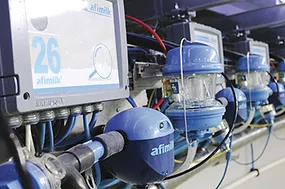
Several other producers mentioned they are planning to build new facilities or retrofit existing ones with additional automation to assist with labor concerns and animal welfare while enhancing overall efficiency and productivity. Others – like Maryland dairywoman Alice Crothers – are focusing on other aspects of long-term sustainability.
“Our farm’s focus is on expense reduction and elimination since we have very little control over income,” Crothers says. “We have and will continue to work on environmentally sustainable projects that produce operational and financial gains for the farm.”
Travis Senn, assistant director of milk marketing and analytics at Southeast Milk Inc., expects to see current trends continue with fewer but stronger, more professional operations over the next decade.
“Success will hinge on efficiency, people management and financial discipline as much as scale,” he says. “Labor availability will play a major role in determining which farms grow, which hold steady and which ultimately exit the industry. Dairy producers in the Southeast are preparing by making measured investments, improving labor efficiency through technology and thinking long-term about succession planning and business structure. The future belongs to farms that can attract, retain and manage people just as well as they manage cows.”
Thank you to everyone who participated in this year’s State of Dairy. I appreciate you sharing your thoughts and insights. If you are interested in participating in our 2027 State of Dairy, send me an email.