The beginning of a new year is often a time to refresh goals and evaluate the vision for one’s life. Similarly, multiple people interviewed for this year’s State of Dairy said late 2025 and early 2026 will be remembered as a reset.

"Moving from fall 2025 to spring 2026 has been rather depressing. We need to find ways to reset our mindset and to focus on what we can control and improve so we are prepared for this downswing,” says Lolly Lesher from Way-Har Farms in Pennsylvania.
Whole milk is back in schools
Consumers prioritizing protein-rich foods is creating great opportunities for dairy. This coincides with two exciting developments for the dairy industry: the new food pyramid and the passage of the Whole Milk for Healthy Kids Act.
President Donald J. Trump signed the Whole Milk for Healthy Kids Act into law on Jan. 14, which sparked excitement among many dairy producers and industry leaders. Many of those surveyed said this would be among the top things that the dairy community remembers about this year.
“I am very excited to see the passage of this bill to put whole milk back into schools and bring full-fat dairy foods to our youngest consumers. This is a game-changer, and all dairy producers will benefit from this,” Lesher says.
Alice Crothers from Long Green Farms Inc. in Maryland describes it as rejuvenating.
“It highlights what dairy farmers have known all along: We produce a nutritious and affordable food. The support from nutritionists and physicians has been incredible. This stands to have a generational impact on both consumers and dairy producers,” she says.
Many producers say this gives them hope for what is to come.
“Allowing 2 percent and whole milk back into the school lunch program is great. They never should have been removed. Hopefully, it will help change long-term dairy consumption habits with kids," says John Haag from Haag Dairy Inc. in Wisconsin.
While a multitude of other producers and dairy enthusiasts shared posts on social media to express their excitement, a few dairy producers were in the Oval Office as the president signed the bill into law, including Tara Vander Dussen from New Mexico.
“As a dairy farmer, this was a huge milestone for us,” Vander Dussen says. “We’ve been fighting for this bill to pass for about 15 years. We know that kids like whole milk better, but I think this bill goes so far beyond that. As a parent, it’s about choice for our kids. Overall, I think this is a win for the millions of children that depend on school lunches for nutrition."
Read more about Vander Dussen’s experience in this 3 Open Minutes article.
New food pyramid prioritizes protein
Another exciting development out of the nation’s capitol is the 2026 Dietary Guidelines for Americans, also known as the new food pyramid, which prioritizes high-quality protein, full-fat dairy, healthy fats and whole foods while limiting added sugars, refined carbohydrates and highly processed foods.
“The U.S. has a real demand for protein, with dairy and beef being a fundamental part of the improved USDA food pyramid,” says Anja Raudabaugh, CEO of Western United Dairies in California. “America's investment in protein appears to be more than just a fad, and dairy is extremely well positioned here.”
Nebraska State Dairy Association Executive Director Kris Bousquet considers this a “huge win” for our industry.
“Putting protein – especially from dairy and meat – back at the top of the pyramid is significantly important for a lot of reasons,” he says. “It not only provides superior nutrition for consumers but will also stimulate our farmers economically. It is too early to know how drastic the growth will be, but this positioning will allow for people on food stamp programs to purchase items they traditionally haven’t purchased in the past due to price constraints.”
Putting a face on dairy farming
Haag considers consumer education to be one of the greatest opportunities for the dairy industry, and many of his industry peers agree.
“Consumers have very real questions about where their food comes from, and we are a good source for those answers,” Haag says. “Misinformation on social media is one of the greatest threats to our industry. This is why it will always be important to keep lines of communication open with consumers and our elected officials.”
One of the ways Georgia dairy producer Katelin Benkoski and her family connect with local consumers is by serving as a host farm for the Adopt a Cow program.
“Being part of the Adopt a Cow program has been an amazing experience for us, and it is eye-opening to see what we take for granted that students don’t know,” Benkoski says. “You see children’s eyes light up with wonder as they learn about farming and where their food comes from in a hands-on way. Connecting people with agriculture gives us hope for the future that dairy will continue to grow and hopefully will be profitable for many generations to come."
Farm camps are growing in popularity across the country. Jon Hermonot and his wife, Erica, from Fairholm Farm in Connecticut started theirs in 2021 as a hands-on way for kids between the ages of 6 and 12 to learn about modern agriculture.
“After the pandemic, Erica was homeschooling our kids and saw the opportunity to provide kids and their families with first-hand knowledge of how a modern dairy farm works. We wanted to show people where their food comes from and bridge the ever-widening gap between consumers and farmers,” Hermonot says.
Their farm camp runs for five weeks each summer, and there is a different theme for each week.
“From watching kids connect with animals and fall in love with the baby calves they care for all week to seeing their teamwork as they tackle a task together, it is hard to narrow down what the best part of this is,” Erica Hermonot says. “I love seeing kids return for multiple summers because they had such a great time the year before. It shows we're doing something right. Knowing that we could be planting seeds that may interest these kids in agriculture in the future, whatever that may look like for them, is rewarding. They think we have the coolest job in the world, and it's nice to be reminded that even if they don't see the difficult and very dirty parts, that yes, we do have the best job in the world and we get to do it every day.”
Beef-on-dairy revenue buffers low milk prices
High beef prices continue to be a highlight for dairy producers utilizing beef-on-dairy in their breeding programs.
“Beef-on-dairy has been a lifeline for many dairy farmers, and diversification will continue to be a major key to success in navigating volatile milk markets. The question is: Will this continue to support dairy’s bottom line in 2026 or will beef prices start to decline?” Crothers says.
This additional revenue has become an important part of the overall financial picture for many operations.
“Our beef-on-dairy calves accounted for over a dollar and 50 cents added to the bottom line,” says Quade Kirk from Dutch Hollow Farm in New York.
Heifer inventories are at a 20-year low (Figure 1), which is a bright spot for Dan DeRuyter from George DeRuyter and Sons Dairy in Washington.
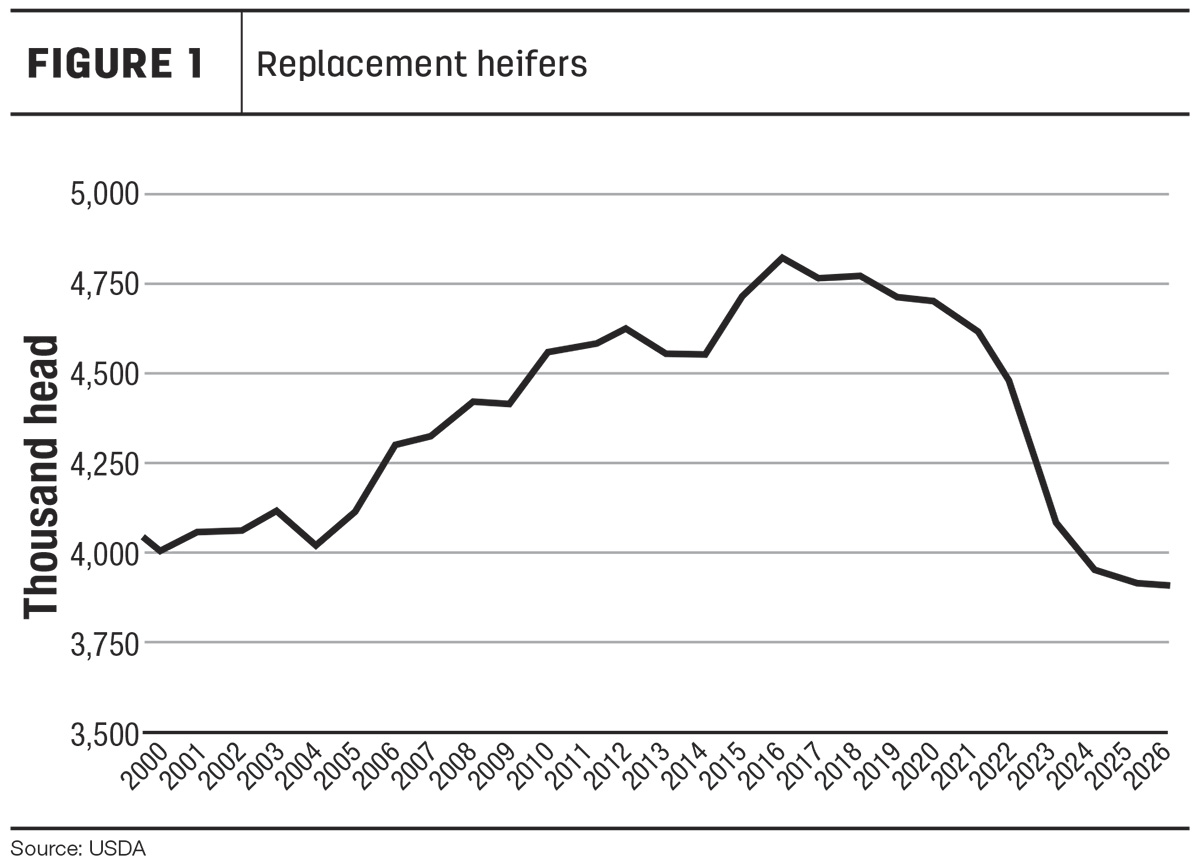
“I think if there is any optimism right now, it would be that heifer inventories are still low and cattle prices continue to be high. If we can get any help with milk prices, we could have an OK year,” DeRuyter says.
Aside from beef-on-dairy, other genetics and breeding are also creating opportunities.
“With the limited ability to grow dairy operations in Connecticut, it’s important to try to capitalize on beef-on-dairy and the embryo market to increase revenue,” Hermonot says. “We are trying to continue improving the genetics of our herd and are watching milk components increase at a higher percentage than milk production year over year.”
Anthony Agueda from Alberto Dairy in California agrees.
“Advances in herd genetics and data-driven breeding tools allow us to make more accurate breeding decisions. This helps us to build a more resilient herd that is better positioned for long-term profitability,” he says.
Technological advances help to attract the next generation back to the farm
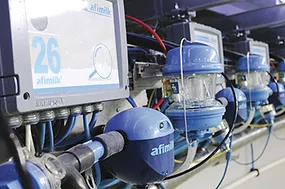
As various on-farm technologies continue to evolve and grow in popularity, dairies are making advancements in cow care and efficiency to keep their operations profitable for generations to come.
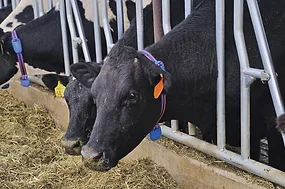
“The technology that is available to us is amazing,” Benkoski says. “Some farms are using smart collars, eartags, boluses and pedometers to better monitor their cows’ activity and temperatures from their phones.”
Fellow Georgia dairy producer Mark Rodgers from Hillcrest Farms Inc. is excited about the technology they added to their farm to help the fourth generation succeed.
“We were the first dairy in Georgia to milk with robotic milkers. In the past year, we added smart gates and a feed pushing robot. We have a great staff, with five of them under 35 years old, and they are taking over the day-to-day management of the farm. My brother, Andy, and I are the third generation and are looking forward to a bit more time away from the farm as we transition management to the fourth generation,” he says.
Their staff shifted from mostly male to primarily female since adding their automated milking system.
“I believe robotics has attracted and retained more women because it provides a more flexible schedule and a much less monotonous lifestyle compared to our previous 3X parlor milking schedule,” Rodgers says.
Crothers predicts that the advancement of technology will likely transform the dairy industry more in the next 10 years than in any previous decade.
“Technological advances in agriculture are very exciting,” she says. “From robotic milkers to self-driving tractors, the innovation in agriculture is moving at an enormous pace.”
For Scott Maier from Maier Farms LLC in Wisconsin, artificial intelligence (AI) is one of the most exciting technological developments.
“You need a team of good people on your dairy to maximize the data,” he says. “As a dairy, you can have more info coming in to make decisions more timely and quicker. AI can observe things 24/7/365, and if things change it will alert you so you can adjust or understand why it's happening. This is where our team comes into play. It all looks good on paper, but is it real and can you apply it on your dairy? You don't want to pay for all this data and come down with information overload and abandon it.”
Energized and inspired to lead
The opportunity to help move the industry forward while honoring what previous generations have built serves as inspiration to many young people in the dairy industry who are excited to step into management and leadership positions in the coming years.
“It’s energizing to be part of an industry that continues to innovate, solve problems and prove its resilience even in challenging environments,” Agueda says. “Being part of a third-generation dairy, I’ve learned how much the industry has evolved, and I’m motivated to find more ways to adapt going forward through technology, sustainability and hands-on management without losing sight of cow care and family values.”
Interest from the next generation is an exciting part of the Indiana dairy community right now, says Indiana Dairy Producers Executive Director Steve Obert.
“It seems many operations have the next generation on the farm and are working to develop these young people into leaders for future ownership transitions. I am certain that farm attrition and consolidation will continue in the future, but many farms are preparing for the long haul, and it is the younger generation providing the inspiration for that commitment,” Obert says.
Jayne Sebright, executive director at the Center for Dairy Excellence in Pennsylvania, says her team has seen a heightened interest in transition planning from dairy producers in her state.
The next generation of Dakin Dairy Farms in Florida transitioned into management in 2024, and two of the four brothers – Ethan and Grant Dakin – said the experience has taught them about growth and has expanded their comfort zones.
“We have learned to utilize key personnel and that having good managers is a key to success,” Grant Dakin says. “We have had to consolidate one of our family’s farms to be more efficient with production and overall costs.”
In addition to dairy farming, they process their milk on the farm and market products directly to consumers.
“We’ve also learned new skills about the processing side of the dairy business,” Ethan Dakin says. “A highlight from our first two years in management includes all the upgrades and new equipment. With this system and our new filler, we hope to increase production and milk processing to further reach the community in the southwest and central regions of Florida.”
Aside from that, they are excited about their agritourism efforts that help their community to learn more about modern dairy farming.
More members of the next generation are stepping up into industry leadership positions, inspired to help create a bright future for the dairy industry. Virginia dairy producer Joanna Shipp has served on the National Dairy Board since 2019, where she has been the chairwoman for the last three years. As chair, she has also served on the board of the Innovation Center, participated in the Dairy Sustainability Alliance and been a farmer representative on the Innovation Center communications committee.
“I take on leadership roles because farmers are stronger when we work together,” Shipp says. “When we come together, we have a larger voice, can affect greater change and we can raise each other up. As a younger producer, I am excited about the renewed consumer interest in the dairy category. I am inspired by my travels around the world meeting people that have not had a traditional dairy diet and who are asking for and embracing dairy. We as U.S. farmers can continue our businesses because we have people at home and abroad that love dairy as much as we do.”