If you put a bunch of cowboys and cowgirls in a room, each one will have a tale of, “Did I ever tell you about the time I …,” and then one might fill in the blank with such things as:

- Swam my horse across the Missouri River at floodwater stage?
- Had a mad cow chase me through the cab of the pickup? Both doors were open, and when I jumped in to get away from her, she just followed me right through.
- Had a cow get an old tractor tire stuck around her belly?
Whatever the story may be, it’s a tale that informs you that they’ve been around the block or around the ranch. They want others to know they aren’t newbies, and they’ve acquired some knowledge.
Of course, there’s nothing wrong with being a newbie, and readily admitting that is encouraged if you’re in a circle of people telling stories – especially if you get invited out to the ranch. People don’t want to find out you’re a newbie when you’re moving cows and sending cattle in the wrong direction. However, once someone has a few miles under their belts, the stories come. Why? Because you can’t learn without experience. And stories naturally flow from experiences.
Those experiences direct how current work gets handled because cowboys and cowgirls figure out what works best for them and for those around them. After many miles and years, the rancher moves into the “wise-sage” phase of life. At this phase, your perspective influences those around you who are still accruing miles. Others want to know your opinions, unless you’re a crusty, grumpy old soul – but none of us are that, right?
Even before one is truly a sage, one moves from learning (early in life) to protecting, nurturing and teaching what’s been learned. Sharing knowledge is natural, unless the person you’re speaking with is “just not getting it.” This happened recently to my cousin as he tried to explain what he needed for A.I.’ing cows to a community co-op worker.
Not everyone is familiar with A.I. (artificial insemination, not artificial intelligence). That’s not a bad thing. However, the worker was not quite in a place to learn.
My cousin went to the co-op looking for CIDRs (controlled internal drug releases), explaining that he needed implants for cattle for A.I.
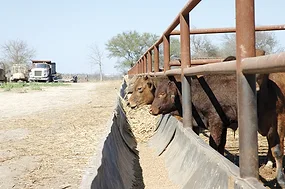
The guy tried to sell him a feeder.
My cousin graphically explained a CIDR implant. (I wasn’t there, but I can vouch that my cousin isn’t shy.)
The man looked back at him with a funny look. Then, he tried to sell my cousin some feed.
Followed by an attempt to sell him grass seed.
My cousin responded with, “The only thing left to do is draw you a picture, and I’m not doing that.”
Obviously, the guy had no idea what a CIDR is or what he was being asked about!
The community that my cousin lives in isn’t exactly a cattle mecca, but one would think that a store with cattle supplies might know what a CIDR is or be able to refer you to someone who did. My cousin ended up driving 60 miles away to find supplies. How funny that instead of the worker acknowledging that he didn’t know what it was, he tried to redirect to different supplies!
In our current day and age, if you’re not familiar with cattle, the concept of A.I. is likely foreign – unless it’s AI (artificial intelligence, not artificial insemination). Our past experiences inform our current reactions. The guy obviously had never been around it or heard about it. And he certainly didn’t understand that feed or seed wasn’t going to fit the need. Yet, that’s his frame of reference.
We all have a frame of reference. And if we are used to something, then we might not respond in a way that makes sense to someone else. (Perhaps that is really what is happening in the world right now on a global scale.)
Maybe we need to pause, sit around and listen to a bunch of ranch folk tell stories. Or, maybe, if we’ve got the mileage, we need to tell more stories. I know listening to others’ wisdom has increased my knowledge and helped me avoid stepping in some cow pies.
Stories have been spun around cows, horses and land for longer than any of us can imagine. Campfires have long burned secrets and lit up tales as people warmed themselves. Why? What do stories really do? Ultimately, they inform. If we listen closely to stories, we’ll learn from those with many miles under their belts. And we’ll also learn whose tales are too tall to be true, which tells you a lot about the person. (We once had someone tell us about Guatemalan ninjas who broke onto the ranch, but that’s a story for another time.)
Whatever we have lived through and are living through now will become the lens through which we see the world and the way we shape our own stories. That’s my perspective, anyway. This certainly makes me consider: What kind of stories am I writing with my life? Whose stories am I listening to?