The weather had definitely taken a turn toward fall. I needed a hoodie or a vest in the mornings now, and a quick glance at the mountains to the east, with the subtle beauty of the yellow gold of the quaking aspen leaves, mingled with the dark green hues of the pines in the high country, gave a gentle reminder of Mother Nature’s changing of the guard. My chore for this particular morning was to take a quick inventory of the hay in each of the stackyards.

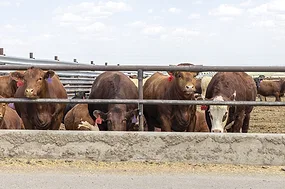
Earlier in the year, before turnout on the mountain, and about the same time I was running out of hay, I’d temporarily turned the cows out on the country that I’d planned on reserving for the fall, in the hopes that some early summer rain would coax some life back into the ground before the cows came home in October. The summer had been pretty rough, though. We saw nary a drop of rain from the end of May all the way through August. Subsequently, my fall pastures, though entirely devoid of cattle throughout the summer, looked as if Gus and Woodrow’s herd had recently wandered through on their way to the greener pastures of Montana. It didn’t take the sharpest of grass farmers to determine that there wouldn’t be much feed available for my cows when they came off the mountain.
And so here I was, counting bales. We’d had a surprisingly good hay year, but with the dearth of fall pasture, I knew I’d need to buy some more hay to supplement what I had hoped earlier would be enough to get through the winter. Thankfully, and with my sympathies to the producers of virtually every commodity outside of beef, the weird economics of the past year were still in play. My calves were going to actually be worth something, and hay was not so exorbitantly priced that I’d have to sell half of the herd in order to feed the other half. Everything wasn’t perfect, but it could have easily been worse. I figured I’d be OK, even though my apparent misstep in the spring called for some correction in the fall.
Later that evening I was racing the sun to finish my evening chores before my light source slipped below the western horizon and disappeared with the beautiful orange complexion of the day’s end. My attention was drawn to the 70-foot poplar tree that stood like a gentle, ever-present sentinel, guarding the west end of my unassuming little house. Every day, the tree’s merciful shade now fully protected the house from the relentless heat of the summer’s afternoon sun. That wasn’t always the case.
My mind thumbed back through pages of the years that had passed since the day we planted that tree in a vain effort to remember exactly when that day was. Was it more than 20 years ago? Probably, but I couldn’t say for sure. The hope, when we stuck the spindly, 5-foot sapling in a shallow, hand-dug hole those many summers ago, was that it would eventually do exactly what it was doing now. It was fulfilling its purpose with quiet, dignified poise.
As half a dozen horses gathered around me, curiously nosing the bucket full of apples I’d gathered up off the ground, I wrapped my arm around my favorite old mare’s neck and marveled out loud to my equine partners at what the once-paltry poplar had become. In reality, it was probably a decade, but it seemed like only a year or two ago that I had raged at a late May snowstorm as it lay a heavy, wet blanket over the valley, snapping off tree limbs unable to bear the weight that clung to their fresh, green leaves. At the time, my tree was finally becoming big enough to offer a little bit of shade to the house. But with no thought whatsoever to my family’s well-being, the storm looked me straight in the eye and laughed at me with an icy grin, as the biggest, most protective and shade-producing limb of the tree snapped under the weight of its chilly, wet burden and fell to the ground. At that moment, I was pretty sure I’d not live to see the day when the tree would offer any real benefit to my house.
“Awe” may be too strong a word. Maybe “gratitude” would be more applicable under the circumstances, but at that moment, I suppose I really felt some kind of unique and special bond with that aging tree. I thought of the three (or was it four?) dogs my sons and I had buried under and around the tree over the years, and the tears that were shed with each burial. My eyes searched up and down the strong, tall trunk, but I couldn’t find the spot where the snowbound limb had broken off. A lot of healing had taken place over the course of a couple of decades – so much so that the scar was imperceptible, known only to the tree.
Even though the beginnings were humble and the desired result indistinguishable from a distant future that may well have never come to pass, my tree was now more than just a source of shade. It was a reminder of hope and healing and redemption; a promise that the mistakes and the wounds from last spring or last year or even 10 or 20 years ago can heal – maybe not forgotten completely, but repaired and tucked away where they belong; a lesson, but not a life sentence.