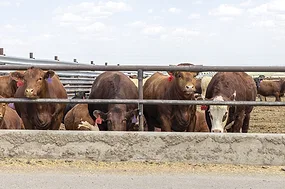
I talk a lot about the mountain – and for good reason. My professional life, ergo my personal life, my family life and my leisure life, revolves around and is quite beholden to the mountain. By the mountain, I mean the mountain range to the east of my home place where we summer the cattle on U.S. Forest Service grazing allotments. Nearly every decision I make regarding the cattle and our entire ranching operation, such as it is, is tied with a pretty firm knot to the mountain.

One of the most anticipated and dreaded activities of the year is the annual trek to the top of the range to put up the let-down fence before summer turnout. It’s really quite a big project, and since the labor force at my place is usually somewhere in the range between no help at all and a three-person crew, including myself, my wife and my octogenarian father, the quality of the work on the fence often tapers off after about the third day.
For those flatlanders and low-country dwellers who have no conceptual grasp of such a fence, an explanation is apropos. A let-down fence is a barbed wire fence that is laid down each fall to prevent the heavy winter snows from reducing it to a mangled mess of broken wire and bent and broken steel posts. Once, several years ago after the fall gather, I had only let down about half of the roughly 5 miles of fence up in the high country before the big snows hit. I’ve been paying for that little bit of negligent procrastination for over a decade now, and I consider myself somewhat of an expert on the subject. (I know you’re wondering if I speak of procrastination or let-down fences.)
This year was going to be different. For several reasons, it had to be. A Memorial Day lightning strike had started a fire that ripped across two of the three units of our allotment. By nothing more than Providence, the fire remained strictly in the timber, where years of deadfall and thick stands of evergreen trees in varying degrees of decay and vibrance kept the flames occupied. The fire burned for nearly three weeks, but crews were miraculously able to keep it contained to a mere 1,500 acres with very little serious resource damage.
Even more miraculous was the decision of the Forest Service rangers and supervisors to allow us to graze our full allotted numbers. It was a wise and practical decision, but an unexpected one, for sure. It restored a little of my faith in a system that I’ve watched time and again abandon all common sense as it clung to an apparent nonsensical agenda. If my local Forest Service managers, people whom I’d come to honestly respect over the years, were going to place enough trust in us to graze our full numbers, I had dang sure better do my level best to maintain their trust. Building my fence the right way was a good place to start.
With that in mind, I hired four local ranch kids, in the 12- to 14-year age range, to spend four or five 10- to 12-hour days building fence. Now, building and repairing fence through sagebrush, aspen and fir trees at 8,000 feet is not the toughest job in the world, but neither is it the easiest. It’s somewhere between rocket science and picking rocks. I was forced to endure some mind-numbing and intriguing conversation on a variety of subjects ranging from rawhide riatas to flatulence, but at the end of the last day, the fence was in better shape than it had been in several years. And I was thankful. I was thankful for a lot of things.
I was thankful that the fire crews had saved most of my fence and, at the behest of my local ranger, had moved all of the slash and logs that they had piled on top of the fence, which happened to be lying in the easiest spot to stack hundreds of sawed-up trees. Doing the job twice couldn’t have been easy.
I was thankful for my adolescent-aged crew, some of whom worked for the first two days with the belief that they were working for no pay other than the satisfaction of the service they were rendering, even after I gave them a stern lecture at the beginning of the campaign about the perils of doing any part of the job in a “half-hearted” manner. (I may have used a slightly altered version of that term, just to drive my point home.) I don’t feel that old, but it made me miss my own kids when they were that age.
Beyond the obvious, my gratitude extended to deeper spheres. There is a section of fence that goes through a grove of quaking aspen trees. In the bark on dozens of those trees is written a part of my history and legacy, more than three decades in the making.
Nearly every time we put up that stretch of fence, we’d carve our names in a tree, a tradition we picked up from my dad, who got it from his own father. Each time I passed through the grove this year, I had to choke back my emotions as I read and remembered the stories behind the innocent cowboy graffiti. I could see my 5- and 7-year-old sons arguing over the knife and who got to use it first. I could hear their mother scolding me for allowing her babies to come anywhere near that knife. I teared up just a little when I saw “Peyton + Lexy ’21” carved in a tree a few yards from the fence. My youngest son left it the first time he took his new bride on the annual fence trek. Lexy passed away a short three years later, but I think she still visits that spot occasionally.
The experience this year was filled with the warmth of the good times and the steel gained from the hard times, but also salted with a twinge of regret. I don’t mean overwhelming regret, but the regret that gently pricks your heart and reminds you of the opportunities missed but alternately offers the chance to do better. Inexplicably, in the shade of a burnt-out stand of pines on one side and the rustle of shimmering quakie leaves on the other, the old let-down fence somehow lifted me up.