What if you could break free from being stuck by emphasizing the positive aspects of your farm family business? One of my core strengths, according to the Clifton Strengths Assessment, is positivity. As a coach, I often see the positive choices ahead, and I hope this article by my coaching teammate Crisol Gonzalez gives you some new tools to move forward.

The Appreciative Inquiry process has challenged our approach to problem-solving. How could focusing on the positive elements of our family business resolve conflicts? It sounds contradictory, doesn't it?
David Cooperrider, Diana Whitney and Amanda Trosten-Bloom explain how Appreciative Inquiry is a flexible and adaptable exercise for organizations seeking a positive mindset shift in The Power of Appreciative Inquiry: A Practical Guide to Positive Change. It's a nine- to 12-month exploratory journey, a process of rediscovery and realignment. Like machinery, farming family teams require alignment, organization, strength-building and planning spaces. Appreciative means "recognizing the best in people … affirming past and present strengths, successes and potentials. … Inquiry is the act of exploration and discovery, asking questions.” The process involves several individual conversations and family meetings that will discuss topics divided into the five-D cycles of conversations: define, discover, design, dream and destiny. Here we will explore three of the five Ds.
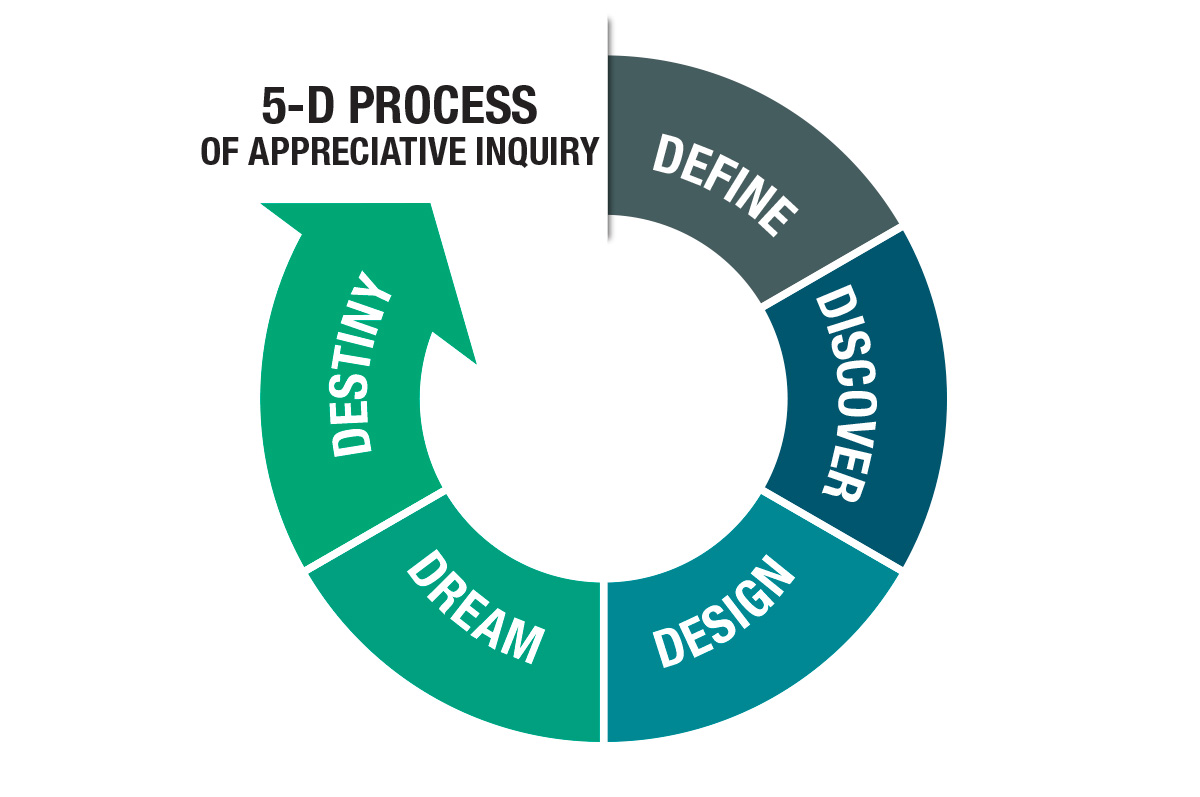
Source: The Center for Appreciative Inquiry.
Discovery cycle: Being curious to ask positive questions
These conversations are about "uncovering what gives life to your farming family." Sit down with each family/team member and ask curious, positive questions. Let them openly share their strengths and discuss the strengths they see in the entire family. Encourage them to share examples where the family team demonstrated these strengths. Prepare to be open, avoid judgment, listen attentively and understand your family team's aspirations, dreams and goals. This cycle offers an opportunity to reconnect, understand your family team's strengths and, most importantly, listen to their goals. Often, family business goals are overlooked or dominated by a few members. However, setting goals collaboratively inspires the family team because goals are the compass for the farm. As Mexican businessman Arnoldo De La Rocha says:
"Those who don't know where they are going have already arrived; don't stress about it. On the other hand, those who know where they're going have an advantage. There's no favorable wind for those who haven't set a course. We need to know where we are going. The world coordinates to clear the way for those who know their destination."
Setting goals as farming families is the first step to moving forward. Start building a strong team by involving everyone in setting farm goals. What goals are hidden within your family team?
Dream cycle: What are we called to?
This is one of the most inspiring processes in any organization; it's an opportunity to exercise your imagination and envision an inspiring organization. Based on your family's discovered strengths, you will formulate a vision for your farm in this stage. This process will span multiple meetings, where each member brings and reflects collectively on their ideas. At each meeting, you will agree on statements to shape the farm's future vision. Your goal is to answer the question: "What is the world calling us to become?"
Destiny cycle: Co-creating daily decisions for change with an appreciative mindset
This phase reminds the organization that a process like Appreciative Inquiry requires a firm grip on family values and adopting and practicing new principles. Appreciative Inquiry stretches our thinking and reactions to the world. It also invites us to embrace five principles that will generate momentum to move forward and get unstuck: co-creation, simultaneity (readiness to change), poetic, anticipatory and positivity. Appreciative Inquiry will challenge and transform your family farm as much as you are willing to align your thoughts, words and actions with these principles:
- Co-creation principle: It reminds us that "a single leaf working alone provides no shade"—Chuck Page. A family farm is a collective project that should engage in dreaming, planning and envisioning together, in addition to handling daily chores.
- Simultaneity principle: It reminds us that change occurs in our daily small decisions. Respect grows as much as I commit to speaking respectfully to my partner, children and siblings. Visions should be crafted to be lived out daily.
- Poetic principle: " … Human organizations are more like an open book … An organization's story is constantly being co-authored. Past, present and future are endless sources of learning, inspiration and interpretation." Every past, present and future member of your farm family writes and will leave a message in your legacy book. What would be the title of your family book?
- Anticipatory principle: "Our positive visions of the future guide our positive actions." It's about choosing the path we want to take every day. Do we approach life challenges with a scarcity mindset or with appreciation for the people and resources we must face?
- Positive principle: This is the most life-giving principle. It calls us to stay connected and appreciate the people we work with “to be rich in relationships." What actions, routines and practices in your family/team can sustain "hope, excitement, camaraderie, a sense of urgent purpose and sheer joy in creating something meaningful together"?
We hope this inspires you to embark on a process like Appreciative Inquiry to co-create a better "farmily." May you discover the richness in life while serving the farm and family.
Crisol Gonzalez is a trained lawyer, mediation and conflict specialist who also is part of a dairy farm operation in northern Mexico. She is part of the Farm Family Coach team with Elaine Froese. She speaks Spanish, English, high and low German. Her husband, Gerrardo Reimer, runs a 900-dairy-cow operation.