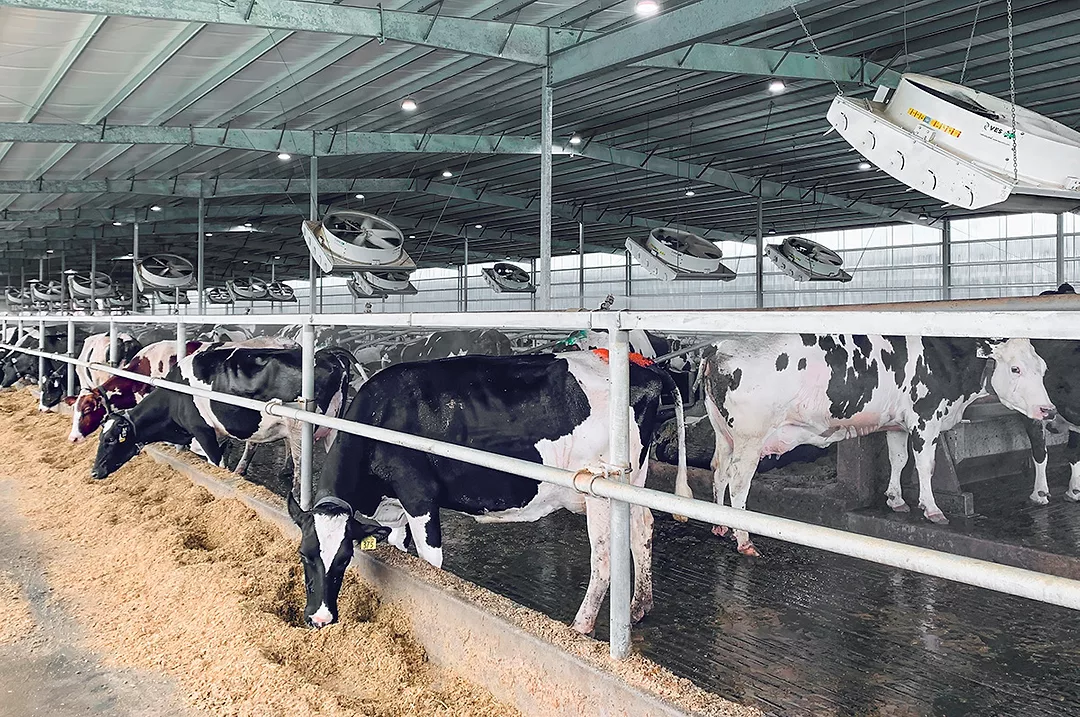
Building a dairy barn that prioritizes cow comfort involves several key aspects to ensure the health, productivity and well-being of the cows. Here are highlights to get you started.

Ventilation, cooling, bedding, lighting, feed and water access are the main foundations of cow comfort. Focusing on these aspects when designing and building your dairy barn will greatly enhance cow comfort, leading to better milk production, reduced health issues and overall improved welfare.
Ventilation
Every barn must have a ventilation strategy to best support the herd. Depending on your ventilation needs and goals, there are multiple strategies to choose from. The following three are the most commonly used in North America.
- Natural ventilation: A barn with open sidewalls and a properly designed ridge opening which allows air to come and go by thermal buoyancy and natural airflow through the building. This airflow removes heat, humidity and noxious gases. As a general rule of thumb for summer ventilation, the sidewall opening should be at least 1 foot high for every 10 feet of barn width. For winter ventilation, there should be 1 inch of opening for every 10 feet of barn width. The ridge should be open 2 inches for every 10 feet of barn width (in every season because the ridge is permanently constructed). Circulation fans are positioned over the beds and feedlane to encourage airflow. The barn is typically oriented east-west to limit the amount of sunlight entering the barn, thus reducing the amount of sunlight heating the bedding, walkways, steel and increasing the ambient temperature of the barn. These barns require lower upfront capital and running costs than other ventilation layouts. They are best suited for moderate climates.
- Cross ventilation: A cross-ventilated barn is a wide barn with usually more than 12 rows. Inlets must be sized appropriately to the exhaust fans so that the facility stays within 0.1 – 0.15 static pressure. Staying within this range of static pressure ensures optimal fan performance, meaning it reduces heat and energy load on the fan. Airflow moves parallel to the cow’s orientation in the stall. Baffles are strategically positioned to increase air speed, and each baffle will add to the static pressure the exhaust fans experience, resulting in less CFM performance per fan. The influence of baffles must be included in the overall ventilation design. However, circulation fans can be substituted for baffles in some barn designs. Positioned on the opposite wall of the inlet are the exhaust fans. They are responsible for pulling the dirty air out of the facility. Barns with this strategy usually require more fans than other layouts, but these barns are usually larger and house a larger herd.
- Tunnel ventilation: A basic tunnel-ventilated barn has inlet curtains, circulation fans and exhaust fans installed on the gable end wall, and occasionally sidewalls, on the opposite end of the inlet curtains. Baffles can exist in tunnel barns but are not recommended anymore because they add static pressure and do not effectively create the targeted airspeed of 5 mph at the bed level. The faster airspeed is created down the feedlane and scrape alley in a tunnel barn, which doesn’t encourage cow comfort and lying behavior.
An advanced tunnel barn is completely enclosed and features inlet fans (commonly referred to as positive pressure or fresh air injection fans), circulation fans and exhaust fans positioned on the gable end wall. In addition, inlet fans are strategically placed along the length of the barn, injecting fresh air into it. The fresh air is then pushed to the herd by circulation fans. Ideally, the fresh air is directed to the cows lying in their beds by louvers attached to the circulation fans. The industry standard for airspeed in the cow bed is 5 mph. In tunnel barns, ventilation fans are run year-round. Utilizing variable-frequency drives (VFDs) to control the fan speeds is recommended, as it saves energy and operating costs. Compared to cross-ventilated barns, tunnel-ventilated barns use fewer fans.
Cooling systems
Mitigating heat stress is vital for any herd to be healthy, productive and comfortable. Combining fans with soaking systems and/or high-pressure fogging systems help to maintain a normal core body temperature of the cow. Aim to keep the herd’s Thermal Heat Index below 70.
Cooling systems are not compatible with every climate or barn strategy. For example, high-pressure fogging in naturally-ventilated barns is not recommended because depending on inconsistent Mother Nature to exhaust the barn is unreliable. We need to control the rate of water being introduced and removed from the facility to avoid creating a sauna-like environment, which is completely opposite of the intended result.
Soaking systems with fans at the feedlanes are one of the most effective methods to cool a cow through evaporative cooling. Soaking the cow all the way to her skin cools the cow, but the evaporation produced by the airflow is what significantly aids in dropping the cow’s body temperature. Evaporative cooling is highly recommended for use in the holding area.
In every area of a barn, the roof must be insulated when the sidewall is less than 18 feet (5.5 meters). Without insulation, a barn experiences condensation, freezing in the winter and radiant heat in the summer. Cooling systems and ventilation systems rely on insulation to help mitigate heat stress in the summer and retain warmth in the winter.
Comfortable bedding
Cows will lie down where it is comfortable, so it is in the farm’s best interest to ensure the bedding is as comfortable as possible. The most common bedding materials include sand, dried recycled manure solids, mattresses and rubber mats with straw. Sand is often considered the gold standard for comfort and hygiene as it reduces pressure points and provides traction. With any material used, ensure bedding is dry and clean to prevent infections like mastitis.
Building the appropriate stall size is also critical to encourage cow comfort. Stalls should be wide and long enough to allow cows to lie down, rise and move comfortably. Physical signs for when a cow is not comfortable in her bed include hair loss over hocks, skin irritation and skin erosion. There are various stall dividers that accommodate movements and indexing.
Feeding and watering facilities
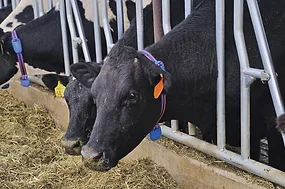
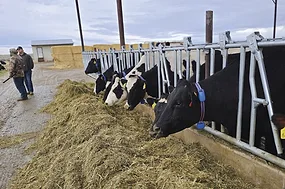
Access and availability of feed and water is an obvious requirement for every barn. Whether you are using a self-lock or just a feed rail, each cow requires at least 24 inches of linear space to eat comfortably. Research shows that providing adequate feeding space reduces aggression and competition, leading to better overall intake and cow comfort.
Remember to install the self-lock tilted out to the feed alley to extend the cow’s reach. The height of the curb the self-locks are mounted on should be between 18 to 20 inches (46 to 51 centimeters) for Holsteins and 15 to 16 inches (38 to 41 centimeters) for Jerseys. The feed curb height for feed rails should be about 21 to 23 inches (53 to 58 centimeters) for Holsteins and 18 to 19 inches (46 to 48 centimeters) for Jerseys.
Fresh water availability is always needed but is especially important during hot summer months. Ensure cows don’t need to travel more than 50 feet to reach water, the water supply rate is at least 6 to 7 gallons (23 to 26.5 liters) per minute and that there are at least two waterers per pen group. Daily cleanings are always a priority to ensure hygiene. Install the waterer at a comfortable height so the cow doesn’t have to strain or perch on a curb to reach the water. A guard rail is also recommended to keep the cows from stepping in the water. If cows step into the waterer, you should inspect your cooling and ventilation settings, as they may need to be increased. To assist a cow’s navigation to the feedlane and waterers, walkways need to be spacious, at least 10 to 12 feet (3 to 3.7 meters) wide.
Lighting
Precise lighting conditions help animals perform their best based on their physiological needs throughout different phases of the year. The modern, animal-centered approach to delivering optimal lighting includes using efficient LED industrial light fixtures to produce light based on a cow’s core retinal sensitivity for 16 hours per day in the back of the barn. Research has shown 16 to 18 hours of light and six to eight hours of darkness support optimal milk production cycles. Research has shown short-day lighting for dry cows is advantageous for transition cow health and milk production.
High bay lights are mostly used in the bedding area, parlor, walkways and wherever ceiling heights exceed 10 feet (3 meters). Low bay lights are utilized in areas where the ceilings are 10 feet (3 meters) or lower. Directing light on the udder is always recommended for use in the parlor so staff can work efficiently and inspect for hygiene. Connecting lights to sensors and an automated control system is recommended to simplify their operation and maximize energy efficiency.