Recent reports confirm the U.S. dairy herd is growing; even heifer inventory is up by 100,000 after years of declining supplies. With more cows has come more milk, and the dog days of summer have done little to curb production as the USDA’s Milk Production report confirmed June milk output was up 2.3% from the year prior.

Additionally, over the last month, component values have begun to realign with global market prices. While this is good news for U.S. dairy exports, it has also caused milk class prices to stumble heading into fall with Class III and Class IV now in the $16.75-$17.50 per hundredweight (cwt) range from August through December. In the Milk Producers Council Weekly Friday Report from the fourth week of July, Sarina Sharp states, “Those prices are dangerously close to most dairy producers’ break-even costs, especially after the other commodity markets foretold a jump in feed expenses and a drop in beef revenues.”
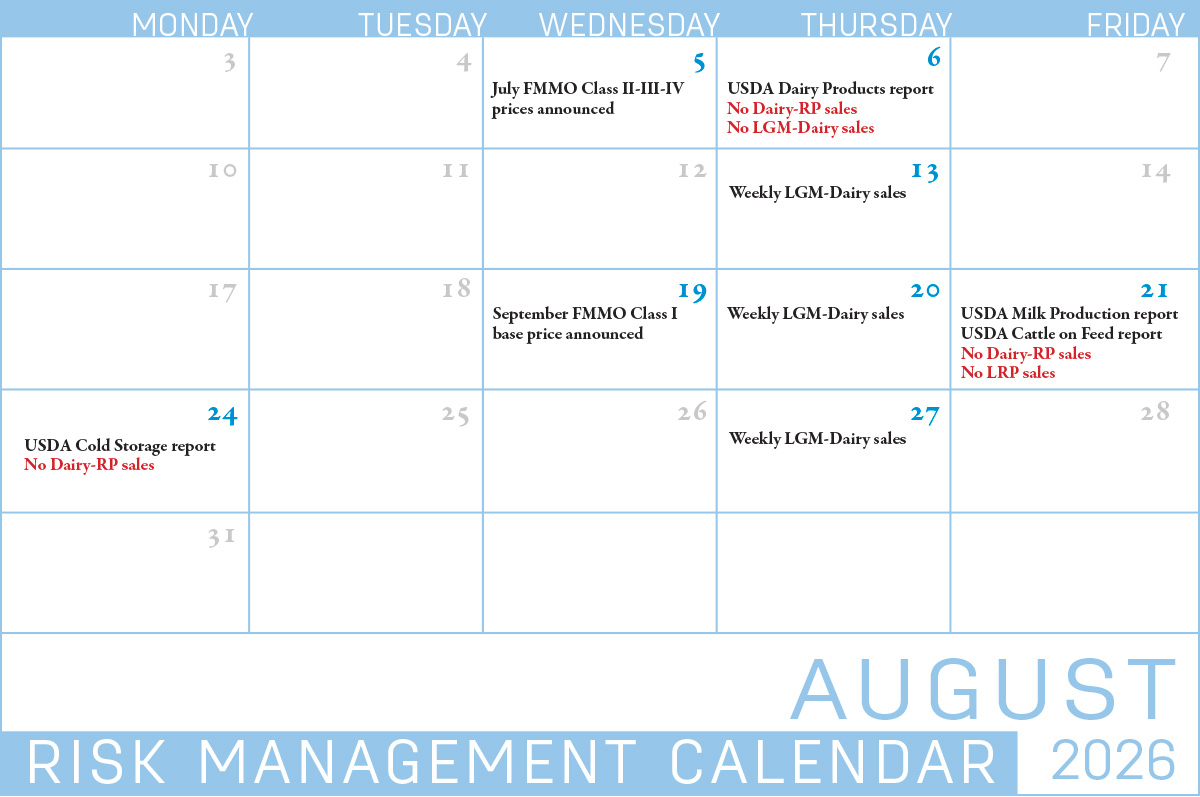
Here's Progressive Dairy’s look at important dates, reports and advice affecting risk management decisions, as well as information that will affect dairy producers in the month ahead.
Dairy Margin Coverage (DMC)
May was another month of a strengthening all-milk price, comparable to that of May 2025, and there was an equally sturdy feed cost. This allowed the DMC margin to rise by a modest 8 cents. At $10.62 per cwt, the margin positioned all enrolled dairy operations $1.12 per cwt above the $9.50 per cwt coverage level and resulted in no indemnity payments for the month. (Read: May DMC margin is realized at $10.62 per cwt)
At the time of this writing, the June margin is anticipated to rise to $11.28 per cwt even as both the all-milk price forecast and feed cost forecast fall. However, it’s the feed cost that takes the bigger hit, with all commodities used in the price formula declining for a predicted feed cost of $9.52 per cwt, nearly $1 less than the feed cost realized in May. The all-milk price, on the other hand, falls only 50 cents to $20.80 per cwt, if the forecasts hold true. The actual June DMC margin will be announced July 31 following the release of the USDA Agricultural Prices report.
As of July 24, market conditions have forecast a DMC margin below $9.50 per cwt for July and are set to remain beneath the indemnity payment threshold for the second half of the year. If conditions hold true, the year will close with an average DMC margin of $9.39 per cwt, as the average all-milk price comes to $19.78 per cwt and the average feed cost at $10.39 per cwt. Despite healthier margins in the second quarter of 2026, how the market is shaking out is a good reminder of the effectiveness of the DMC program as a risk management strategy. (Read about the relevancy of the DMC program in today’s evolving U.S. dairy market.)
Dairy Revenue Protection (Dairy-RP)
Dairy producers managing risk through Dairy-RP are eligible to cover revenue quarterly, up to five nearby quarters. In August, Dairy-RP coverage is available for the fourth quarter of 2026 (October through December) through the fourth quarter of 2027.
The market changes daily and Dairy-RP endorsements must be purchased between the Chicago Mercantile Exchange (CME) market closing and the next CME opening. Dairy-RP is also not available on days when applicable futures contracts move limit-up or limit-down, or on days when CME trading is closed due to holidays. Also, typically Dairy-RP coverage cannot be purchased on days when major USDA dairy reports that could impact markets are released. This includes Milk Production, Cold Storage and Dairy Productions reports (see Calendar).
Livestock Gross Margin for Dairy (LGM-Dairy)
LGM-Dairy provides protection when feed costs rise or milk prices drop, and can be tailored to any size farm. The program uses futures prices for corn, soybean meal and milk to determine the expected gross margin and the actual gross margin. LGM-Dairy is similar to buying both a call option to limit higher feed costs and a put option to set a floor on milk prices.
Coverage for LGM-Dairy can be purchased on expected milk marketings over a rolling 11-month insurance period. So the coverage period during August includes the months of September 2026 through July 2027. Sales periods for the LGM-Dairy program are open on a weekly basis each Thursday except when Milk Production and Cold Storage reports are released on the same day. Sales are also closed on biannual USDA Cattle Inventory report release days.
Livestock Risk Protection (LRP)
The LRP program is a valuable tool for dairy producers as beef-on-dairy and strategic culling decisions are key parts of herd management and business decisions. For dairy producers, LRP coverage is available as LRP-Feeder Cattle (beef-on-dairy calves) and LRP-Fed Cattle (cull cows) with four additional options to select the appropriate coverage, including head count, targeted marketing weight, and coverage length and level. No more than 12,000 head can be covered in a specific coverage endorsement with an annual limit of 25,000 head per farmer, per crop year (July 1 to June 30).
The sales period for LRP coverage is open each afternoon after futures prices are settled and closes the following morning. Similar to Dairy-RP, LRP is not available on days when CME trading is closed due to holidays or when major USDA reports impacting prices are released, namely Cattle on Feed and biannual USDA Cattle Inventory. The USDA Risk Management Agency (RMA) also has the right to close sales at their discretion.
Production and price outlooks
- Based on the latest USDA monthly Livestock Slaughter data, the number of dairy cull cows marketed through U.S. slaughter plants in June was estimated at 208,100. (Read: Larger U.S. dairy herd drives higher June cow culling)
- June U.S. milk production increased from May and was also up about 2.3% from USDA’s estimates a year earlier. (Read: Dairy herd growth pushes June milk production higher)
- USDA’s July World Ag Supply and Demand Estimates (WASDE) report raised 2026 milk production to 236.6 billion pounds on expectations of a larger cow herd and a decrease in milk output per cow. (Read: USDA milk production forecasts edge slightly higher)
- The August Class I base price dropped after July’s price indicated imminent downward pressure as the result of ample milk production but weaker markets for dairy categories like cheese. (Read: Economic Update: August Class I base milk price falls more than $2)
- For the sixth consecutive month, the average Federal Milk Marketing Order (FMMO) uniform milk price climbed from the month prior. (Read: Uniform milk price climbs in most orders, falls in those utilizing Class III)