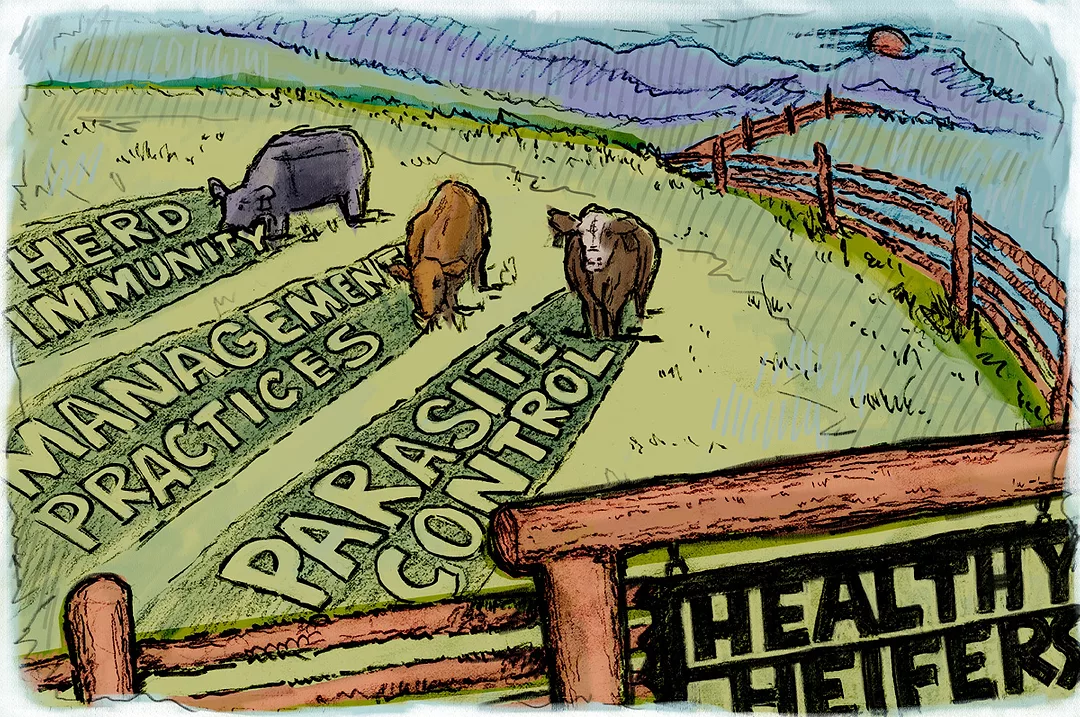
As the beef industry approaches the expansion phase of the cattle cycle, retention of the most productive heifers will be a critical strategy for the most successful herds. Management practices, parasite control and herd immunity are all key components of raising healthy heifers aimed for longevity in your herd.

“When it comes to retention of heifers from your own herd, you have to have the genetics that you're looking for,” says Jacques Fuselier, DVM, Merck Animal Health. “You have to have a trait that you want to have on your operation. And once you have all of that, how you select the heifers you're going to keep as replacements is actually very important.”
Management practices
Mitch Blanding, DVM, Zoetis, emphasizes the importance of maintaining heifers in an appropriate body condition score and managing their nutrition to optimize their reproductive potential.
"Proper management will enable heifers to sustain their pregnancy throughout gestation and calve at a body condition score that helps ensure a successful second breeding,” Blanding says. “First-calf heifers, still in their growth phase, are the most challenging group of animals to successfully breed, and ensuring they are appropriately managed allows them to remain productive in the herd for years to come."
There's a lot of evidence that shows heifers born in the first half of your calving season have more stability in the herd, Fuselier says. Those born in the first half have an age and maturity advantage when it comes to breeding time.
“When you're making your selection on which heifers to keep, it behooves you to keep the heifers born in that first half of the calving season,” Fuselier says. “A lot of people wait until the heifers are about a year old or so before they make their terminal selection of which ones to keep. You're better off if you could start that selection earlier by eliminating the second half of calves born. Then at weaning, you can start to evaluate them for the traits you’re looking for and which ones fit the bill.”
After selecting the heifers you plan to breed, you can work with your veterinarian to do a reproduction tract score around 1 year old. This evaluation is a measurement of the uterus and ovaries, looking for maturity of the reproductive system to make sure they are maturing appropriately, Fuselier says.
In addition to physical measurements, there are genetic indicators that may help in the selection of replacement heifers.
“There are genomic tools available to producers to make more informed selection decisions,” Blanding says. “There are genomic tests designed to help identify those heifers that are going to have the greatest potential for productivity in your herd. This technology allows us to identify traits that may not be immediately obvious to the eye or match what we might be seeing phenotypically.”
Parasite control
When it comes to developing heifers, parasite control is high on the list of priorities.
“Young replacement heifers are still particularly susceptible to the impact of parasites, so prioritizing efficacy in the control of both internal and external parasites is an important consideration,” Blanding says. “It’s important to deworm replacement heifers at weaning and also at pre-breeding to ensure we're limiting the parasite burden and optimizing reproduction.”
Managing both internal and external parasites can have positive impacts on pregnancy rates.
“There are several studies that show the value of deworming heifers and cows related to pregnancy rates and calving weaning success,” Fuselier says. “So parasite control is very important, and there are several methods you can use to monitor parasite load, which a veterinarian can help you with.”
He adds, “If you start trying to zone in on a certain species of internal parasite to control, you're going to end up chasing your tail. It's best to focus on the overall volume of egg shedding to give you an indication of parasite load on the pasture. Most dewormers control multiple species and life cycle stages of parasites.”
Herd immunity
Herd immunity is extremely important when it comes to heifer health.
“Let's make sure we all understand what herd immunity truly is,” Fuselier says. “When we look at an individual, we look at all the systems in that individual. And so, if you're going to vaccinate an individual animal, you're trying to get that individual animal’s immune system prepared for an individual attack. But if you look at a herd as an individual, and each animal that makes up that population is part of that system, the more of those that are individually protected contribute to the whole, providing overall protection. And if you have at least 70 percent of the animals that are immune or have some immune protection toward a certain disease, then that'll help protect the ones that don't have that same protection, whether it’s because they didn't respond to vaccine, or were never vaccinated, or whatever the case would be, the herd immunity is the overlapping protection.”
To create herd immunity, proper vaccinations become extremely important.
“Starting heifers out on a good, solid vaccination program as a calf is very important so they are well protected by the time they get to breeding age to minimize pregnancy loss due to infectious disease,” Fuselier says.
Blanding adds, “From a timing perspective, we like heifers to have at least two doses of a vaccine that provides fetal protection prior to breeding. Subsequently, an annual revaccination prior to breeding offers the highest level of protection against diseases that cause reproductive loss.”
Your veterinarian can help with proper management, parasite control protocols and building herd immunity to create long-lasting, healthy heifers.
“I would be remiss if I didn't encourage producers to work closely with their veterinarian when developing herd health protocols and making retention and breeding decisions,” Blanding says.
Fuselier adds, “I think heifer development is very often overlooked, and it's a critical thing. So, if we can follow these basic pointers, you'll be ahead. The other thing is to not forget about the bulls. Have a game plan in mind for those first-calvers. Match the bulls to the heifers for calving ease purposes. We really need to give them the best opportunity that we can. You should always work with your veterinarian to make sure you have everything you need and to come up with a game plan that best fits your operation.”