Ranching is in my blood.
In 1958, my grandfather, Arnold Wienk, already a successful rancher, started Wienk Charolais when he purchased his first Charolais bull, sight unseen. He had seen the benefits of crossbreeding and wanted to cross the Charolais bull on his Hereford cattle.
Today, together with my parents, brothers, wife and kids, I run 450 head of registered Charolais on the rolling plains of eastern South Dakota. On our seedstock operation, we provide purebred Charolais bulls to other seedstock operations and commercial cattlemen with the goal of helping them add profit and pounds to their own operations. We have annual bull and, occasionally, female sales and a bull leasing program. With more than 60 years under our belts raising seedstock, we’re in it for the long haul.
Like any other ranching operation, over those 60 years we have faced weather challenges, economic cycles and other obstacles to keeping our ranch operational, successful and growing. And, like nearly every ranch, we want to make sure our operation is one that is not just here for the next generation, but better than it was when we started. With three generations working on the ranch now, we have our work cut out for us.
That’s why, in addition to herd genetics and efficiency, we pay close attention to conservation and the productivity of our land, too.
My dad, Jeff, was the first in our family to really take a hard look at land conservation, implementing practices that helped us improve our soil. This allowed nature, rather than equipment, to do some of the work for us, while also benefiting our cattle operation.
Wanting something that might improve our soils and add an additional feed source for our cattle, we began experimenting with cover crops. Traditionally, we raised corn for silage, but the South Dakota growing season proved too short to follow corn with a cover crop. We ultimately decided to transition some of our acres away from corn silage and began planting oats and peas. The shorter growing season allowed us to follow with turnips, radishes or a true cover crop mixture that we could graze in the fall.
The cover crops also allow us some flexibility if we know we’re going to be short on hay in the fall. In that case, we follow up with hay millet because we can either graze it or can hay it for the winter.
And, as we hoped, the added benefit didn’t just come in the form of an additional feed source for the cattle.
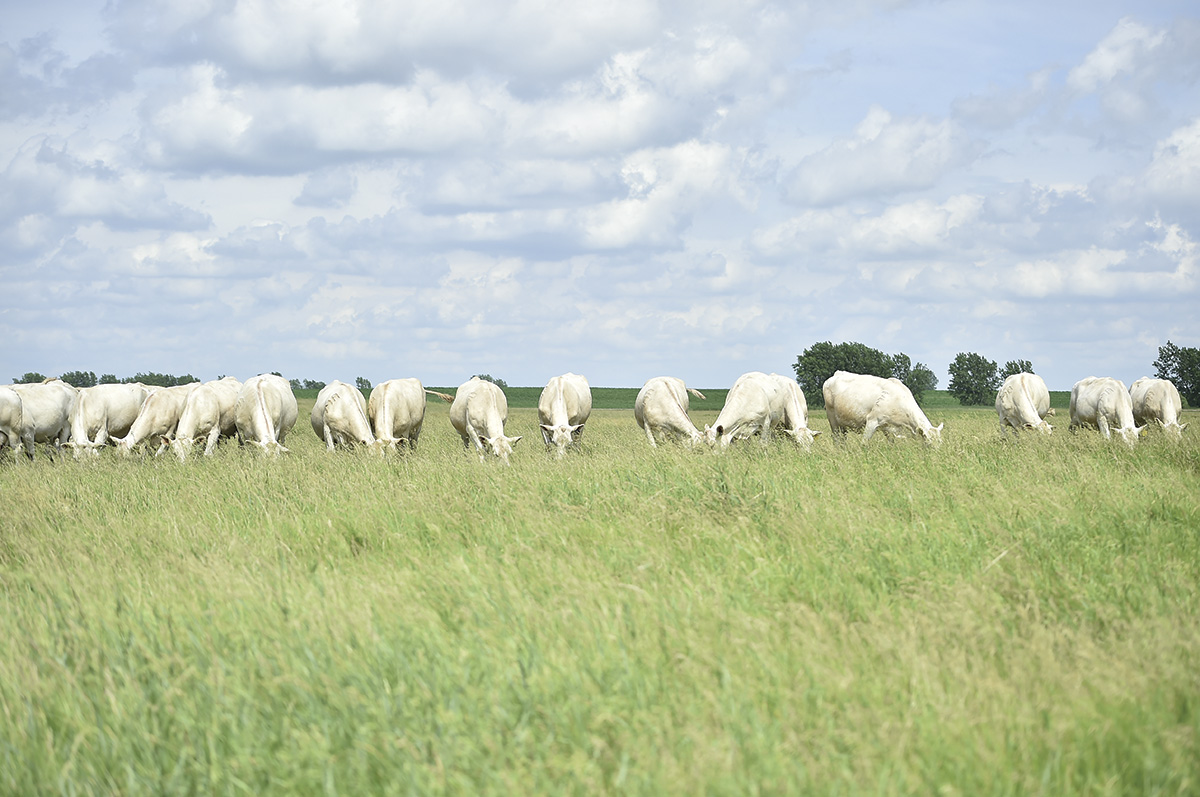
Planting cover crops not only provides more forage for cattle, it also leaves healthier soil for crops and pasture in future years. Image courtesy of LC Marketing.
Turnips and radishes grow so deep, they’re almost a form of tillage without having to use equipment. In those fields where we’re planting cover crops, we’ve seen less soil compaction, and the lower-lying areas are getting more production because the root systems of the turnips and radishes have helped increase soil quality.
What’s more, turnips and radishes rot over the winter and, because we’ve reduced our tillage, they become a source of nutrients and organic matter on top of the soil. The organic matter holds moisture in the soil, which has been an incredible benefit in drier springs.
Cover crops and reduced tillage, combined with rotational grazing to benefit our cows and pastures, became standard conservation practices on our ranch, helping us care for the land and our cows more sustainably and efficiently.
The changes meant we were doing a better job of taking care of the ground – letting nature do what it does best – and working through the life cycle of the cows while also keeping equipment costs lower. And while the conservation practices we put in place have definitely been beneficial, there’s always room for improvement.
As conservation and sustainability programs have become commonplace in recent years, and companies throughout the beef supply chain have been looking for additional ways to deliver on sustainability promises, we saw another opportunity to improve the efficiency of our operation.
Our contacts in the beef industry came through when they introduced us to AgSpire, a company that offers free, incentive-based programs centered on helping ranchers increase efficiency and ensure longevity.
Knowing that we were already committed to conservation practices on our ranch, the AgSpire team tailored aspects of their programs to our individual conservation practices, needs and operational goals. They helped us gather the necessary data and get the proper documentation in place. They walked us through it and helped us get the most benefit out of the program, allowing my focus to stay on the ranch.
Through our program, we’ve been able to improve and monetize conservation practices already in place on our ranch. And while the productivity benefits of reduced tillage, cover crops and rotational grazing have been most beneficial, we’ve also been able to add income from the program’s incentive payments for cover crops and cattle sold into the beef market on years we’ve seeded new cover crops or forage acres.
Ranching isn’t easy, but the rewards are many. Using conservation practices to protect the soil, feed the cattle and add income for the ranch puts things in a better position for the next generation to take over the operation and run with it. That’s just icing on the cake.