Nobody likes dealing with sick cows. Whether it is a respiratory disease, a uterine infection, HPAI or pinkeye, selecting a treatment protocol leads to frustration and lost profit. At some point, the questions get asked, “Should we be vaccinating for that?” or “Aren’t we vaccinating for that?” or even worse, the statement “I don’t think the vaccine is working.”

The basis for the questions is realizing that vaccines help to stimulate the cow’s immune system, producing antibodies that offer protection against disease-causing pathogens. An ounce of prevention, after all, is worth a pound of cure. While antibodies are important, they are a small part of the immune system. Keeping animals healthy requires the entire immune system to be functioning. And if vaccines don’t seem to be working, we need to figure out why.
The immune system
A body’s immune system is its defense against invaders. Equipped with barriers and patrolling guards, and with a special forces unit that is capable of remembering old invasions, the immune system could compete with any nation’s police force and military. Broken down into separate segments, the innate immune system behaves much like the police and national guard. The skin, pH and mucous are all physical barriers that prevent pathogens from entry into the body. Should a pathogen pass through the physical barriers, phagocytic cells patrolling through the bloodstream recognize the pathogen and immediately work to suppress and destroy the invasion. Inflammatory cells send out a siren to the body calling for reinforcements. While phagocytic cells are constantly being made and released from the bone marrow, this inflammatory response will cause an increase in the number of cells released, even if they are still not fully developed. Whether viral or bacterial, the body’s innate immune system behaves the same with no specificity.
As the attack to clear the infection continues, certain cells will carry the pathogen over to the second arm of the immune system, which forms the adaptive immunity. The adaptive immune system can be thought of as more like the special forces. T-cells and B-cells combat against specific antigens that a pathogen has. The process of recruiting and developing these special forces for specific invaders takes time, which is the reason why vaccines must be given prior to when there is risk. Mature T-cells will begin seeking out and destroying any cell in the body that is harboring the infection. This cell-mediated response prevents pathogens, especially viruses, from utilizing the body’s own cells against it. B-cells form antibodies. Antibodies are then capable of attaching to the pathogen, neutralizing them from being able to bind to the host cells, opsonization, marking them for phagocytic cells to destroy them or utilizing complement fixation to destroy the pathogen. After the body has faced an invasion, the adaptive immune system maintains a memory to quickly destroy an invasion from that pathogen again.
Trace minerals in the immune system
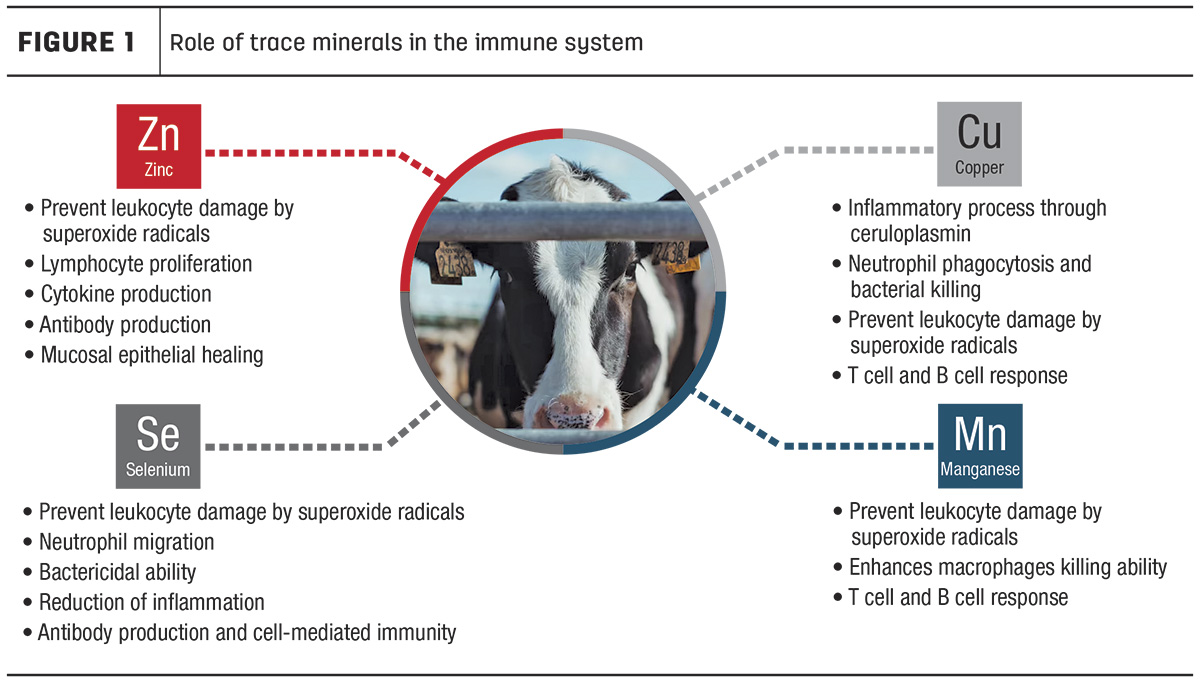
The vast number of cells and responsibilities of the immune system require substantial amounts of nutrients to remain effective. Beyond the energy and protein used, many trace minerals are used to catalyze both the innate and adaptive immune system (Figure 1). The physical barriers such as skin and mucous contain large quantities of zinc, manganese and copper. Selenium is needed to move white blood cells such as neutrophils from the bloodstream into the tissue where the infection is located. Phagocytosis, or ingesting the pathogens by the white blood cells, requires copper. Killing the pathogens once ingested by the cell requires the release of an oxidizing agent, meaning that trace mineral-dependent antioxidants are required to protect the blood cells from self-inflicting damage. Additionally, the production and activation of both T-cells and B-cells require large quantities of zinc. Insufficient trace mineral supplementation can have severe negative impacts on the functionality of the immune system.
Trace mineral supplementation
Trace minerals are typically added into the ration to supplement the cows’ requirements. There are times when oral supplementation may not be able to keep up with trace mineral demands, and additional supplementation should be added. Research has shown that parturition can decrease the trace mineral status of a cow by approximately 30%. This reduction of trace mineral status could negatively affect the cow’s ability to fend off infectious disease, especially during the transition period.
At times such as this, rapid replenishment is required. Injecting trace minerals, while maintaining animals on oral minerals, is the most effective way of rapidly replenishing trace minerals in the cow’s body. In one university study, lactating cows that received an injectable trace mineral were shown to have improvement in phagocytosis and oxidative burst in neutrophils in comparison to control cows. Additionally, numerous studies have shown that when injectable trace minerals are included at the same time as a vaccine, animals are able to produce more antibodies and produce them more quickly.
Conclusion
While vaccines contribute greatly to a cow’s immune system, there are other aspects of the immune system that should not be forgotten. Ensuring that essential elements such as trace minerals are provided allows for the cow’s entire immune system to be ready to fight off an invasion, not just relying on the special forces.