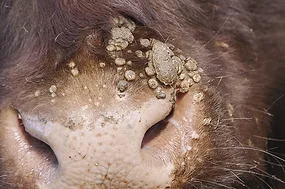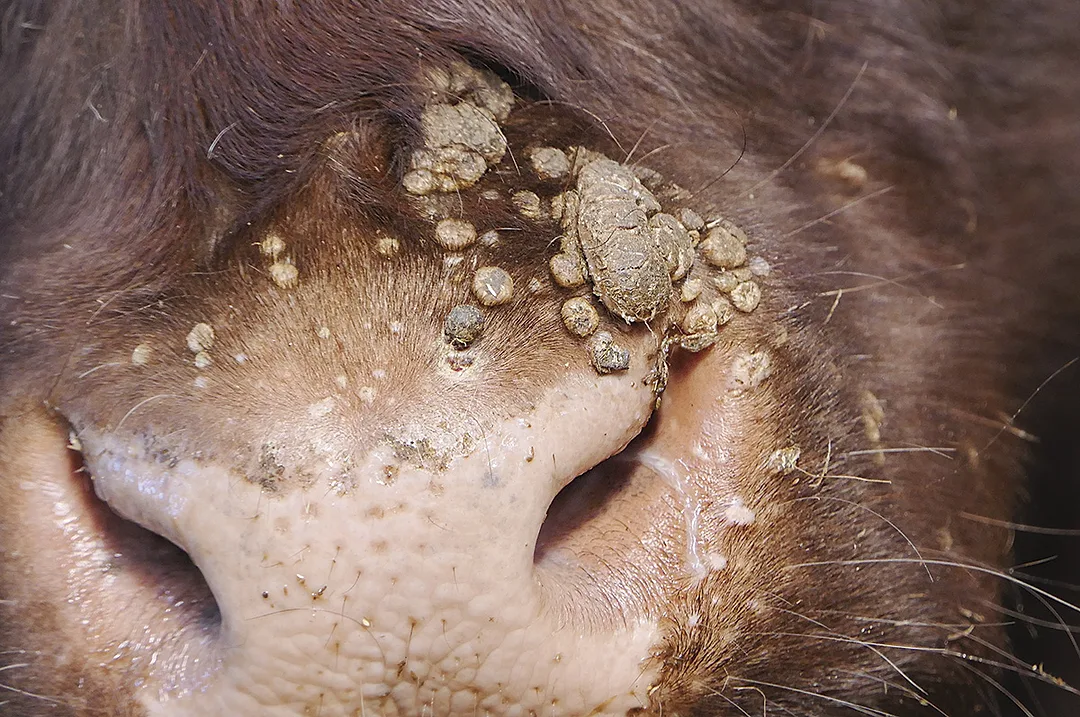
Bovine fibropapillomas or warts are a common condition of cattle caused by a bovine papillomavirus (BPV). Young cattle are more frequently affected, due to their naïve immune systems and increased exposure in group housing settings. Warts are benign growths that appear commonly on the head, neck, shoulders, teats or penis. While most warts do not cause any harm and usually regress on their own, warts can raise concerns for cattle producers due to their negative impact on animal health, breeding performance and market value.

Etiology and transmission
Bovine papillomaviruses are species-specific viruses that infect skin tissues. BPVs do not infect humans, therefore there is no human risk associated with handling affected cattle. Several BPV types have been identified, each with a tendency to affect particular locations on the animal. For example, BPV type 1 viruses are commonly associated with warts of the penis, teats and udder, while BPV types 2 and 3 are associated more with skin lesions.
The virus gains entry through abrasions or injuries of the skin. Transmission occurs primarily through direct contact, such as bulls mounting on an infected animal or rubbing and scratching on contaminated surfaces such as fencing or with the use of contaminated milking equipment.
Clinical presentation
Bovine warts can vary widely in appearance. Warts can be small, smooth and flat, or they may be large, cauliflower-like masses attached by a stalk or broad-based. Common locations include the head, neck, brisket, shoulders or penis. In dairy cattle, the teats and udder can be affected, sometimes interfering with milking. In show animals, warts can also affect the cattle’s appearance and health status. It is common for cattle to be rejected for admission to a show for even the smallest of warts, even if they were inadvertently issued a health certificate by a veterinarian.
Penile and preputial warts
Warts can develop on the penis and inner lining of the prepuce (sheath); these lesions may appear as small clusters of rough nodules. Large proliferative masses can occur in severe cases. Penile warts are usually identified at the time of the breeding soundness exam; this reinforces the importance of visualizing the penis during semen collection. Penile warts are most often observed in young bulls, particularly those under 2 years old. Young bulls have a naïve immune system with little to no natural immunity and they exhibit mounting behavior when in group housing; both of these factors contribute to their susceptibility to penile warts. Penile warts often develop in several bulls from the same production group, with no visible lesions being observed on other parts of the body.
While penile warts are typically benign, their location makes them clinically significant. Penile and preputial warts can interfere with normal breeding behavior and negatively impact marketing. Large or numerous penile warts may physically impede breeding by causing trauma and pain. Damaged warts may become infected, compounding the inflammation and pain, which can reduce a bull’s willingness to breed. For natural service systems relying heavily on a small number of bulls, the economic impact can be substantial due to decreased conception rates and extended calving intervals.
A bull with penile or preputial warts should never pass a breeding soundness examination. An infected bull serves as a vector for the virus as semen collected from an infected individual can transmit the papilloma virus to other animals.
Diagnosis and immunity
Diagnosis of warts is generally based on clinical appearance and location. In atypical or severe cases, further diagnostics may include biopsy and histopathology to confirm the diagnosis and to rule out other skin conditions such as squamous cell carcinoma.
One of the defining characteristics of bovine warts is their tendency to regress spontaneously. This typically occurs within 1 to 6 months as the animal develops an immune response against the virus. After regression, cattle often develop immunity to the specific BPV type, reducing the likelihood of recurrence. Complete immunity may not occur across all BPV strains.
Treatment options
In many cases, treatment is unnecessary due to the self-limiting nature of the condition. However, intervention may be warranted when warts interfere with vision, milking, breeding or if the warts are large or numerous. Common treatment options include removal of individual warts with scissors or a scalpel, or ligation by tying off the base of pedunculated warts which cut off blood supply, causing them to become necrotic and fall off. Freezing and cryotherapy with liquid nitrogen is also a viable option. Caustic agents or antiviral preparations are sometimes used, though their effectiveness is questionable. Vaccination of an animal with visible warts is not very effective as a treatment.
Warts prevention and control
Preventing the spread of bovine warts involves good management and biosecurity practices. Animals should be isolated when feasible, especially in youngstock groups. Avoid shared grooming tools between infected and uninfected cattle. Ear warts are common and easily transmitted with tattoo instruments, so it is critical to disinfect equipment between each animal.
Commercially available whole-cell vaccines often have limited availability and may be less effective than autogenous preparations due to strain differences. The recommended 10- to 15-milliliter dose volume of commercial vaccines requires two separate injections in order to be compliant with Beef Quality Assurance guidelines. Recently, platform vaccines, also known as prescription vaccines, have become available and may offer a better option than either the commercial or autogenous vaccines that are available.