On May 11, the USDA announced that it will close U.S. ports of entry along the southern border, effective immediately, to imports of live cattle, horses and bison due to the continued and rapid northward spread of New World screwworm (NWS) in Mexico. Recently, NWS was detected in remote farms with minimal cattle movement as far north as Oaxaca and Veracruz, about 700 miles away from the U.S. border. This import suspension will persist on a month-by-month basis until a significant window of containment is achieved. Forecasts in this report reflect this restriction, and in the absence of an official timeline for achieving containment of NWS, these restrictions are assumed to remain in place indefinitely. Subsequent forecasts will reflect any official policy changes when they occur.
2026 beef production forecast to drop 5%
The outlook for beef production in 2026 is forecast at 25.14 billion pounds, a 5% decline from 2025. It would mark the fourth consecutive year of lower production following the record volume set in 2022. A smaller expected calf crop in 2025, more heifers retained for breeding and fewer live cattle imports will contribute to fewer calves placed in feedlots in late 2025 and early 2026. Fewer placements during this period will limit marketings for slaughter in 2026.
It is expected that cattle weights will plateau next year after the feedlot sector notched significant weight gains in fed steers and steers over the last couple of years. As a result, this will not offset the decline in slaughter as it has in previous years when weights trended higher during periods of year-over-year lower slaughter. This is likely due to feedlots being limited in their ability to extend the time on feed beyond the advances made in recent years. Figure 1 shows that production is mainly driven by cattle slaughter because weights typically change only modestly from one year to the next. Cattle weights were relatively stable from 2015-23, but average carcass weights are anticipated to jump by about 6% from 2023-25.
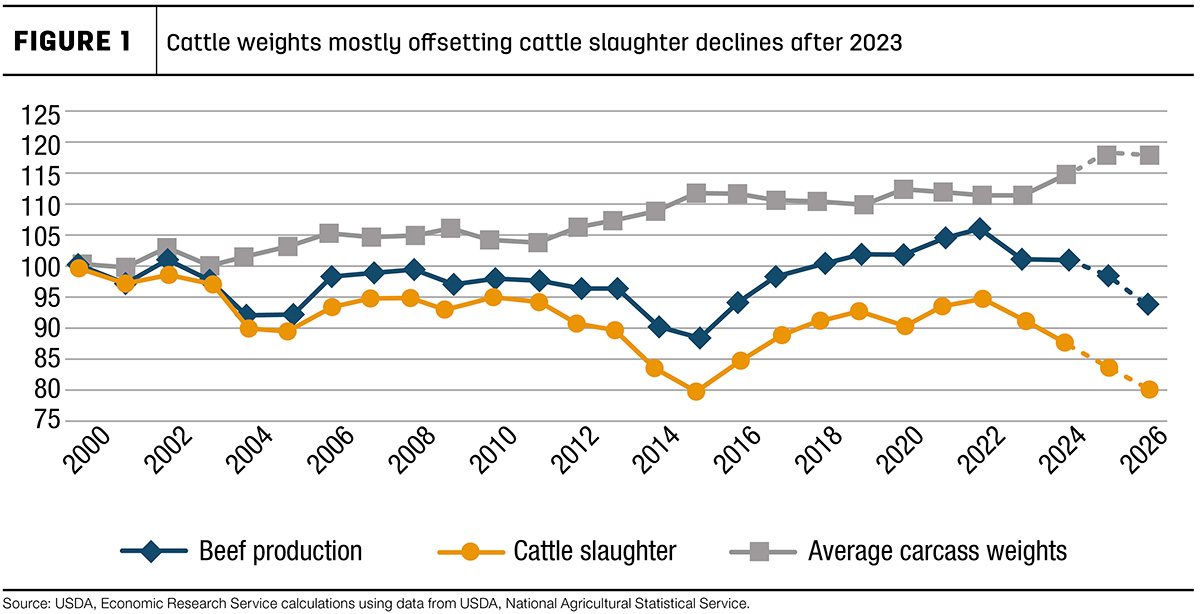
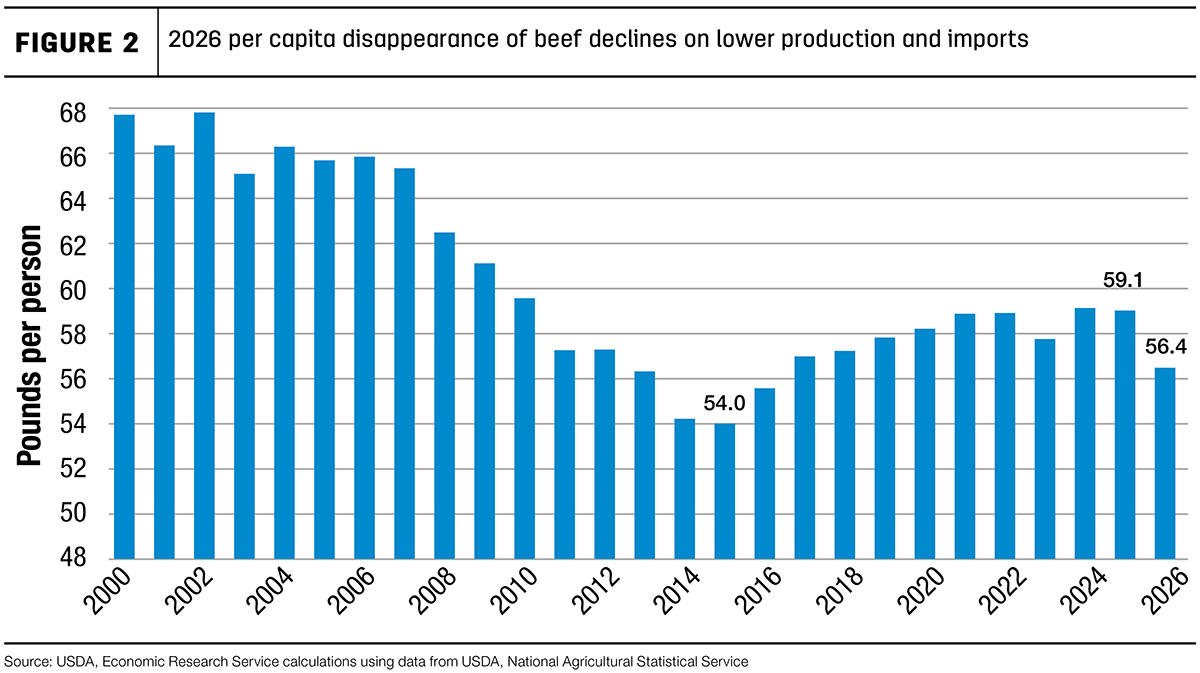
Figure 2 shows per capita disappearance on a retail weight basis from 2000-26. The disappearance of beef on the domestic market is calculated as the volume of production that remains for domestic use, including grocery stores and restaurants, after adding net trade and changes in cold storage volumes. However, domestic disappearance also includes beef that is used for non-human consumption, such as pet food and food waste. With anticipated production declines in 2026, exports are forecast to drop to the lowest level since 2015, to which domestic disappearance will be partially offset by relatively large beef imports, second only to the record import forecast for 2025. As a result, per capita disappearance in 2026 is forecast at 56.4 pounds, a 4.6% decline year over year.
2025 beef production lowered on slower pace of marketings
With the immediate suspension of cattle imports from Mexico, it is expected that feedlots, particularly in Texas and the Southwest, will continue to keep cattle on feed longer than in the past to prevent having underutilized feeding pens and increase the value of animals by continuing to feed calves to heavier weights. As a result, this will slow the pace of marketings moving forward more than previously anticipated. In addition, this will likely support elevated carcass weights for fed steers and heifers.
The latest Cattle on Feed report, published by the USDA National Agricultural Statistics Service (NASS), showed the April 1 feedlot inventory at 11.638 million head, almost 2% below the 11.826 million head in the same month last year. Feedlot net placements in March were more than 5% higher year over year at 1.786 million head. Following a very slow pace of marketings in February, marketings in March were 1.725 million head, up about 1% year over year. Despite stronger year-over-year marketings in March, the number of cattle on feed over 150 days on April 1 rose 4% from year-ago levels. The percentage of cattle on feed over 150 days and overall number of head is at the highest level since June 2020, when packing capacity was severely diminished following the onset of the coronavirus (COVID-19) pandemic.
Currently, feedlots appear willing to add weight to cattle while awaiting higher bids from packers. To the extent that the pace of marketings slows through the rest of the year, the outlook for 2025 beef production is lowered by 277 million pounds to 26.423 billion pounds, a 2% decline from last year.
Cattle prices expected to reach new highs in 2026
Cattle prices in 2026 are expected to be modestly higher than the record set in 2025. Further tightening of cattle supplies available for placement in feedlots in 2025 and into early 2026 is anticipated to bolster prices next year. The forecast for fed steer prices in the 5-area marketing region is $222.75 per hundredweight (cwt), a year-over-year increase of 4%. The 2026 forecast for feeder steers weighing 750 to 800 pounds at the Oklahoma City National Stockyards is $306.25 per cwt, an increase of 3% from 2025. Lastly, cull cow prices in 2025 are forecast at $145 per cwt, a year-over-year increase of 5%. The increase is based on the slower pace of cow slaughter this year and the assumption that relatively higher returns for beef and dairy cattle producers are expected to spur retention of breeding animals.
2025 cattle prices raised substantially from last month
The April average price for fed steers in the 5-area marketing region was $213.80 per cwt, about $30 above last year. In the first week of May, prices averaged $220.97 per cwt, more than $35 above the same week last year. Based on recent price data and feedlots slowing the pace of marketings, the 2025 price forecast is raised $9 from last month, with the annual price projected at $214.51 per cwt, 15% higher than in 2024.
U.S. demand for feeder calves has shown significant strength this spring and will likely continue to do so without Mexican feeder calves in the market. In April, the weighted-average price for feeder steers between 750 to 800 pounds at the Oklahoma City National Stockyards was recorded at $298.22 per cwt, about $44 above April 2024. The feeder steer price reported on May 5 reached $311.50 per cwt, over $56 above the same week last year. Based on recent price data, assumed adequate forage supplies and the suspension of feeder cattle from Mexico, the second-quarter forecast is raised by $30 to $310 per cwt, and the third and fourth quarters are raised by $20 to $302 and $306 per cwt, respectively. The 2025 annual feeder steer price is forecast at $298.53 per cwt, a 15% increase from 2024.
Trade uncertainty in March likely led to surge in beef imports
U.S. beef imports in March were the third-highest monthly import on record, behind January 2024 and January 2025. This surge was likely motivated by trade uncertainty preceding the tariff announcements in April. March imports totaled 502 million pounds, bringing the first-quarter total to 1.482 billion pounds. First-quarter imports from nearly every major beef supplier were higher year over year, with the largest increases coming from Brazil and Australia. Imports from Canada were more than 8% lower year over year, with its share of year-to-date imports falling to 17%, compared to 23% in 2024.
According to data from the Trade Data Monitor, Australia, New Zealand and Brazil all reported month-over-month increases in shipments of beef heading for the U.S. in March. Thus, with the lag in transit time, April is expected to be another strong month for U.S. beef imports.
Based on this expected strong pace of imports to start the second quarter, the beef import forecast for the quarter is raised 160 million pounds to 1.25 billion. It is expected that some of this product would have been sent later in the year but was shifted forward; therefore, the forecasts for the third and fourth quarters are lowered 10 and 60 million pounds to 1.2 and 1.14 billion pounds, respectively.
U.S. beef exports in March held relatively strong, coming in at 256 million pounds for a first-quarter total of 713 million pounds. March exports to Taiwan were quite strong, while exports to Mexico and Japan were also up slightly. Exports to China in March rebounded from February. However, as there has been no movement to recertify U.S. beef establishments for export to China, export sales reports have fallen off in April and May. The beef export forecast for the second quarter is unchanged at 675 million pounds. The third and fourth quarters are lowered slightly to 635 million and 640 million pounds, respectively, for an annual total of 2.663 billion.
U.S. beef trade forecasts for 2026
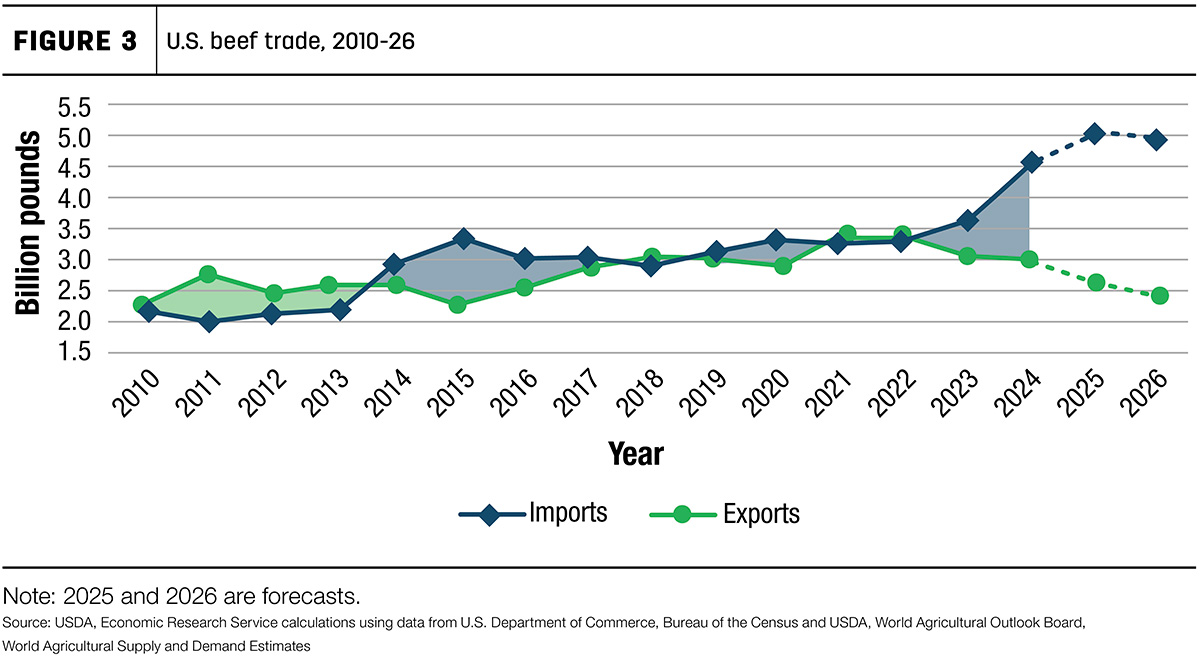
The beef trade deficit is expected to remain wide in 2025 and 2026 as lower production limits exportable supplies and stimulates imports. Figure 3 shows the beef trade balance from 2010-26. With U.S. beef production expected to fall about 5% in 2026, annual exports are forecast at 2.495 billion pounds, representing a 6% decrease year over year. As a percent of production, 2026 exports would be just under 10%. In 2025, exports as a percent of production are forecast just over 10%, while the average from 2020-24 was around 12%. The combination of fewer supplies available to export, higher beef prices in the U.S. and sustained competition from Oceania will continue to create challenges for the expansion of U.S. beef exports.
Beef imports in 2026 are expected to fall slightly, due more to global supply constraints than demand for beef in the U.S. Cow slaughter is expected to continue falling in 2026, sustaining the need for imported lean beef trim to mix with fat trimmings from domestic slaughter. However, global supplies are not expected to expand substantially in 2026, limiting the potential for further year-over-year growth. Additionally, tariffs, including those associated with tariff-rate quotas (TRQs), will constrain beef imports to some degree. Therefore, the annual beef import forecast is 4.975 billion pounds, which would be a slight decrease year over year. Imports are expected to be front-loaded in the first quarter as countries rush to fill the TRQ when it resets in January.