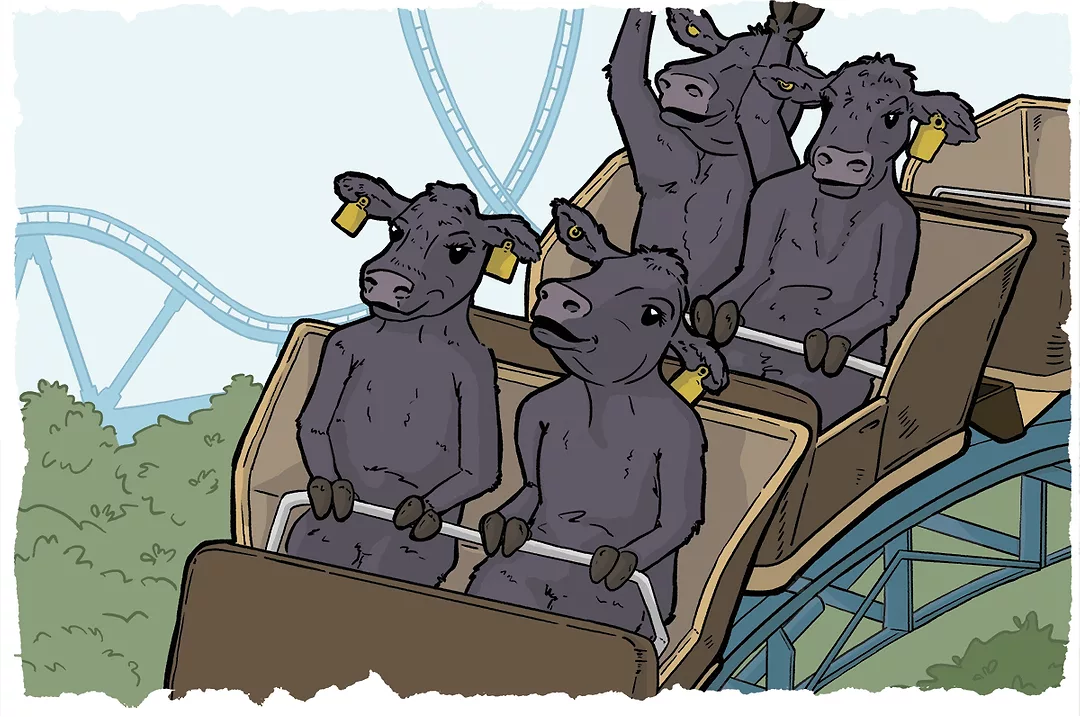
For the first time in years, you felt that you could take the family on vacation this summer. It seemed like a fun idea at the time when you bought the tickets to the amusement park. Standing in line, listening to the screams and seeing the cars go flying by on the roller coaster have you second-guessing life’s decisions. Just keep reminding yourself that it will all be over in a few minutes.

While we intentionally put ourselves on roller coasters, cattle experience a roller coaster themselves, unintentionally, with essential trace minerals. Just like we erroneously thought it was a good idea to go to the amusement park, we often think that as long as we have a mineral available, the cow’s mineral status is set. The natural events of a cow’s life set up a roller coaster for the trace minerals that, if we aren’t prepared, can be more costly than the trip to the amusement park.
Starting high and falling fast
Trace mineral levels in milk are low. Since a calf still needs to have trace minerals available for physiologic needs, the cow will transfer trace minerals via the umbilical vein in utero. This allows the calf to be born with trace minerals, such as selenium, to be two to five times greater in the liver than the calf’s dam and upward of 20 times greater for copper. As soon as the calf is born, the trace mineral levels start to fall. Being exposed to pathogens – which stimulate the immune system and activate the thyroid hormone to utilize brown fat for thermoregulation and growth – all cause the trace mineral levels in the calf’s liver to fall. By the time branding rolls around when the calf is 2 months old, the trace mineral levels have already dropped to about 25% of what they were at birth. Inconsistent intakes and poor palatability may limit the minerals that a calf consumes through weaning time, resulting in many calves being deficient by preconditioning and weaning time. One observational study reported that more than 90% of calves submitted to a diagnostic lab with summer pneumonia were deficient in selenium and/or copper.
Cows also experience a sudden drop in mineral status post-calving. The same process that allows the calf to be born with such high mineral levels is the exact cause of the sudden drop in cows. In order to supply adequate levels of minerals to the calf, a cow’s mineral status will drop by over 30%. Those same minerals needed to keep the calf alive are also the ones that the cow needs for her reproductive system to function. Just like a roller coaster has a slow climb back to the top, increasing a cow’s mineral status also takes time. Consumption of organic trace minerals at over 100% of recommended levels will still require approximately four weeks to get back to normal levels; inorganic minerals may require 50% additional time. Summer heat, vaccination and trucking all cause additional drops in trace mineral status, but none as dramatic as calving. Since these drops are less dramatic, consistent intakes allow the cow to finally get back to the top.

Why the slow climb?
Oral trace mineral supplementation is necessary to allow the cow to climb back to adequate levels. But as mentioned above, an oral program is a slow climb due to four major obstacles.
First, the cow must be able to consume the mineral. Trace mineral consumption is driven by palatability and accessibility. White salt is the only mineral that a cow is capable of regulating their intake, which allows consumption of trace minerals to frequently be controlled by the inclusion of white salt. Putting plain white salt out in addition to trace minerals may pull cows away from the trace minerals and simply to the white salt, further delaying the recovery of trace mineral status. Next is absorption of the trace mineral into the bloodstream. As a rule, trace minerals have very poor absorption. Less than 1% of consumed manganese gets absorbed and only about 5% of copper. Feeding organic forms of these minerals can increase the absorption rate. A 30% increase in absorption typically seen with many organic minerals may still only lead to 6.5% of the copper being absorbed. Much of the poor absorption is caused by the third obstacle: antagonism. Mineral interactions in the rumen as well as competition for transporters in the small intestine may further suppress the absorption of many trace minerals. As a result, many of the trace minerals consumed by the cow may end up being excreted in the feces, our final obstacle.
The need for speed!
Just like the thrill of the roller coaster is associated with its speed, there are times when we want mineral levels to climb as fast as some of the drops. Cows can’t be waiting in line for their trace minerals to catch up when we are vaccinating or breeding cows. The minerals have to be available at that time, or we run the risk of not getting the response we want out of the vaccines, or for cows to breed up later, or even worse, fail to breed at all. Because of the hurdles that oral minerals face, other routes of administration become necessary to find the desired speed. University studies have shown that injectable trace minerals can increase blood levels in eight to 10 hours. These blood levels return to normal within 24 hours as the mineral has been stored in the liver, causing liver levels to increase. By implementing injectable trace minerals at times when we know a big drop-off is coming, we can allow the cow the ability to store extra minerals before the event, or recover much more quickly after the event than what oral supplements are capable of. The speed of the injectable allows the cows to bypass the wait, allowing us to give the cow the minerals exactly when she needs them and maintain her status through oral supplement.
This summer, let’s help our cows get through the mineral roller coaster.