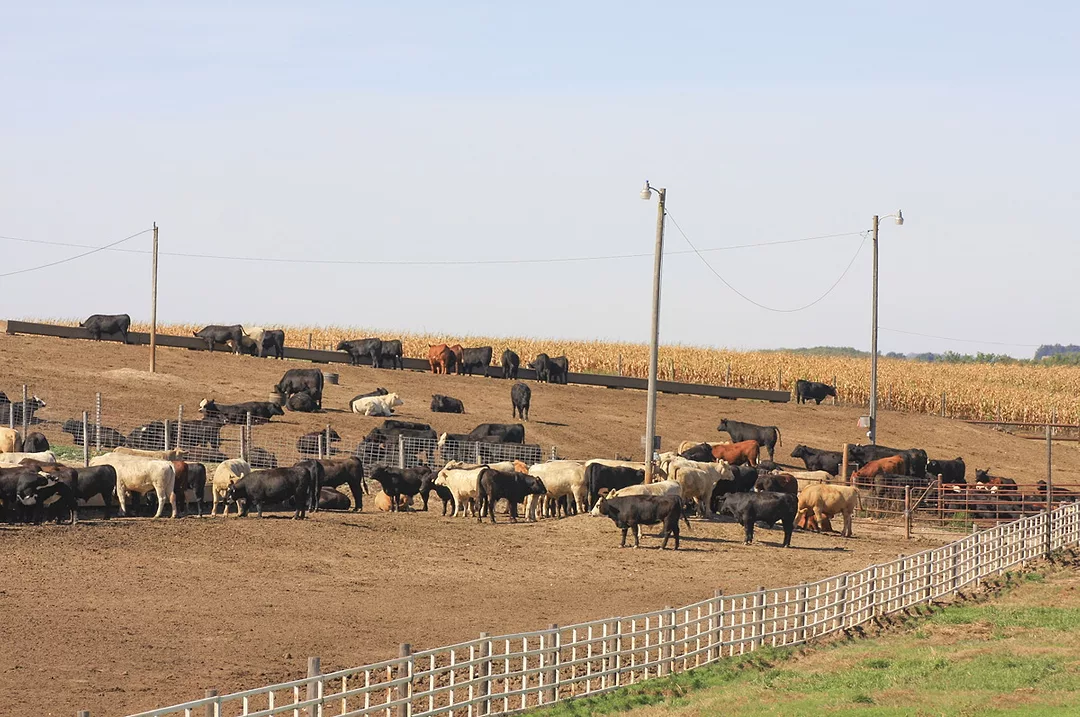
Typically, feeder cattle concentrations have shifted north from Kansas and Texas into states such as Iowa and Nebraska in the summer months; however, the industry has seen new movement beginning earlier this year.

The USDA’s Cattle on Feed reports indicated an 18% decrease in U.S. placements from February to May, with the June report maintaining this pattern. Southern states have held long-term dominance of the feeder cattle industry, but factors such as feed economics, climate, herd dynamics, high cattle prices and packing infrastructure are driving cattle into Northern feedlots. “This is part of a multidecade adjustment,” says Dr. Glynn Tonsor, a livestock economist at Kansas State University. “Shifts in where processing facilities are, where water availability is a concern and access to evolving feedstuffs all have a role here.” The result: a geographic shift that may permanently alter the feedlot industry.
From February to May 2025, USDA Cattle on Feed reports showed a clear regional difference in feeder cattle placements. In February, placements fell sharply nationwide, down 18% from last year, driven largely by steep drops in Texas (-27% at 260,000 head) and Kansas (-22% at 360,000 head). Although national placements recovered somewhat at a 5% increase in March, Southern states continued to struggle, with Texas down 14% at 360,000 head and Kansas down 5% at 440,000 head compared to last year.
April’s national placements slipped again, down 3%, with Texas dropping 6.1% with 310,000 head, though Kansas posted a small gain of 2.7% at 87,000 head. In May, the trend continued: Placements were down 3% nationally, with Texas and Kansas declining 5% and 4% at 295,000 and 360,000 head, respectively.
In contrast, Northern states showed strength. Nebraska and Iowa saw increases of 4% and 7% at 480,000 and 156,000 head, respectively, in May placements. These figures reinforce the broader trend: Southern Plains states are seeing continued contraction, while Northern regions remain stable or are gaining ground.
Iowa has become an extremely competitive player in the grain-based ethanol production industry, producing a record-breaking 4.6 billion gallons in 2023 and maintaining that production throughout 2024. This level of output solidifies Iowa’s role as the nation’s top ethanol producer and reinforces the state’s influence on feedlot economics in the region.
Ethanol byproducts such as wet distillers grains (WDGs) and dry distillers grains (DDGs) are valuable livestock feed inputs. These byproducts are not only rich in protein and energy but are also cost-effective. On average, WDGs and DDGs are between 4%-10% cheaper to feed than corn, which remains elevated in price despite projections of a small drop in 2025. Because Nebraska and Iowa are densely packed with ethanol plants, feedlots in the region have immediate and low-cost access to these feed inputs. In contrast, Southern feedlots such as Kansas and Texas, face higher feed and transportation costs.
Feedlots in Nebraska and Iowa have increased profitability due to a combination of higher premiums and proximity to major beef packers. Nebraska is home to three of the largest packers in the country – Cargill (Schuyler), JBS (Grand Island) and Tyson (Dakota City) – all located within a short haul from most Northern feedyards. This closeness reduces transportation costs and shrink, making it easier and cheaper to move finished cattle to slaughter. Additionally, Northern feedlots routinely offer higher grid premiums for Prime-graded carcasses and those in branded programs such as Certified Angus Beef. Nebraska and Iowa usually show a more stable cattle basis (the difference between local cash prices and the futures market), as well, compared to Kansas and Texas feedlots, which translates to higher local bids on cattle.
Interestingly, while much of Nebraska is currently facing extreme drought, feedlot placements have remained steady. Moderate to extreme drought conditions have spread throughout most of the state. Yet despite these challenges, Nebraska and Iowa continue to see stable or increasing cattle placements, which can be explained by resource and infrastructure distribution.
Many of the large feedlots and packing plants are in eastern Nebraska, which has received some timely rainfall and maintains better access to irrigated feed products. These factors protect many of the cattle-feeding operations in the region from the worst drought-related feed shortages impacting more pasture-dependent areas. Meanwhile, these pasture-dependent areas such as Texas and Kansas have seen significant herd liquidations due to prolonged drought and rising feed costs. Feeder cattle are being shipped north in search of more stable conditions as a result. In this way, drought may be affecting Nebraska’s cow-calf sector, but the feedlot sector remains competitive, drawing cattle in from across the country despite the weather conditions.
National cattle herd numbers remain low and heifer slaughter rates are steady, showing little increase in heifer retention rates – all of which are additional factors in the declining Southern feedlot placements. “The reduction in breeding herd and subsequent calf crop has led to long-expected reductions in feedlot placements,” says Tonsor. “This is a national pattern that certainly includes Kansas and Texas.”
With no predicted herd expansion in 2025, feeder cattle placements are becoming increasingly competitive. Additionally, feedlots are holding cattle longer (120-plus days on feed), in part due to higher finishing weight demand but also to maintain cattle on feed amid fewer head available.
Although June feeder cattle placements are not expected to differ significantly from 2024 (about 1%), the data shows a continuing northward shift. Rather than a seasonal adjustment, the numbers reflect a long-term structural change in the geography of U.S. cattle feeding, as the industry’s center of gravity gradually moves north.
Southern cattle placements are also lower, unsurprisingly, due to the reemergence of New World screwworm and the closing of the southern border to live cattle imports. Mexico has been the source of approximately 1 million head of feeder cattle into Texas, most of which are destined for the feedlots or slaughter. The border closure is expected to increase already high feeder cattle prices and exacerbate the lack of head present in the South – all leading to continued economic strain for the region.
While Southern states remain key players in the feeder cattle sector, the Northern states are gaining dominance as the center of gravity as the sector shifts northward. With Iowa and Nebraska’s proximity to major packers, better access to cheap and effective feedstuffs and a more stable market, they have a strategic advantage over the Southern feedyards. Drought, biosecurity threats at the southern border and the continuation of low herd numbers are all contributors to the upward movement of feeder cattle placements, but no single factor is the sole cause of the shift.