Compared to last month, minor adjustments are made to the 2025 and 2026 production forecasts, with no major changes to industry fundamentals. The changes center on updates from current slaughter data, reducing expected cow slaughter, temporal changes to fed cattle marketings and lifting anticipated carcass weights.
The projection for 2025 beef production is lowered less than 1% from last month to 26.358 billion pounds. This change is the result of actual and estimated slaughter from April, May and early June. Lower production is carried forward into the third and fourth quarters, as a slower pace of cow slaughter is expected to more than offset a slight increase in anticipated carcass weights.
The 2026 beef production forecast is raised from last month by 135 million pounds to 25.275 billion pounds. This change is less than 1%, and it reflects increased placements in the second half of 2025 and into 2026, further evaluation of the timing of expected marketings and slightly heavier weights that more than offset lower expected cow slaughter next year.
Cattle prices remain robust
In the second quarter of 2025, packers slowed the slaughter pace of steers and heifers, so much so that federally inspected slaughter declined from April to May. This was the first time such a decline had occurred since the series began in 1970. Typically, the pace of slaughter increases in the spring months, heading into grilling season. Further, this was unexpected because the number of cattle on feed over 150 days was above volumes a year ago at the beginning of March, April and May. Upon reviewing slaughter data through mid-June, it appears that the pace may stay relatively flat month over month, which would also be a divergent trend.
As the pace of slaughter has trended atypically this time of year, wholesale composite boxed beef prices have likely increased in response to less beef produced than might have been expected going into the second quarter. The rise in composite boxed beef prices has only partially offset packers’ negative margins, as cash prices paid for slaughter steers have climbed at a faster clip than boxed beef prices. Specifically, from the first week of April to the second week of June, comprehensive boxed beef prices climbed 9% compared to 13% for slaughter steer prices in the 5-area marketing region over the same period. Weekly slaughter steer prices in the 5-area marketing region have been climbing so rapidly that eight consecutive records have been established with the week ending June 15, setting the latest record at $238.68 per hundredweight (cwt).
The daily weighted average price for slaughter steers in May was $226.51 per cwt, $12.71 above the record set the prior month and nearly $39 higher than the same month last year. Based on price data through early June, the second-quarter 2025 slaughter steer price forecast is raised $9 to $226 per cwt. The third quarter is raised $10 to $226, and the fourth quarter is raised $9 to $229 per cwt. As a result, the forecast for 2025 is raised $7 to $221.51 per cwt. The outlook for 2026 slaughter steer prices is raised $5.75 from last month at $228.50 per cwt, based on the price strength from 2025 being carried over into 2026.
In the first 11 weeks of the year, feeder steers weighing 750 to 800 pounds at the Oklahoma City National Stockyards averaged just over $272 per cwt. Since then, prices have averaged almost $296 per cwt, although some weeks producers were impeded by wet, and often severe, weather from bringing relatively low volumes of calves to the sale barn. These smaller sales receipts made it difficult to identify a price trend. For example, at the beginning of May, 107 feeder steers sold for a record $311.50, but the month finished with 444 head selling at $292.51 for a monthly weighted average price of $300.43 per cwt.
After Memorial Day, early June sale prices showed resilient demand for feeder steers, which is likely on the back of plentiful rains in the Southern Plains, improving grazing conditions. In the first two weeks of June, prices had a $15 range for a weighted average price of $306.29 per cwt. In fact, the June 9 sale set a new record for feeder steers weighing 750 to 800 pounds, $317.50 per cwt, albeit lightly tested on 111 head. Based on the price data, the second-quarter price forecast is lowered $9 to $301 per cwt. However, the third- and fourth-quarter forecasts are raised $4 and $2, respectively, from last month on improved projections for slaughter cattle prices. Overall, the 2025 annual forecast is raised to $297.78 per cwt. The outlook for 2026 feeder steer prices is unchanged from last month at $306.25 per cwt.
Beef exports
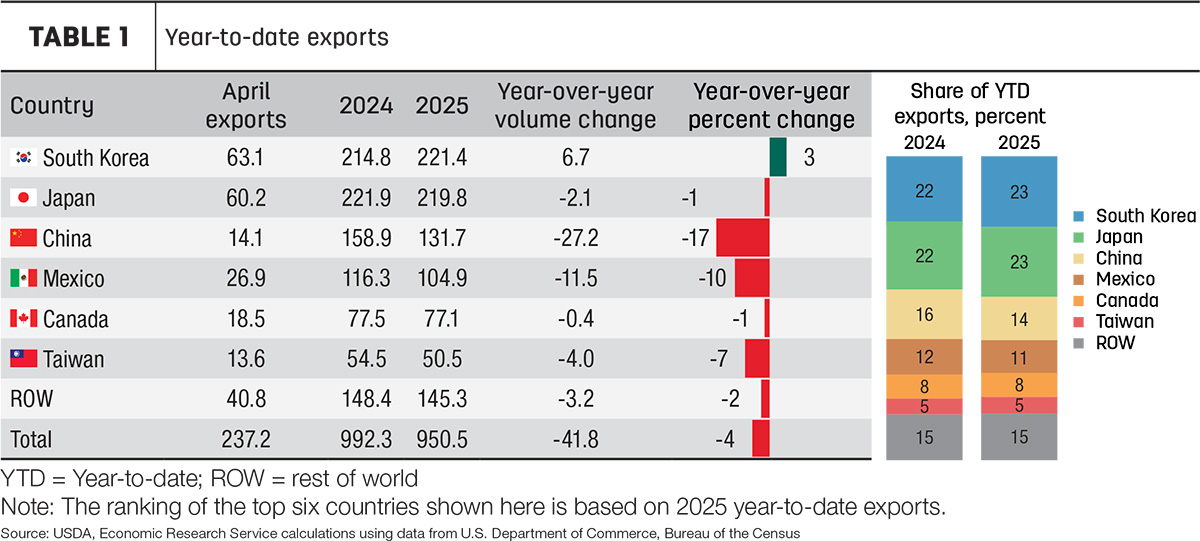
U.S. beef exports in April totaled 237 million pounds, 9% lower year over year. Exports to China were 68% lower year over year, having dropped 66% from the March level. A majority of U.S. beef establishments are still ineligible to export product to China due to expired registrations with the General Administration of Customs of China. Regardless of tariffs, these expired registrations will continue to severely limit U.S. exports to the country. However, April exports to Hong Kong were up 87% over last year, the highest for the month of April since 2020. Exports to South Korea and Japan were up 15% and 8%, respectively, in April. According to USDA Foreign Agricultural Service Export Sales reports, there has been an uptick in export sales to Taiwan and Hong Kong since April. These data point to some U.S. beef that would have been destined for China shifting to other markets.
Based on the stronger-than-expected pace of exports to certain markets, the export forecasts for the remaining three quarters of 2025 are raised 15 million pounds each to 690, 650 and 655 million pounds, respectively. The 2025 annual export forecast is 2.708 billion pounds. The export forecast for 2026 is lowered slightly to 2.47 billion pounds, setting expected exports as a percent of production at 9.8%.
Beef imports
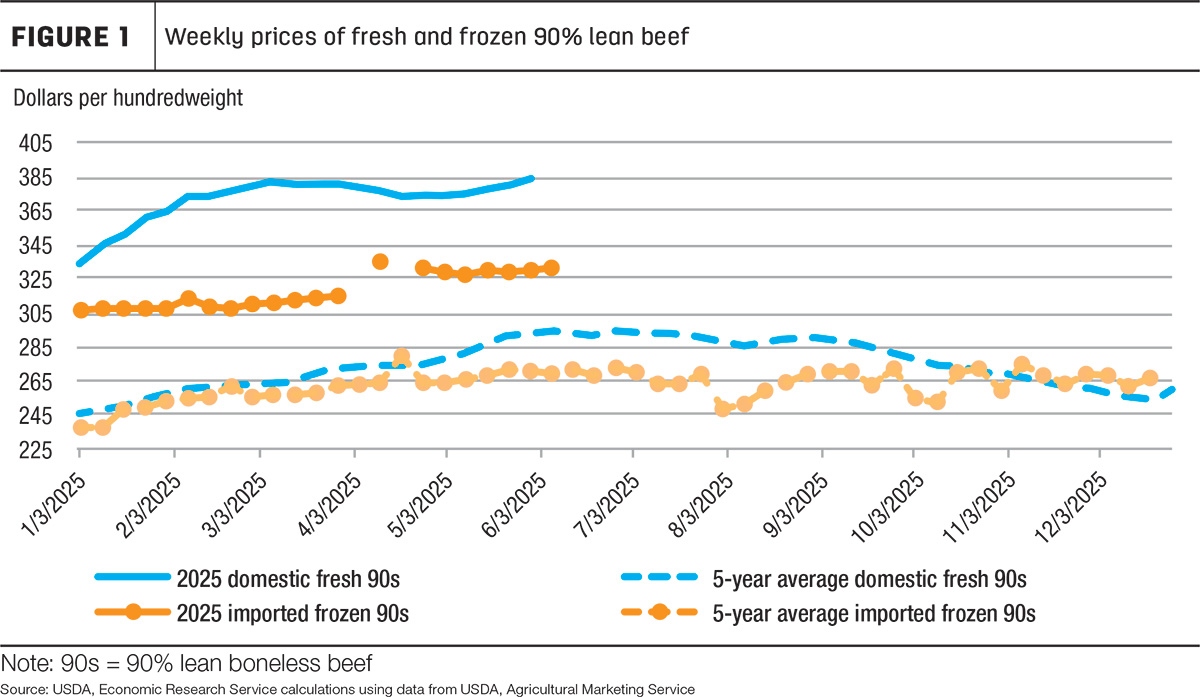
U.S. beef imports in April reached 475 million pounds, 45% higher than a year ago (Table 1). Cumulative imports through April are more than 28% higher year over year, compared to the same period last year. Imports from nearly all major suppliers – with the exception of Canada – are higher year over year. The effect of additional tariffs implemented in April can be seen clearly in the price of imported frozen lean trim, with about a $20-per-cwt increase from March to April, shown in Figure 1. However, the spread between frozen imported trim and fresh domestic trim remains historically high. Cow slaughter, which results in product comparable to imported lean trimmings, has decreased 14% through April, compared to the same period last year. As a result, domestic demand for lean grinding beef is expected to remain strong, making it a continued destination for global beef exports, despite higher tariffs.
Based on continued strength in imports, the forecasts for the second, third and fourth quarters of 2025 are raised to 1.325, 1.22 and 1.16 billion pounds, respectively. The annual import forecast for 2025 is 5.187 billion pounds. The annual import forecast for 2026 is raised 50 million pounds to 5.025 billion pounds. The expected year-over-year decrease in imports going into 2026 remains driven by limited global supplies of exportable beef.