In recent years, dairy producers have faced a paradoxical challenge: balancing the supply of replacement heifers while maximizing the value of calves and minimizing raising costs. The availability of sexed and beef semen has enabled a variety of breeding strategies, but the economic implications are not always straightforward. At stake are herd demographics, future productivity and year-to-year profitability.

This article outlines the economic outcomes of alternative breeding strategies that combine sexed, beef and conventional semen. Using both short-term decision support tools and long-term simulation models, we explored how reproductive performance and semen use strategies interact to shape profitability on dairy farms.
The replacement dilemma
Improved reproductive efficiency over the last two decades has contributed to an oversupply of replacement heifers. This has become both a management challenge and a financial burden. When farms generate more replacements than needed, they incur unnecessary raising costs and dilute selection intensity. Conversely, excessive use of beef semen in search of premium calf prices can lead to a shortfall in herd replacements.
The goal is to produce the right number of replacements from the best animals, while capturing the added value of beef-on-dairy crossbred calves.
Evaluating breeding strategies
The decision to use beef or sexed semen is not just about biological efficiency – it is also shaped by market signals. With beef-on-dairy calves often commanding premium prices, producers are increasingly weighing calf value into breeding plans. Sexed semen ensures genetic progress by producing more heifers from elite animals, while beef semen enhances short-term income from calves without genetic merit for future replacements. This dual-use strategy aligns with both biological and economic goals.
We evaluated breeding strategies through two lenses:
- Short-term analysis: A year-by-year economic comparison using the Income from Calves Over Semen Costs (ICOSC) tool.
- Long-term analysis: A simulation of individual animal life cycles using the open-source RuFaS (Ruminant Farm Systems) model, which considers multiple years of herd dynamics.
Each scenario varied in:
- Reproductive performance (high, moderate)
- Semen use strategies:
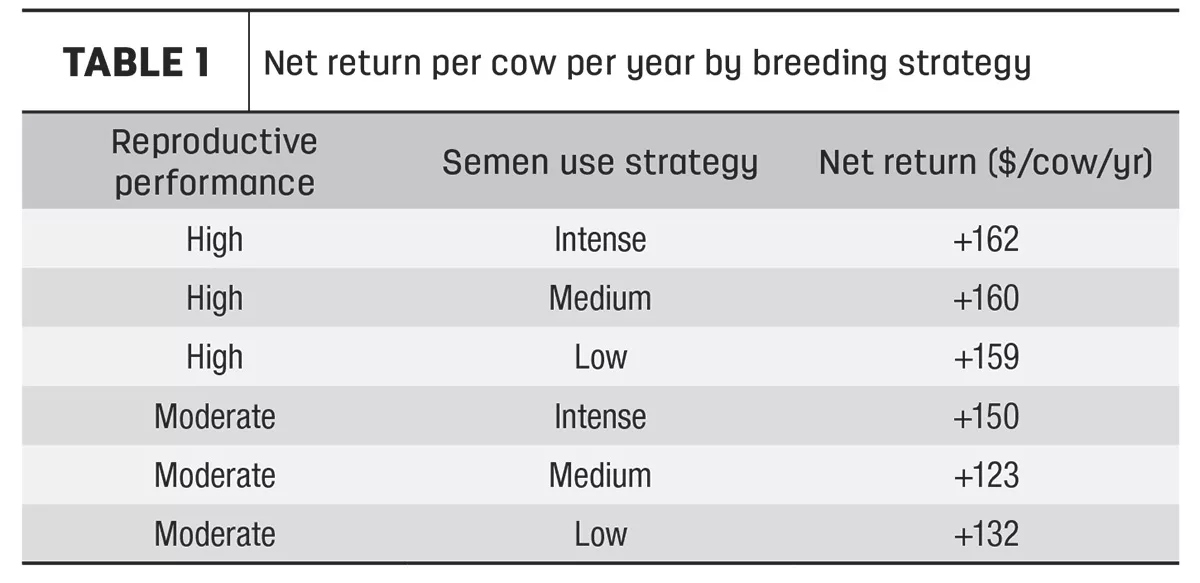
- Intense: Sexed semen in heifers and superior cows, and beef semen on inferior cows. No conventional semen.
- Medium: Balanced use of sexed, conventional and beef semen.
- Low: Greater proportion of conventional semen with some limited use of sexed and beef semen
- Economic assumptions including semen cost, calf value, feed, labor and milk price
Key takeaways from short-term results
Short-term analysis revealed three important trends:
- Reproductive performance matters: Higher conception rates amplify the benefits of sexed semen by increasing the likelihood of generating genetically superior replacements.
- Beef semen is valuable: Using beef semen on lower-genetic cows or third-lactation animals can generate higher-value calves without compromising replacement supply.
- Moderation is key: A moderate mix of sexed and beef semen typically meets replacement needs and maximizes ICOSC.
Table 1 summarizes the short-term net return per cow per year for various strategies (relative to an all-conventional semen baseline).
Cattle price outlook reinforces strategy
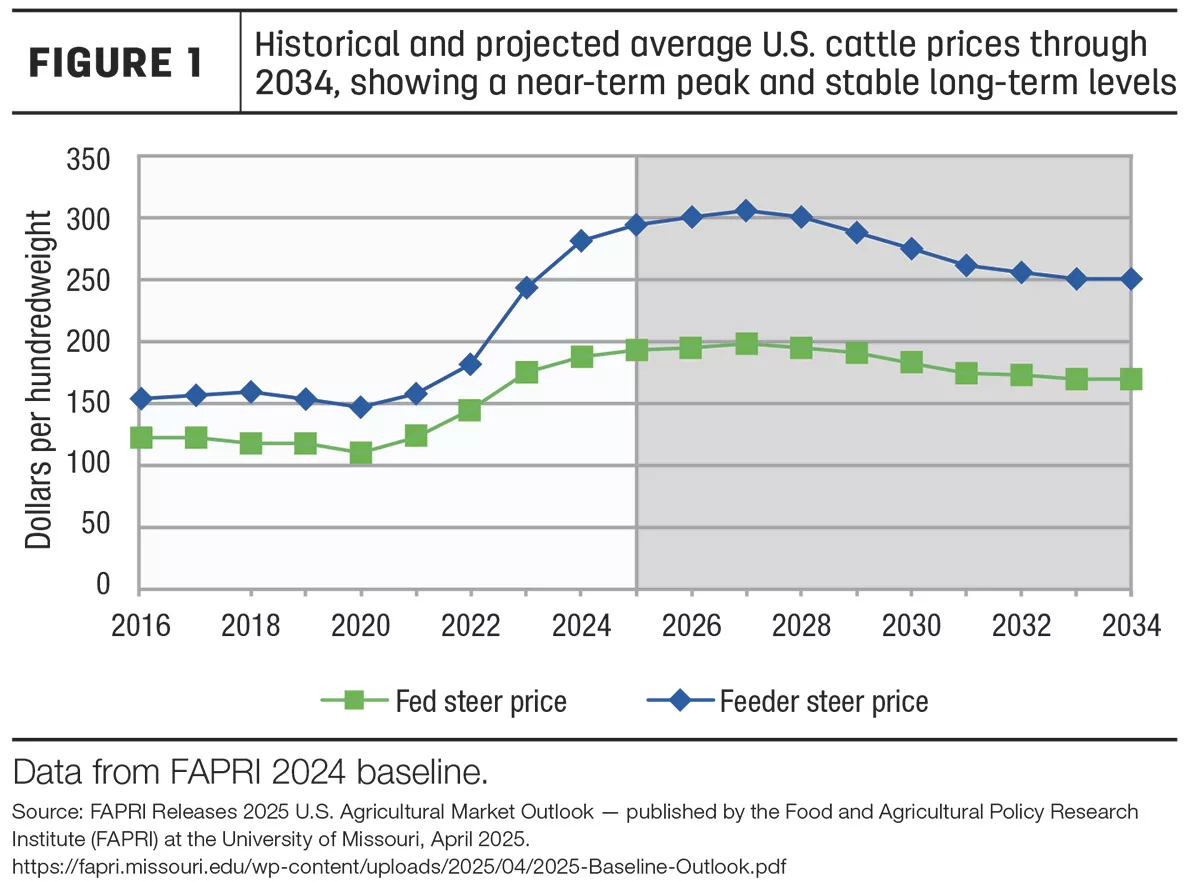
To further contextualize the economic impact of calf value, it is important to recognize projected cattle market trends. According to the 2025 outlook from the Food and Agricultural Policy Research Institute (FAPRI), beef cattle prices are forecast to remain high and increasing through 2027, with cyclical declines followed by stabilization at historically strong levels. Figure 1 shows a 10-year projection for average U.S. cattle prices from the FAPRI baseline. The data suggests sustained margins for crossbred calves, validating their role in reproductive programs.
These market dynamics support the profitability of beef-on-dairy crossbred calves in the next 10 years, particularly in the next three to five years. Farms that use beef semen strategically – on lower-genetic cows or later-parity animals – can maximize the value of each pregnancy in a bullish calf market.
Insights from long-term modeling
Using the RuFaS life cycle simulation, we extended the analysis to examine herd demographics, income streams and replacement needs over a 10-year period.
The results were consistent:
- All strategies using sexed and beef semen outperformed the conventional semen baseline in net returns.
- The intense strategy – using sexed semen on top genetic heifers and beef semen on the rest – delivered the highest net return, even in herds with only moderate reproductive performance.
- Income gains came primarily from calf sales and increased milk production from genetically superior replacements.
- A higher proportion of youngstock and first-lactation cows was observed under high sexed semen use, along with slightly more reproductive culling, reflecting the turnover dynamics of these strategies.
Practical implications
Farmers and advisers should not treat breeding decisions as one-size-fits-all. Instead:
- Reassess replacement needs annually based on herd goals and culling rates.
- Leverage tools like the Premium Beef on Dairy decision support tool and its ICOSC calculator to fine-tune breeding plans.
- Recognize that strategic use of sexed semen on genetically elite animals, coupled with beef semen on the rest, can enhance both genetic progress and cash flow.
- Monitor reproductive performance closely – success with sexed semen depends on conception rates.
Final thoughts
Breeding programs that integrate sexed and beef semen can lead to substantial economic benefits – but only if guided by data, realistic projections and clear farm goals. Decision support tools are essential for translating complex biological and market interactions into actionable insights. As models like RuFaS continue to evolve, they will offer increasingly powerful ways to simulate long-term outcomes and optimize dairy farm management.