If I asked 10 different producers, “How good of quality do you think your CRP (Conservation Reserve Program) forage is for grazing?” I would expect that nine would respond with something to the extent of “Not much better than trees” or “About like cornstalks after harvest.” Maybe the remaining one person would say something like “Don’t waste your time!”

While we typically think about pasture forage quality in the context of native grasslands, CRP lands represent a significant source of forage for producers in some areas. For us in Kansas, CRP lands in 2024 comprised over 12% of the state’s total native grasslands. Back to the question of forage quality, it is a forage resource where available data to help guide producers is quite scarce. Certainly, emergency grazing or haying of CRP during drought is the most common reason these forages are utilized, but there may be many other situations that lead to usage by producers. Information on standing forage quality is necessary for accurate feeding recommendations for producers, and it also applies to situations in which CRP tracts are harvested as hay. Yes, calf prices are at record-high levels, but our goal should still be to optimize our supplement inputs by avoiding both over- and undersupplementation. Having accurate forage quality estimates is key in helping us do so.
To improve our understanding of seasonal nutrient content changes of CRP forages across Kansas, a statewide assessment was recently conducted. Project details and preliminary data may be found in the 2025 KSU Cattlemen’s Day Report. In short, all standing forage above 1 inch was collected, so prior management impacted the sample quality. Some samples would contain the current and prior year’s growth. Be sure to check out the 2026 Cattlemen’s Day Report when it becomes available next spring. It will contain the final summary of this project; a snapshot of those data are presented here.
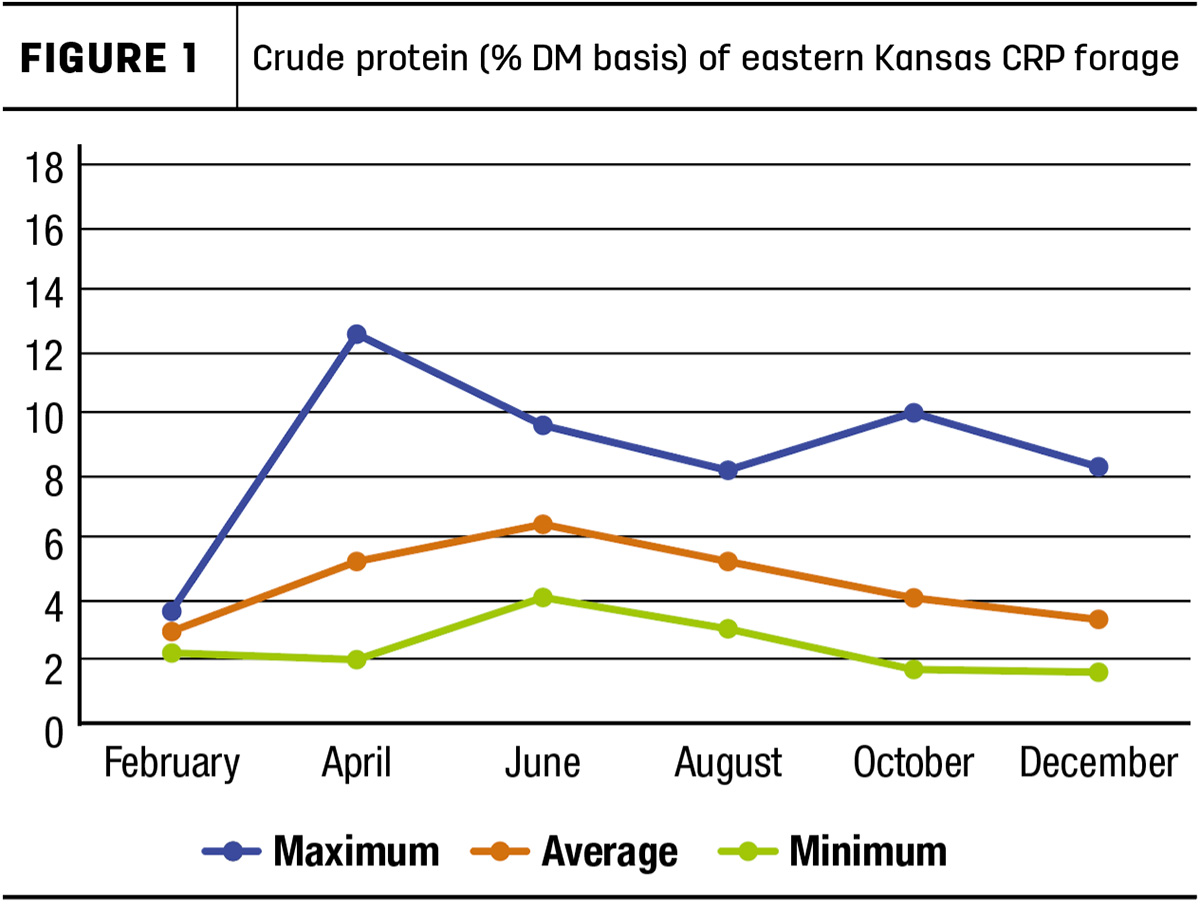
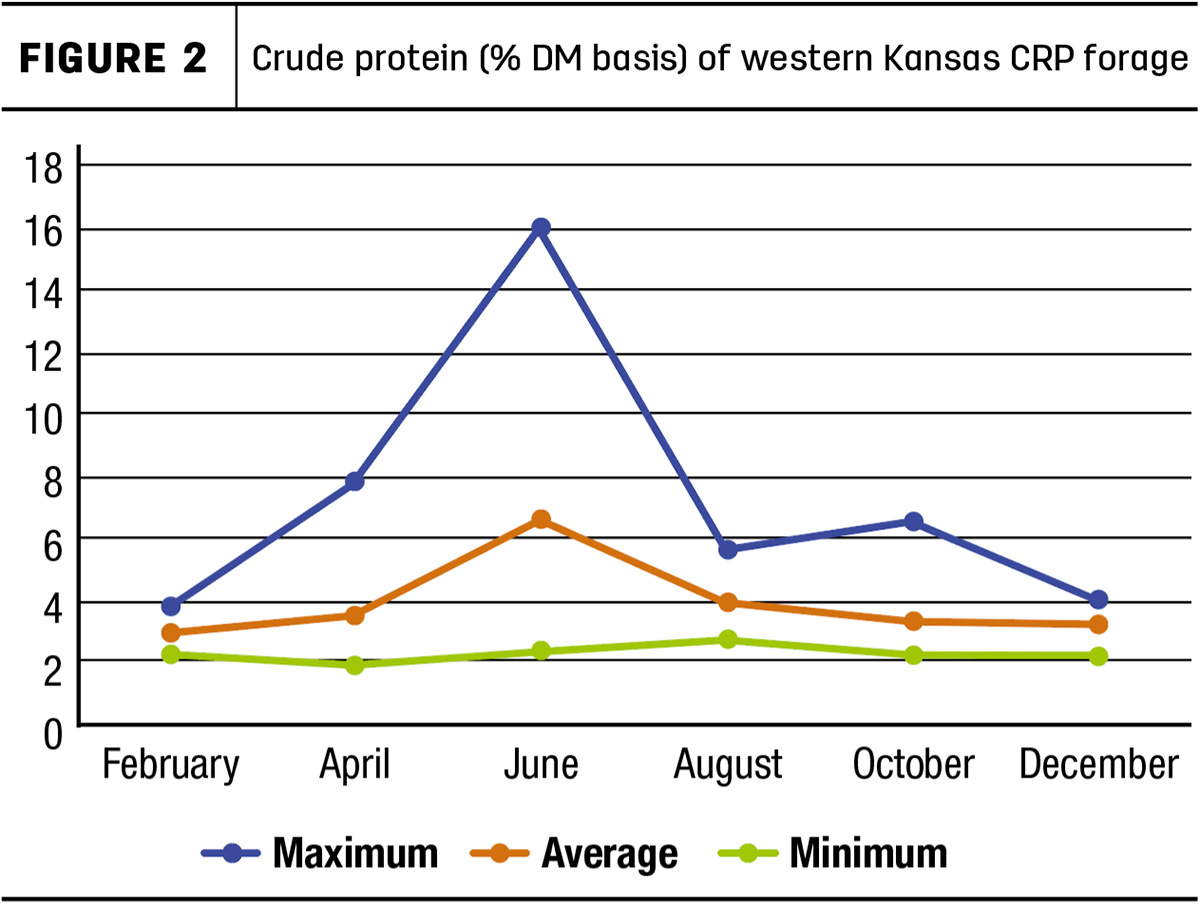
In general, crude protein increased during the growing season and decreased during fall and winter for both eastern and western Kansas samples. For eastern Kansas samples, crude protein (on a percent dry matter basis) ranged from less than 3% in February to over 6% in June, but some samples were as high as nearly 10% during that month (Figure 1). On average, eastern Kansas samples were 4% crude protein in October and declined going into winter. Samples collected from western Kansas ranged from 3% crude protein in February to over 6% in June, with wide ranges noted during the primary growing season months (Figure 2).
The key takeaway here is that these data have been generated to help serve as a benchmark guide for making informed nutrition decisions when CRP forages are used. There are certainly times when beef cow nutrient requirements may be met by CRP forages alone and times when supplementation will be needed. Keep in mind the following points:
- Variation in forage nutrient concentration exists.
- Production stage of the cow herd will determine how well CRP forages meet requirements
- Operation-specific forage sampling can always help fine-tune nutrient intake estimates, but these data are a useful point of reference in getting started.
What is the Conservation Reserve Program?
The Conservation Reserve Program (CRP) is a voluntary program administered by the Farm Service Agency (FSA) that encourages agricultural producers and landowners to convert “environmentally sensitive acreage” – such as areas prone to erosion – to vegetative cover such as native grasses, trees and riparian buffers.
Enrolled participants receive annual rental payments and cost-share assistance to establish long-term, resource-conserving vegetative covers. The program aims to improve water quality, control soil erosion and enhance wildlife habitat.
Producers and landowners with environmentally sensitive land that meets specific criteria are eligible. Applicants must demonstrate the potential for significant environmental benefits through the implementation of conservation practices.
More information can be found by visiting the website or contacting your local FSA office.