Great hoof health advances the well-being of dairy cows while improving overall farm sustainability. Managing hoof health on farms requires proper and timely execution of preventive hoof trimming. From experience as hoof care technicians and conducting on-farm hoof care training all around the world for the past several years, it is evident that a simplistic approach to hoof trimming begins with three fundamentals of hoof care.


1. Observe
Observe and understand farm conditions. Every dairy production and management system has its unique characteristics. Consider the differences between a freestall system using sand bedding versus organic bedding with cows on concrete or the conditions on drylots or pasture systems. All scenarios demand a different approach. Walking surfaces and walking distances, as well as stocking density and heat abatement, uniquely impact outcomes. To properly perform hoof care and obtain successful results, it is necessary to understand the correlation between the animal’s environment and how these factors impact hoof health.
2. Evaluate
Evaluate the claws with an understanding of the anatomy. Regardless of the dairy breed and aside from where your dairy operation is located, there is only one anatomy of the bovine claw that guides hoof care. Today, we know that any claw horn disruption lesion will impact the future health of underlying tissues in the claw. Proper function of the claws is critical for lesion prevention and preventing the cycle of repeated lameness. In our opinion, there are three critical points that are the foundation for the best outcomes.
Protect the functionality of the toe triangle
This area has the strongest suspensory apparatus, as it connects the pedal bone to the hoof wall on both sides (Image 1). The hoof wall is predominantly responsible for the weight transfer from the animal skeleton to the environment. The pedal bone is completely fixed, having no movement. The toe triangle consists of the hoof wall, sole, corium (horn-producing tissue) and the pedal bone. The digital cushion is not present in this region. It is widely known that a minimum of 3/16-inch to 1/4-inch of sole thickness and an intact hoof wall is required to protect the pedal bone and the corium in the toe region. Less sole thickness or removal of the hoof wall will result in trauma to the corium. This causes inflammation which then can permanently make changes to the underlying tissues.
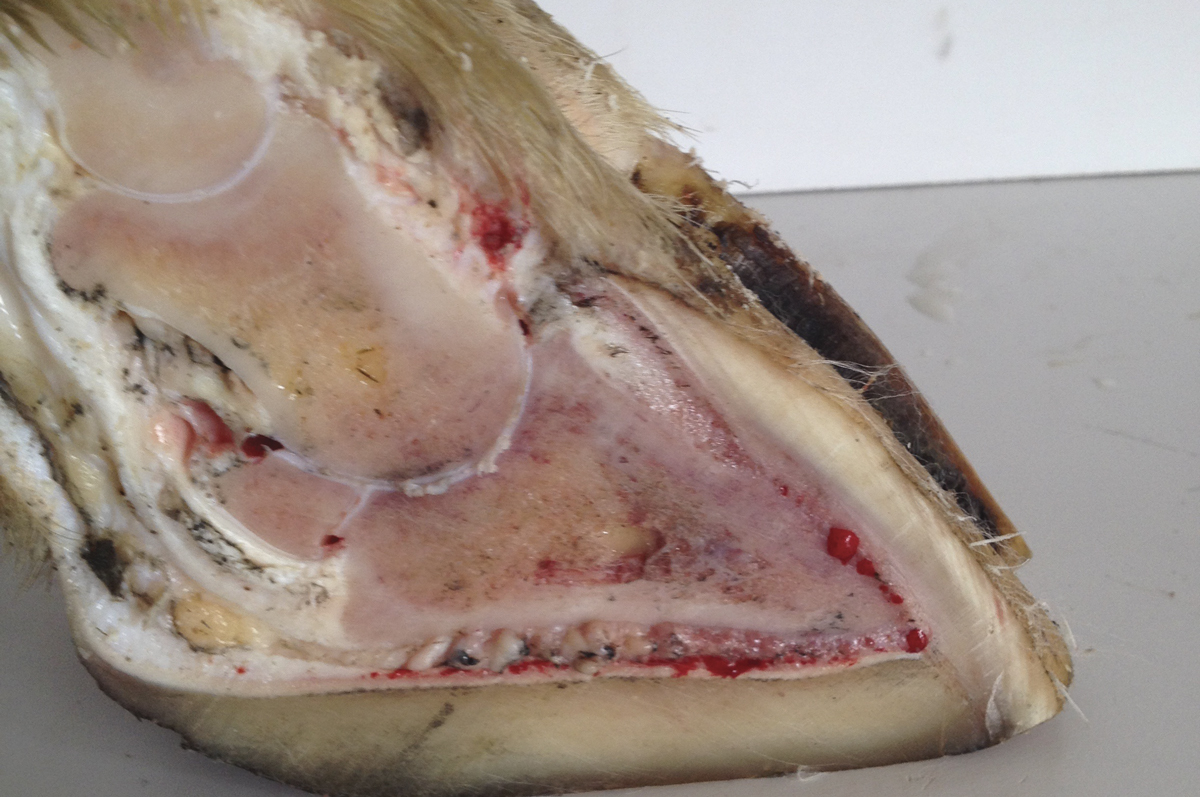
A cross section of a convex healthy claw with adequate sole thickness is shown. Image provided by Karl Burgi.
Evaluate the dorsal wall length and sole thickness with consideration of age and breed size of the animal
We can only achieve the correct measurement if the animal has a convex or straight dorsal wall. A concave dorsal wall or a buckle in the wall will falsify the measurement. A normal claw of a 3-year-old full grown animal of average size of 1,500 pounds to 1,750 pounds is 3 inches long. Additionally, allow for 1/4-inch of sole thickness, adjusting the measurement according to the size and breed of the animal. When removing extra claw length and sole thickness, it is necessary to improve dorsal wall angle to 52-55 degrees for cows on concrete. This can only be achieved if the heels of both claws are preserved or not trimmed.
Properly load the claw
Researchers from the Swedish University of Agricultural Sciences, led by E. Telezhenko, are conducting advanced biomechanical tests on cow hooves using internal pressure sensors. At the recent Lameness in Ruminants conference in Venice, Italy, they showed that a large model combined with a steeper toe angle allows for greater relief of pressure from the pedal bone than smaller or moderate model (Image 2). This results in shifting the load to the suspensory apparatus, which is essential for cows on concrete walking surfaces.
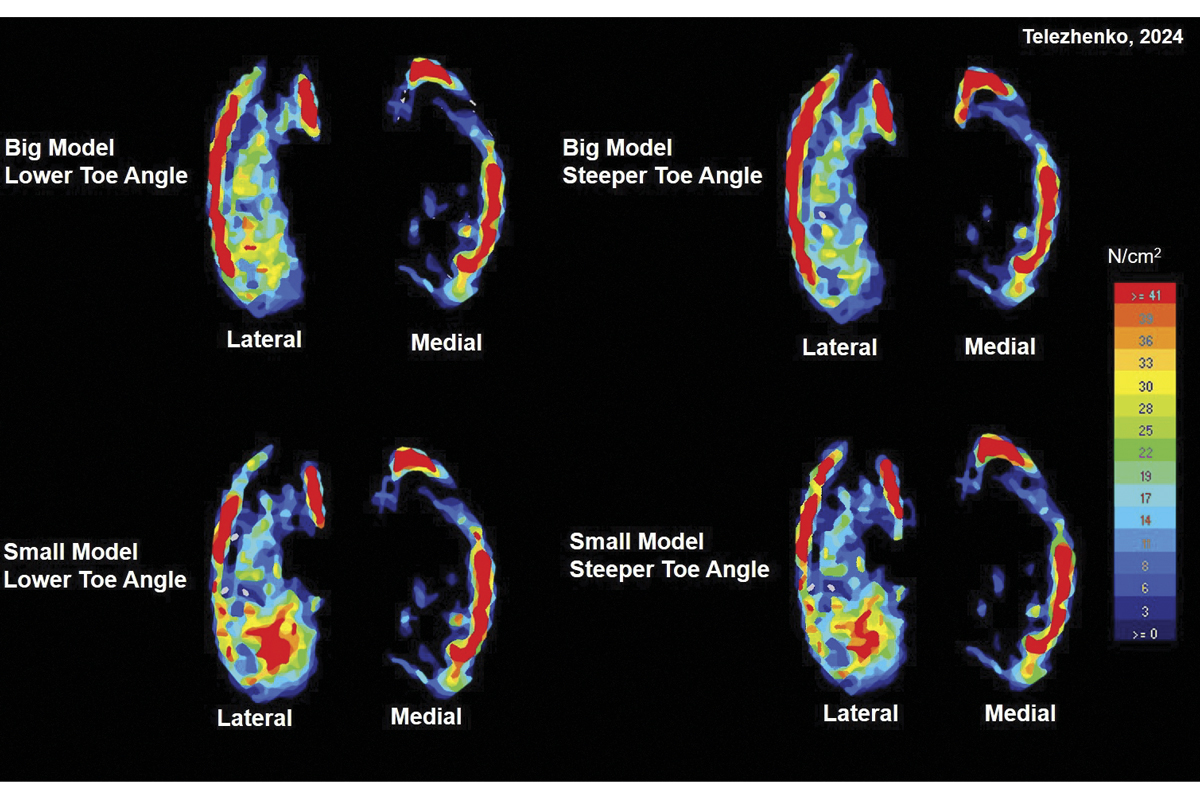
The color-coded internal pressure images. Image courtesy of the Lameness in Ruminants Proceedings 2024, I-scan pressure system, Tekscan MA.
3. Execute
Execute proper trimming (Image 3).

Simplistic hoof trimming is completed. Image provided by Karl Burgi.
The dorsal wall length and sole thickness of every claw must be assessed before any horn is removed. Extra length and sole thickness of each claw calls for removing sole horn perpendicular to the leg in the toe triangle, leaving a flat surface. This action moves the load to the toe triangle, the strongest part of the suspensory apparatus.
When removing horn in the toe triangle, be mindful that the wall is the hardest portion of the claw. The reason that the toe becomes long in some environments is because the hard wall does not wear as well as the soft sole. This brings us to the necessary part of horn removal. Correcting the abaxial (outside) wall of the toe triangle will improve the dorsal (front) wall angle. As a rule, the cut of the abaxial wall should be made to preserve the dorsal wall angle as well as the sole thickness.
With normal claws, we recommend modeling only the rear lateral and front medial claws. The modeling of the claws relieves the load from the posterior axial end of the pedal bone. This is what optimizes the proper loading of the suspensory apparatus, which improves the anatomical function of all claws. With optimal sole thickness 1/4-inch on the rear lateral and front medial claws, modeling can occur up to 75% of the typical sole ulcer site area. With insufficient sole thickness, the size of the modeling must be reduced accordingly to 30% to 50% of the sole. The modeling should be done so the complete toe triangle, hoof wall, sole and the heel are preserved. The more the horn is thinned in this area, the more of the load is shifted onto the suspensory apparatus which is present throughout the hoof wall.
Around the world, we often witness lameness caused by thin soles and overtrimming. Routine evaluations of claw length and sole thickness in addition to correct horn removal are vital to improve hoof health. These assessments must start eight to three weeks before first calving. For example, it is likely that springing heifers may not need a trim because of the environment they are raised in. On large dairies, there may be a high percentage of first- and second-lactation cows that may only require an assessment and trim at dry-off. Proper evaluation of the claws and hoof health records will dictate the correct intervention. Consider this bottom-line motto after an evaluation: “Less is more.”