Cattle prices are at historic highs, making management of the cow herd investment more critical than ever. A lot of focus is put on developing heifers, rebreeding the 2- and 3-year-old cows, delivering a uniform, healthy calf crop to the next segment of the industry, or managing cull cows. Rightly so, as all these topics are important to the overall financial success of the beef cattle operation. Very seldom, however, is there much chatter about maintaining herd bulls. There is always plenty of information to be found on selecting bulls or the genetics of the next up-and-coming line from any given breed, but nothing fades into the background quite like last year’s bull purchases. That is, until that $8,000 bull brings $3,000 the following summer as a weigh-up bull because he did not pass his breeding soundness exam.

Nutrition for growth
Herd bulls are generally purchased as yearlings, 18-month-olds or 2-year-olds. After that first breeding season, they start their first winter with a lot of growing left to do. Additionally, it is not uncommon for bulls to lose some body condition during the breeding season. Therefore, the young bull may need to regain some weight, as well as develop more structure and muscle. Unfortunately, winter range, hay and residue fields are low-quality feed resources in most of the country.
The maintenance of sheer size
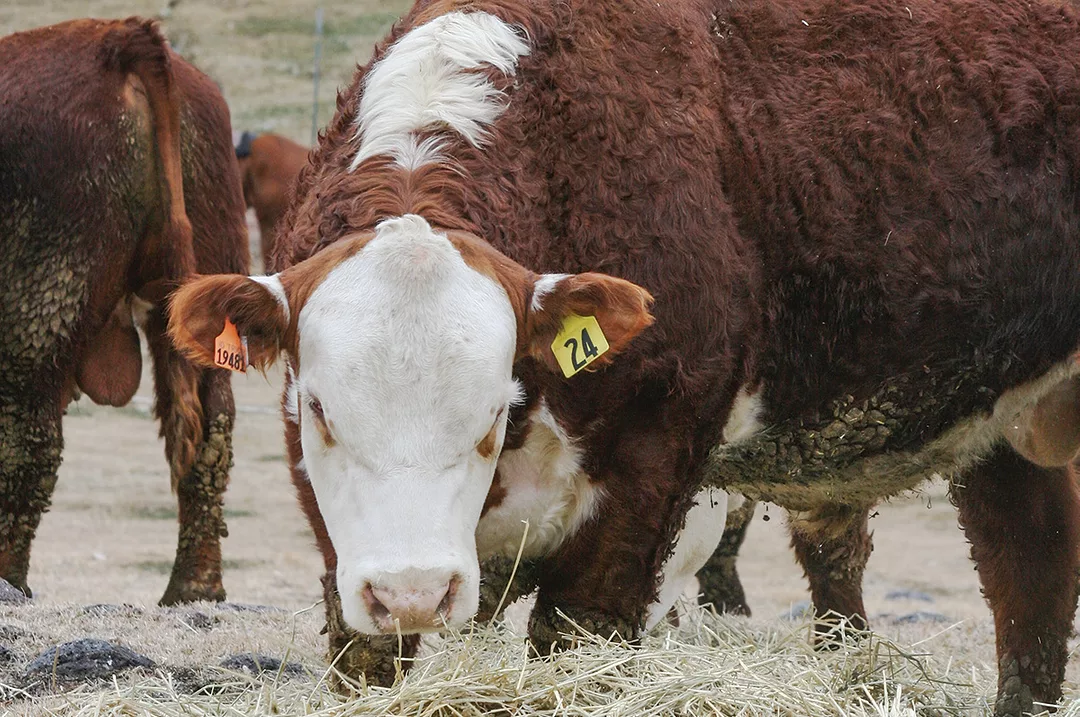
When cattle are out grazing, their actual feed intake is not often considered. When harvested feeds are fed, the tendency is to feed the bulls the same as the cow herd. However, the average mature cow may weigh 1,350 pounds, but even a young bull after his first breeding season may weigh 1,600 to 1,800 pounds. A mature bull can easily weigh 2,000 pounds and therefore have substantially more weight to maintain than a mature cow.
An example diet for a young growing bull (1,300 pounds) that needs to gain 1.5 pounds per day might include 32 pounds of hay per day, which is about 55% total digestible nutrients (TDN) and 6% crude protein (CP), along with 3.5 pounds per day of dried distillers grains (DDG).
A mature bull (2,000 pounds) that needs to only gain 0.5 pounds per day to regain some lost body condition would still need 42 pounds of hay and 2 pounds of DDG per day.
To put these diets in context of something producers are more familiar with, the nutrient requirements for these bulls are equivalent to those of a lactating cow. However, most producers have dry gestating cows in the winter, which have substantially fewer nutrient requirements. Therefore, if the bulls are being fed what the dry pregnant cows are getting, the bulls may not be getting their nutritional needs met.
Beyond energy and protein
Vitamins and minerals are also very important for bull health, not only for spermatogenesis, but also for immunity, hoof health and metabolic functions. Unfortunately, most harvested forages and dormant ranges are low in vitamins and minerals. A good quality vitamin and mineral supplement, in addition to adequate energy and protein, will go a long way to maintaining bull health and productivity.
The Goldilocks approach to body condition score (BCS)
The tendency in most of cow country is for bulls, especially young bulls, to be too thin (a BCS of less than 5 on a 1-9 scale). However, spermatogenesis is hindered not only when bulls are thin, but also when they are fat (a BCS greater than or equal to 7 on a 1-9 scale). Therefore, targeting a BCS of 5 or 6 is optimum for bull health and spermatogenesis.
Managing the environment
One common misunderstanding about bulls is how long spermatogenesis takes. It actually takes 61 days. Therefore, the nutrition and environment that impact spermatogenesis need to be considered and managed well before the breeding season. Frostbite on the testicles can permanently lower sperm production and quality. When temperatures are below 20ºF and snow cover is prolonged, windbreaks and bedding can be very helpful in preventing frostbite as well as enabling bulls to maintain body condition. Additional feed and open water can help bulls maintain body heat by increasing the heat of fermentation from the rumen.
Winter and early spring are not usually times when a rancher’s focus is on the herd bulls. However, making sure bulls are well fed and have wind protection and extra bedding when prolonged low temperatures are forecast can go a long way in assisting bulls to pass their breeding soundness exam later that spring or summer. In today’s cattle market, bulls may be a necessary evil, but they are also a big investment. Seeing them as an investment prioritizes their feed and care to increase their longevity and productivity for the future cow herd.