I have a riddle for you: If you have too much or too little, you worry about it constantly, but if you have the right amount you don’t think about it at all. What is it?

The answer is water.
We understand that water is the single most important nutrient to sustain life, yet most of the time we take it for granted. After all, have you ever been standing in front of the kitchen sink, watching your neighbor get a rain shower that you wish would move a half-mile to the north to help your crops out? Our crops in the field don’t care about the quality of the water, as long as they get it. For our livestock, water availability and quality are crucial to their health and performance.
There are several factors that determine how much water cattle need to consume. A cow’s body is estimated to be comprised of 58% to 81% water. If she is lactating, her milk is about 87% water. The volume of free water that needs to be available per head is dependent on several factors. Their mature bodyweight, the amount of dry matter consumed, ambient temperature and relative humidity, production level, the temperature and quality of the water all affect their consumption. In general, it is estimated that beef cattle require 1 gallon of water per day per 100 pounds of bodyweight. The estimation can double for lactating cows, and as environmental temperatures reach 90°F for all production classes, allow 2 gallons of water per 100 pounds of bodyweight.
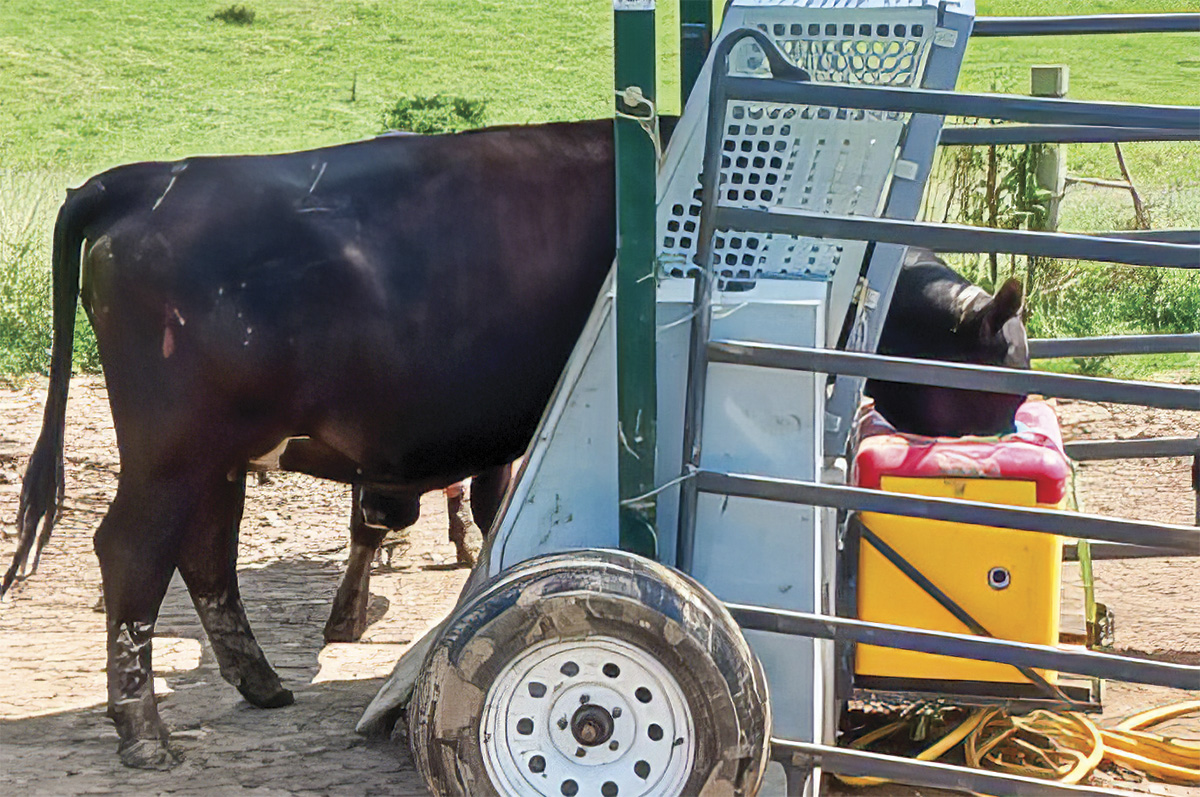
A mobile Vytelle SENSE weigh system with water as an attractant was used to record animal weight and water intake. Image by John Yost.
As you consider supplying your herd’s water needs, you need to factor in their housing environment and behavior. Spring forages can be 80% moisture and supply about 0.5 gallon of water for every pound of forage dry matter consumed. As forages mature, their moisture content drops significantly, and more free water will need to be made available. Cattle are estimated to drink two to five times each day, for one to four minutes at each visit, consuming about 2 gallons of water per minute. To accommodate their needs, it is recommended that cattle be within 700 to 900 feet of a waterer. As distance increases to beyond 900 feet, cattle are more likely to come to the waterer as a herd rather than as individuals. When cattle are forced to come as a herd, there is a greater opportunity for calves and submissive cows to be pushed out and prevented from drinking.
In August 2024, we completed a pilot project at Ohio State University, where we observed the average number of visits to the waterer, the amount of water consumed per head per day and average daily gain (ADG) based on the distance from the grazing paddock to the waterer for a group of crossbred yearling heifers. Waterer visits, water intake and bodyweight were measured with a mobile Vytelle SENSE unit with a Richie brand waterer fitted with a flow meter to determine waterer recharge rate. Water intake and bodyweight were assigned to individual animals via RFID tags (Figure 1).
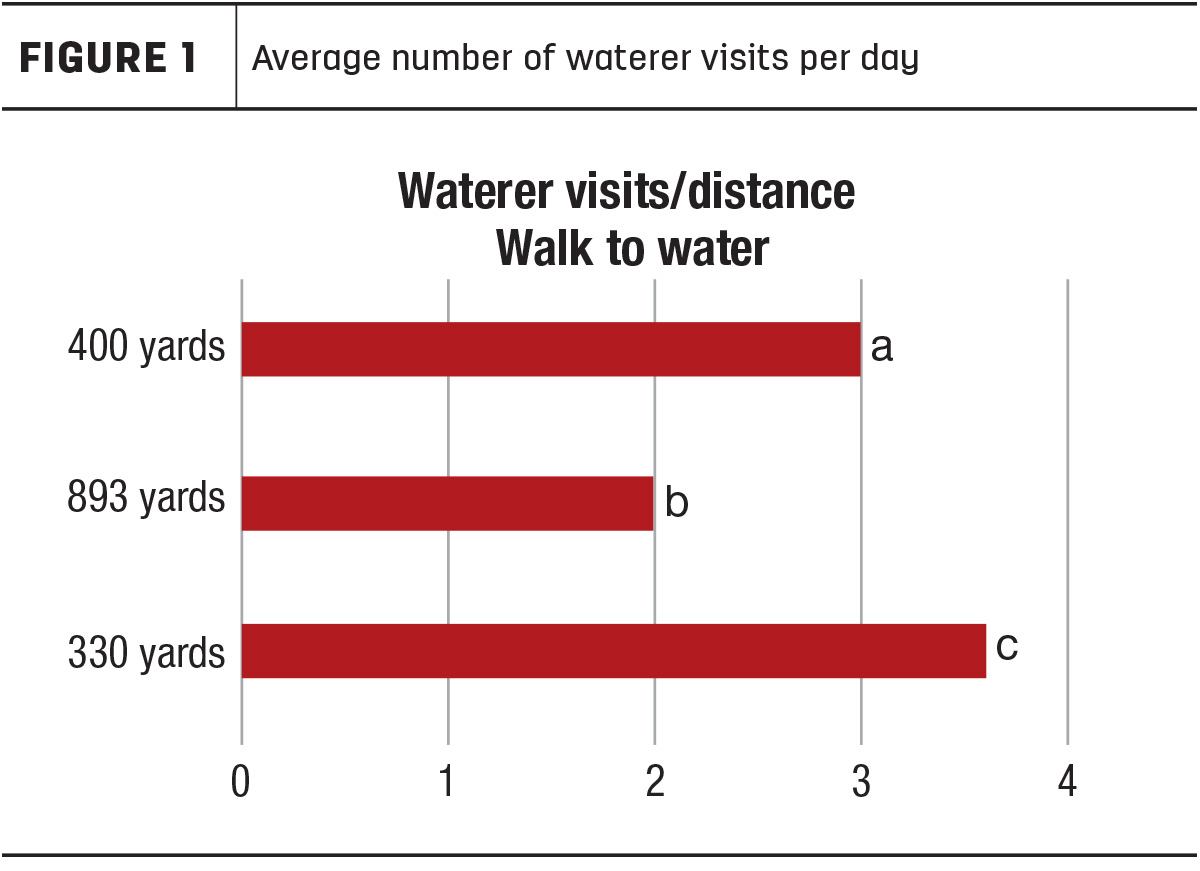
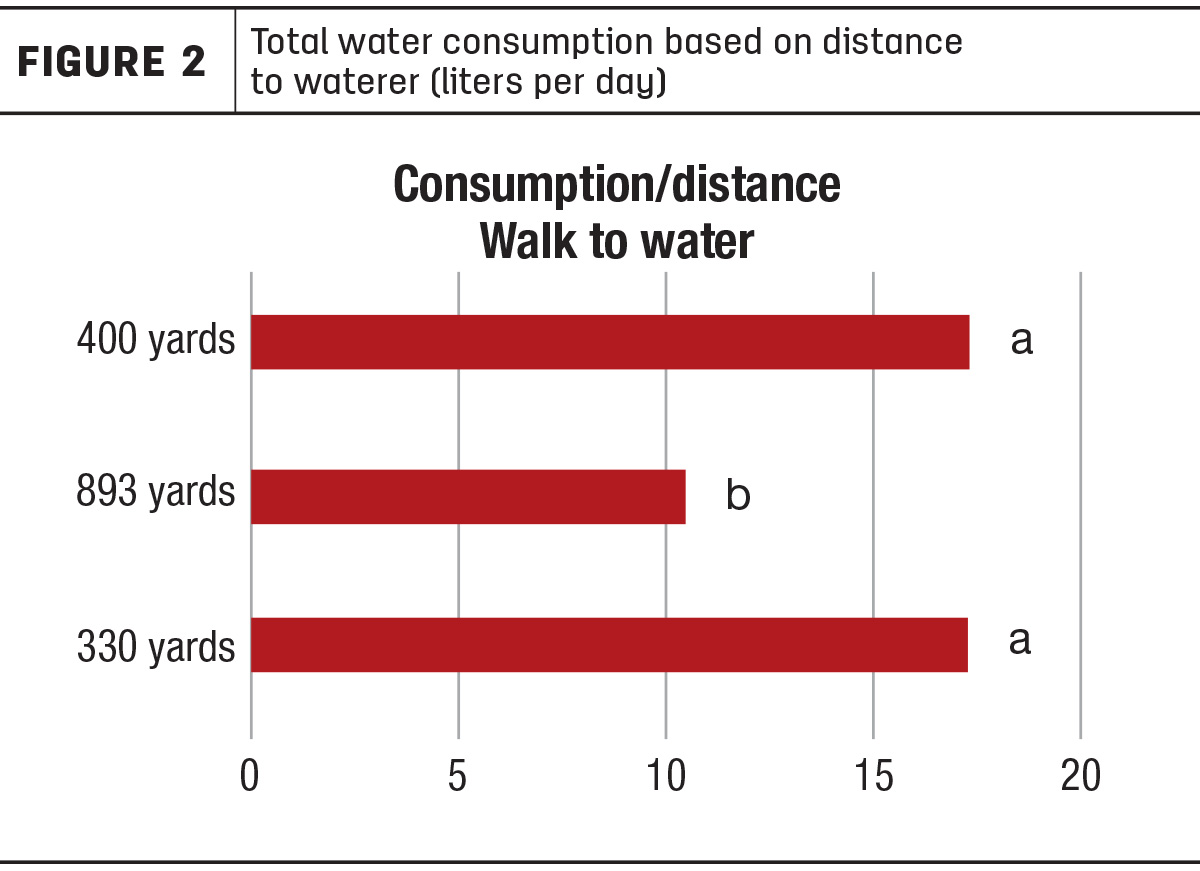
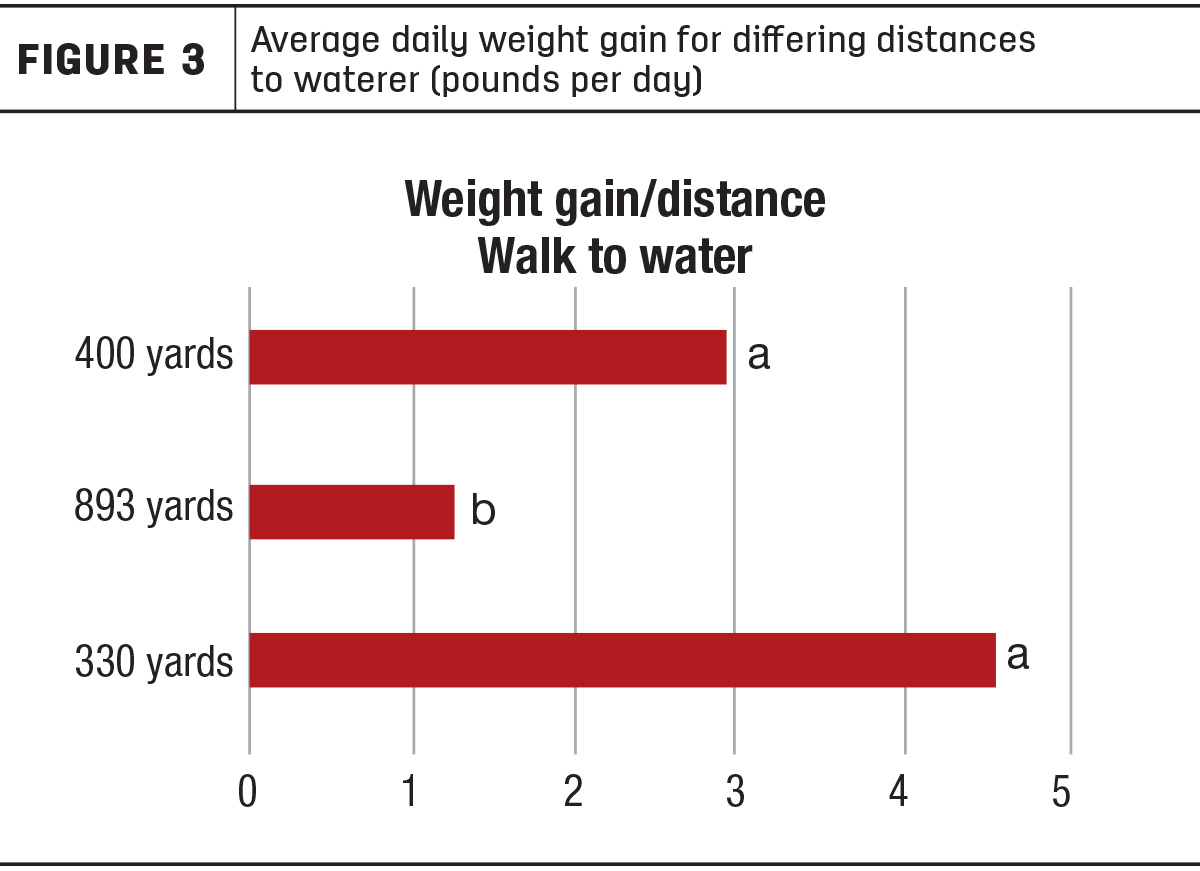
As the walking distance to the waterer increased, the number of daily visits, volume of water consumed and ADG decreased for the herd. Cattle that had to walk less than 400 yards to reach water visited the waterer three times on average each day (Figure 1) and consumed 4.5 gallons per head per day (Figure 2). When the heifers were required to walk a maximum distance of 893 yards to water, they averaged two visits to the waterer and consumed 3 gallons per head per day. When we looked at ADG, heifers gained between 3 and 4.5 pounds per day when grazing close to the waterer and only 1.5 pounds per day when forced to walk close to 900 yards (Figure 3).
Although this was just a pilot project and we didn’t factor in forage quality, it did help us visualize beef cattle water needs and potential production impacts. When sizing and locating waterers, producers need to determine the herd’s daily water requirement and understand the behaviors associated with their management system. The general recommendations are:
- The waterer should be a minimum of 18 inches high.
- For large groups, or when travel distance increases beyond 900 feet, consider trough-style water units or tanks.
- Ideally, allow 3.5 inches of waterer space per head.
- Waterer recharge rate should be equal to 2 gallons per minute for the maximum number of animals that can drink at one time. For example, if a waterer will allow four head to drink at one time, the recharge rate should be 8 gallons per minute.
University of Missouri Extension has a valuable publication titled “Pumps and Watering Systems for Managed Beef Grazing” that can assist you in designing your watering system.