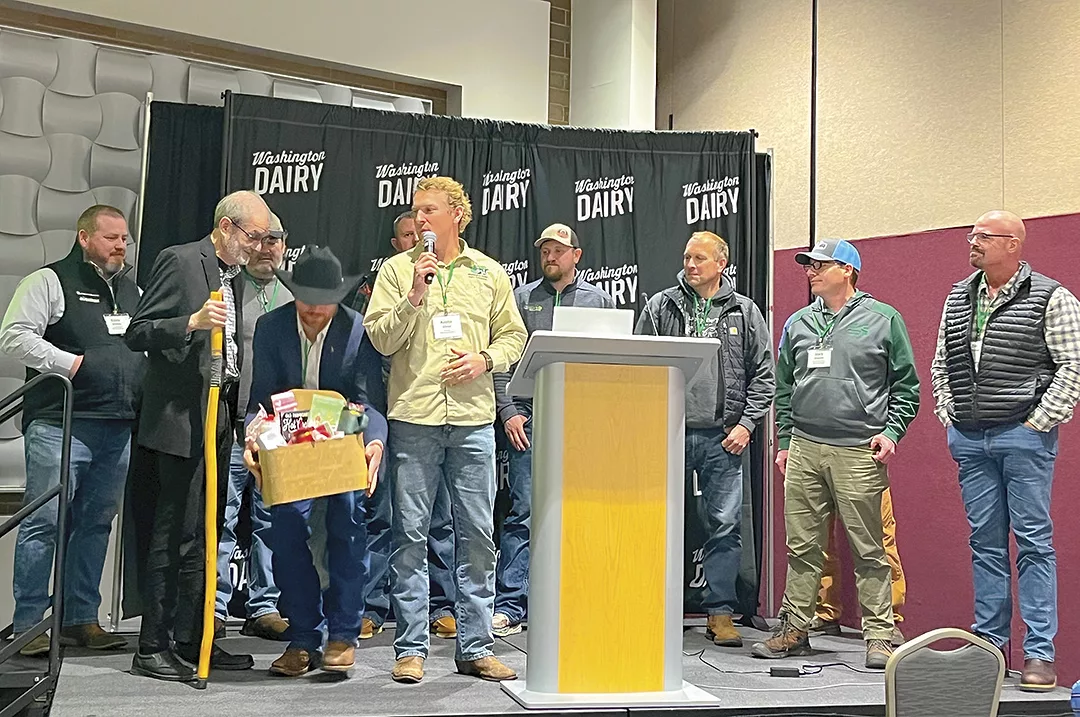
Issues affecting the Washington dairy industry were discussed throughout the 2025 Washington Dairy Conference, held Dec. 2-3 in Wenatchee, Washington. Aside from discussing opportunities and solutions to address water rights, labor and other challenges, attendees enjoyed ample networking time, opportunities to visit with exhibitors during the trade show and a fun evening at the Washington State Dairy Women’s scholarship auction dinner.

Water rights adjudication
Fred Likkel, executive director of Whatcom Family Farmers, discussed the ongoing water rights adjudication in Whatcom County. The Nooksack Basin water rights adjudication is a lawsuit filed by the Washington State Department of Ecology in 2024 requiring all water users in the basin to defend their water rights in court due to the department including groundwater in the case for the first time, in addition to surface water. It is estimated that as many as 37,000 water users are affected. While it works its way through the courts, which could take decades, it creates uncertainty for how and what to farm and whether the affected farmers will be able to continue farming into the next generation. Likkel highlighted the need for farmers to complete claim forms by May 2026 to secure water rights.
“So far, only a small percentage of those claim filings that were mailed last spring have been returned, and many water users have yet to be officially served – with a large number of the court summonses not reaching the intended water users or receiving those users’ signatures,” Likkel said. “The court is now serving those parties via public notice by publishing their names in the local newspaper of record. Others have not received summonses or been listed, and it remains to be seen what will be done to give them a sufficient opportunity to file.”
Labor issues continue
During a panel discussion about the challenges faced by Washington's wheat and dairy farmers, Pam Lewison, ag research director for the Washington Policy Center, noted that Washington loses two farms and 451 cultivated acres daily due to policy and regulation. She also cited a study about mental health and agriculture that emphasized how job stress contributes to other challenges.
“The study showed that Washington’s labor costs per farm are 462 percent higher than the average farm in the nation. It also showed that our operating costs in general – not just labor – are 71 percent higher than farms on average in other parts of the country,” Lewison said.
This data was distributed to state legislators to review during the off season, and she said it helped to change the tone of the conversation with legislators about labor and operating costs on Washington farms.
“Suddenly, legislators who had been very resistant to having conversations around changing labor and industries costs, overtime, seasonality and flexibility changed almost overnight. I think we’ve started to make progress there,” Lewison said.
Panelists discussed how the agriculture overtime law that passed in 2021 continues to impact farm employees.
“When dairy employees have their hours cut down to 40, they now have to get a second job or do odd jobs to make up the lost revenue for their family,” said Jay Gordon, policy director for the Washington State Dairy Federation (WSDF).
While automation was discussed as a popular solution for rising labor costs, Gordon added that it does not come cheap and “you’re really substituting capital for labor.”
Dairy herd and replacement trends
Amber Roberts, an agricultural economist for AgWest Farm Credit, discussed the current state of the dairy market. Replacement heifers are in short supply, with prices reaching record highs. Milk prices have declined since 2022, but revenue from beef-on-dairy crosses has increased.
“Washington is the one state that stands out when looking at the national dairy herd map of year-over-year numbers from recent data in the USDA milk production report,” Roberts said. “While milk production in many other states is growing, Washington has lost a lot of cows. Very clearly, it’s been tough to be a dairy producer here in Washington. Washington dairies are facing significant operational challenges. We have higher regulatory burdens than other states. We also have stricter labor rules and complexities when it comes to costs.”
Another trend she highlighted was that many dairies are holding onto cows longer due to expensive replacement heifer costs.
“When it comes to replacement heifer inventory, we are currently at the lowest level that we’ve seen since 1978, with only about 3.9 million head of replacement calves,” Roberts said.
She said it is estimated that 72% of dairy farms are now using beef-on-dairy genetics to increase revenue from those lower-tier animals as cull cattle prices are strong.
“From 2019 to 2020, the average revenue from those cull cows and day-old beef calves was sitting at a dollar to a dollar and 50 cents per hundredweight. Today, that’s over 4 to 5 dollars per hundredweight, which is increasing dairy farm income. This is supporting a lot of dairies, especially because milk prices are not the greatest right now.”
Looking ahead, Roberts said the cattle herd will likely start to rebuild around 2027, which means the replacement heifer situation for both beef and dairy will “get worse before it gets better.”
“The important thing to note here is as we have fewer replacement heifers, expansion in the future will take longer,” she said. “As producers, you will want to be very strategic thinking about herd management, your replacement plan and capital investments, as it's probably going to continue to be tight on that replacement heifer side.”
Legislators discuss dairy policy issues
Representatives Kim Schrier (D-Washington) and Dan Newhouse (R-Washington) joined remotely to discuss several recent dairy and agriculture bills, including the Whole Milk for Healthy Kids Act and the extension of farm bill programs through the One Big Beautiful Bill and the Continuing Resolution, along with ongoing challenges such as labor, regulatory burdens and high input costs.
“We’ve got a lot of issues in this area,” Newhouse said. “Right now, we are facing some of the most challenging times I’ve ever seen in agriculture. Input costs are through the roof and the prices we receive for the things we produce are low and are not keeping pace.”
While he admits not all these issues can be solved in Washington, D.C., he said Congress can “certainly avoid adding to them.”
“That’s one of the things I’ve been focused on to make sure the regulatory climate we face in agriculture is not one where we cannot survive and be profitable,” he said. “One of the biggest issues overall during my time in Congress has been to elevate the importance of agricultural labor – both the cost and availability – to make sure we have people to work on our farms.”
Schrier agreed.
“In Washington, we are paying north of 22 dollars an hour, which is much higher than many other areas. Cost and access to labor is a big deal,” Schrier said.
Newhouse said it is both good and bad that farm bill programs were extended through the One Big Beautiful Bill and the Continuing Resolution.
“That takes some of the urgency away from developing a new farm bill instead of extending the old one. It is a little disheartening to keep talking about renewing the farm bill when a new one should have been done two years ago,” Newhouse said.