The year of 2025 may not have delivered a perfect crop, but with thoughtful pairing, management and attention to gut health, producers can position their feed for success.

In late December, the I-29 Moo University Dairy Webinar Series continued with a session titled “Positioning 2025 Feed for Success.” Speaker Katie Raver, animal nutrition technical services director with Rock River Laboratory, shared details of the 2025 crop year and what it means as producers plan rations and manage forage inventories heading into 2026.
2025 crop year
Raver provided an overview of the 2025 growing season – a year she described as “very, very interesting” due to the range of weather patterns across the Midwest.
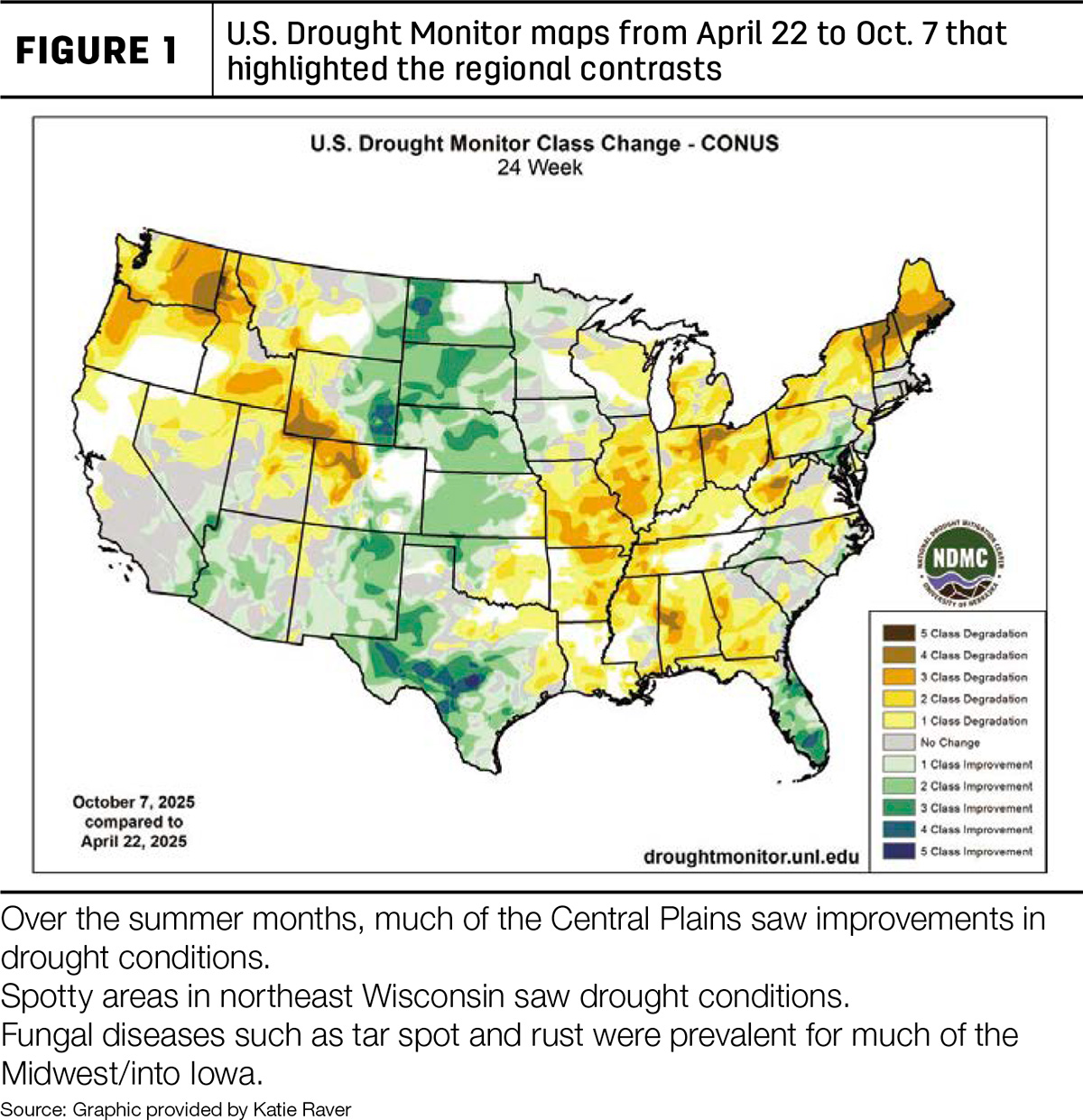
Using U.S. Drought Monitor maps from April 22 to Oct. 7, she highlighted the regional contrasts (Figure 1):
- South Dakota, North Dakota and much of Iowa saw improving drought conditions and adequate moisture through most of the growing season.
- Northeast Wisconsin experienced persistent drought, limiting crop growth and stressing stands.
- Illinois and portions of surrounding states saw drought develop or intensify as the season progressed.
These moisture patterns set the stage for equally varied crop performance across the region.
“Because of these varied conditions, fungal diseases such as tar spot and southern rust were prevalent for much of the Midwest,” adds Raver. “Iowa and southwestern Wisconsin experienced notable tar spot, introducing yet another layer of complexity to the 2025 crop.”
Despite these challenges, Raver emphasized that the year also produced “some really cool insights” into how environmental conditions shaped forage quality – insights that will help producers interpret their 2025 feed inventory and plan for 2026.
Haylage data
Early haylage data revealed:
Dry matter (DM) was slightly lower in South Dakota compared to the previous year and slightly wetter than Wisconsin samples. However, Raver emphasized that these values remained well within normal ranges.
Neutral detergent fiber (NDF) was somewhat higher year over year in South Dakota, reflecting the environmental variability.
Crude protein (CP) shifted downward slightly, another indicator of a crop that may have stayed in the field a bit longer. But Raver emphasized that average CP levels – 22% to 23% – remain robust.
Ash content increased slightly. Raver reminded producers that ash is a critical metric in haylage because elevated levels act as a buffer, slowing the drop in pH during fermentation. When pH declines more slowly, the forage spends more time in an unstable zone, increasing the risk of poor fermentation, spoilage organisms and reduced feed stability.
Raver’s benchmark: Keep ash under 11% when possible. South Dakota haylage was “pretty darn close,” though the high-end tail of the distribution is where she advises producers and nutritionists to pay attention to fermentation quality.
The NDF digestibility distribution showed a bimodal curve or a “two hump” pattern, indicating a more variable crop. Some samples tested high, others lower. South Dakota’s average was lower than Wisconsin’s, probably reflecting weather variability, harvest timing and regional management differences. Even so, Raver stresses that variation doesn’t equal poor quality, it simply means ration adjustments matter more in 2026.
Undigestible fiber increased slightly, at around 15% – already a relatively high number. Because undigestible fiber influences rumen fill and intake potential, this increase is worth noting.
To summarize the fiber data, Raver used the University of Wisconsin total tract NDF digestibility (TTNDFD) model – a tool developed by Dave Combs to estimate how much of the feed fiber is digestible, and how fast the fiber complex digests – to predict how the forage fiber digestion process will occur.
Even though haylage showed slightly higher levels of undigested fiber and slightly lower fiber digestibility, TTNDFD remained steady compared with previous years. South Dakota haylage even performed slightly better than the samples from Wisconsin. As Raver notes, TTNDFD captures how portions of the fiber curve work together, and by that standard, the crop performed well.
“Overall, our haylage quality looks really robust,” says Raver. “These early indicators suggest a haylage crop that is generally sound, with manageable variation in moisture and fiber.”
Corn silage data
South Dakota corn silage DM decreased slightly but still was within the harvest target 35% to 40% DM, ideally 37% to 38%. The 2025 average was about 36% DM, nearly identical to previous years. Raver added that the distribution of dry matter values was similar to past years, suggesting that despite weather variability, producers hit their harvest windows, and that the numbers from South Dakota and Wisconsin were “pretty close and right where we expect them to be.”
Ash content in South Dakota corn silage increased slightly – mirroring the small increase seen in haylage. She says that Western regions sometimes exceed 5% ash, and while South Dakota is not near that threshold, the upward trend is worth watching.
“Good management practices especially during packing and feedout can help minimize soil contamination and keep ash levels in check,” says Raver.
Unlike haylage, NDF levels in corn silage were down slightly in South Dakota. This suggests less fiber accumulation and a crop that may have prioritized starch accumulation over structural growth.
While NDF decreased, starch increased to strong levels, which Raver attributes to wetter conditions, relief from drought stress and adequate moisture during grain fill. South Dakota starch levels were slightly lower than Wisconsin’s but still good, averaging around 35%. Raver says that starch was “one of the highlights of this crop.”
Starch digestibility showed a bimodal curve, reflecting fresh silage samples clustering lower and fermented, stabilized silage clustering higher. This is good news for milk production, though she cautions against delivering too much rapidly degradable starch too quickly. While starch was a bright spot, fiber digestibility told a different story – it decreased three to four units compared to 2024. Raver added that producers should expect fiber to be less digestible this year, requiring careful ration balancing.
As producers start feeding the 2025 corn silage crop, Raver recommends staying attentive to fiber digestibility and considering additional sources of digestible fiber to balance rations. Fortunately, the strong TTNDFD value of this year’s haylage make it an excellent partner to corn silage.
“Haylage will pair quite nicely this year,” she says. “Even though TTNDFD wasn’t much different from previous years, it was quite strong and that’s going to help.”
Small-grain silages
Raver shifted to small-grain silages, a category that continues to gain traction across the Midwest. Rock River Laboratory groups wheat, rye and triticale for analysis, but the trends offer guidance. Small-grain silages in 2025 looked like previous years, with consistent DM and a range in fiber levels. CP increased slightly, and the top tier of samples showed strong values, making high-protein small-grain silage a useful, economical tool for balancing rations. Ash levels trended lower, though a few high ash samples still pose fermentation risks.
There was a broad range in fiber quality, with highly digestible samples and lower-quality material, probably tied to low-protein crops. Undigestible fiber decreased, offering opportunities to reduce total undigested fiber in rations when used strategically. TTNDFD was strong, slightly higher than corn silage benchmarks, and total digestible nutrients (TDN) was higher in 2024, with less low-quality outliers.
Feed hygiene
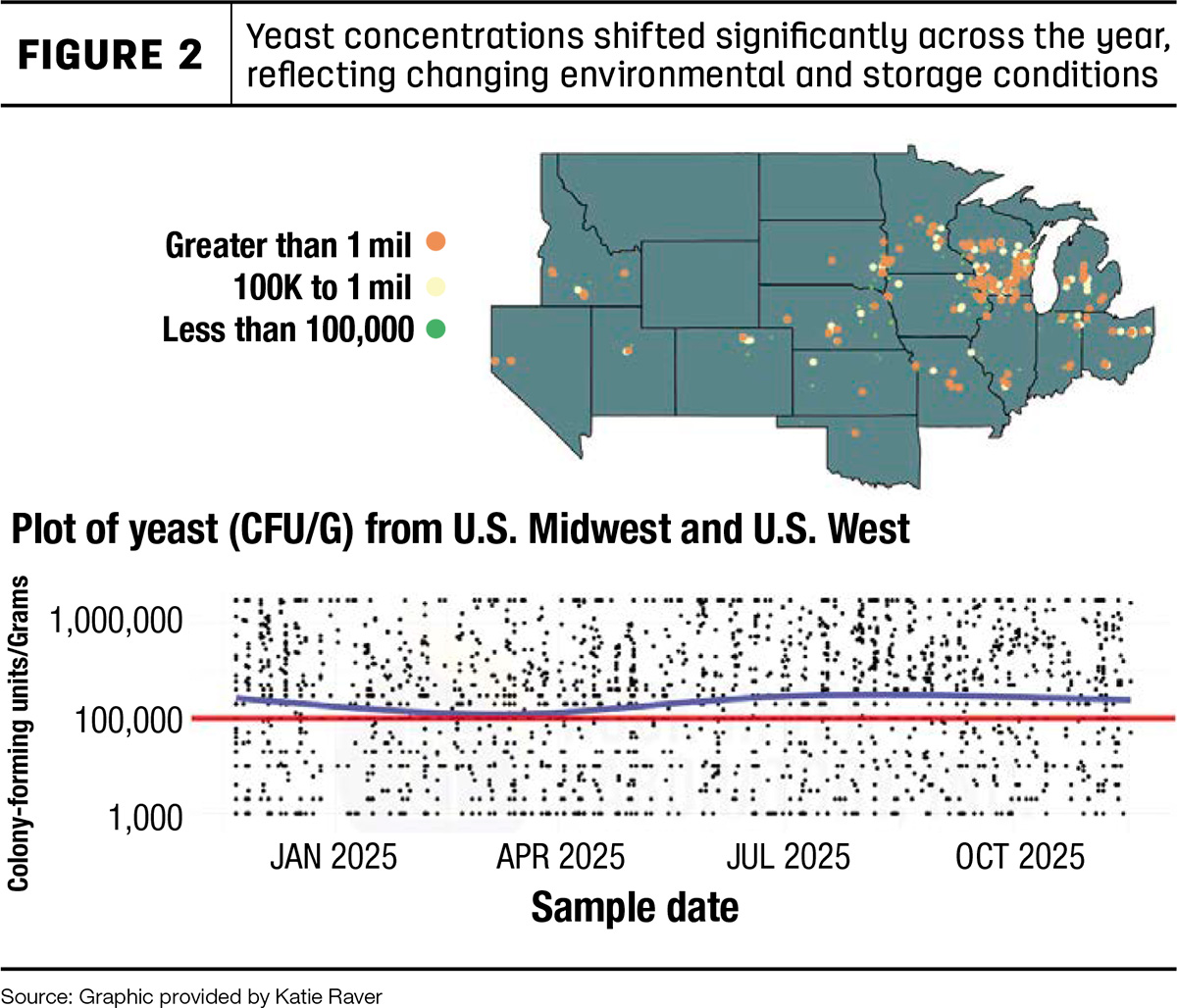
Raver reviewed two years of Midwestern and Western data across all feed types, highlighting anti-nutritional factors to watch in the 2025 corn crop. Yeast levels were seasonally high but management driven, and mold levels stayed steady with no regional patterns (Figure 2).
Enterobacteria increased in 2025, especially in total mixed rations (TMR), increasing the risk of digestive upset when combined with other stressors. Vomitoxin (DON) also trended upward as the new crop corn entered the system, with byproducts showing the highest concentrations. Zearalenone is beginning to increase as well, warranting attention.
“These shifts probably reflect 2025’s humid and drought-stressed growing conditions,” says Raver. “With more emerging risks than in 2024, monitoring feed hygiene remains important when troubleshooting cow performance.”
Pairing forages
Despite the hurdles of the 2025 growing season, Raver emphasized that no single crop tells the whole story and that the strengths of one forage can help offset the weaknesses of another.
- Corn silage delivers excellent starch and improved starch digestibility as fermentation progresses.
- Haylage and small-grain silages offer strong fiber digestibility and crude protein, helping fill gaps left by lower NDFD in corn silage.
Raver encouraged producers and nutritionists to keep a close eye on gut health as they begin feeding the 2025 crop. Monitoring starch digestibility and ensuring adequate digestible fiber will be key to maintaining cow health and performance.
“I think this crop year looks really nice overall,” says Raver. “But fiber digestibility and feed hygiene are two areas we want to keep in mind. Just knowing what you’ve got will help you position how to feed it – and help you navigate the inherent challenges we run into when feeding cows.”