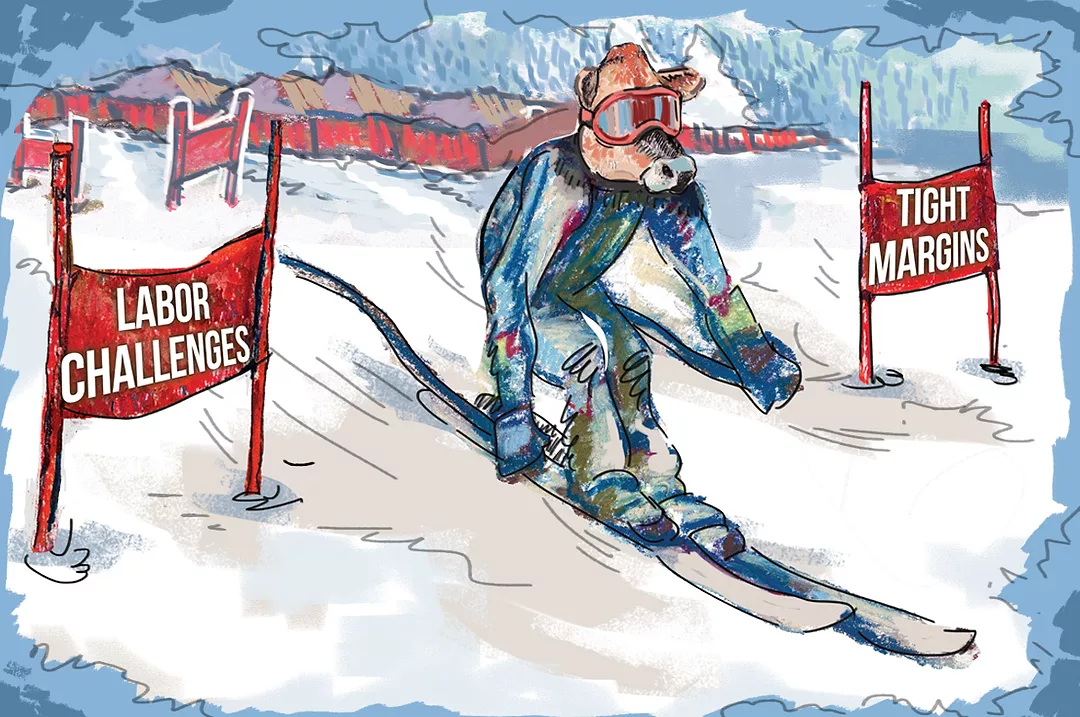
Labor challenges, low milk prices and tighter financial margins on many dairy operations are top of mind for producers heading into 2026, as well as growing concerns about labor availability, labor policy and staying competitive with surrounding nonagriculture industries.

“Many dairy producers are uncertain right now,” says Joanna Shipp from Bowmont Dairy Farm in Boones Mill, Virginia. “2025 was forecasted to be a good dairy year, and then we saw a four-dollar-per-hundredweight drop from the beginning of the year through November. Current forecasting shows even more of a milk price drop, which makes planning hard to do. We are bracing for a hard year with profit loss anticipated.”
Financial stress was noted across the country, especially in states like California where dairy producers are frustrated with low milk prices and are finding their lenders to be extending them less grace, says Anja Raudabaugh, CEO at Western United Dairies.
Higher costs for fertilizer, seed supplies, equipment and fuel are also making it more difficult for many dairy producers.
“Between high input costs and low milk prices, it makes paying the bills a real challenge and adds a lot of stress for producers trying to put food on the table and keep bills current,” says Max Bollenbacher from Argos Holstein Farms in Indiana. “There is not enough to go around right now in many cases. Higher milk prices are not expected in the near future, so it’s a bit depressing right now.”
Lolly Lesher from Way-Har Farms in Pennsylvania adds that lower mailbox prices coupled with higher interest rates are limiting growth and making it more difficult to capitalize on opportunities, such as adding on-farm technology.
With inflation and rising land prices, low margins represent the greatest threat to dairy farming right now, says Jayne Sebright, executive director at the Center for Dairy Excellence in Pennsylvania. Many of her industry colleagues agree.
“We have new markets coming online that will create long-term opportunities, but farms will really need to focus on working through this downturn to capitalize on those things in the future,” Sebright says.
Current conditions are also leading many to continue improving efficiencies.
“Milk prices as compared to costs are certainly challenging, and it is a good reminder of the continued need to evaluate which practices and plans fit each operation best,” says Betsy Bullard from Brigeen Farms in Maine.
Despite the challenges facing much of the industry right now, Travis Senn is optimistic that producers are more prepared and disciplined than they’ve been heading into past downturns. Senn is the assistant director of milk marketing and analytics at Southeast Milk Inc.
“Dairy farms today are far more intentional about risk management, cost control and business planning,” he says. “That doesn’t eliminate the challenges of lower prices, but it does make them more manageable.”
Labor predicted to be the greatest issue for dairy producers in the next decade
Labor was mentioned as one of the greatest challenges facing dairy farms today by almost every dairy producer and industry leader surveyed. This includes the lack of a workable immigration system for dairy, labor laws and labor availability. Many producers predict it will remain a growing threat over the next decade.
“Dairies hire the people who are willing to do the job, and we all know how difficult it is to find these people, so we sure don’t want to lose them,” says Kris Bousquet, executive director, Nebraska State Dairy Association. “I wish we could go into our local community and hire everyone we need to operate our dairies, but unfortunately, there is a lack of people who are familiar with and comfortable performing these duties.”
He says there is an opportunity for current Republican leadership to champion this issue but that agricultural labor and immigration need to be differentiated.
“Our farmers understand the issues of immigration reform and feel that ag labor reform of the H-2A/B or TN visa program to allow for dairy participation is paramount. Making the change to year-round labor and allowing dairy to qualify would provide a huge boost to our ability to keep our farms working in the future,” Bousquet says.
Senn adds that 2026 may be remembered as the moment when labor challenges moved from a long-standing frustration to a defining issue that demands real attention.
Many others agree.
“A sufficient, stable labor force will be the biggest challenge for producers in the next 10 years. Even though more dairies are installing robotic equipment, there will continue to be a need for farm labor, and the shortage will likely limit growth for many dairies,” says Darren Turley, executive director, Texas Association of Dairymen.
Competing for labor with surrounding industries is making it more difficult for producers like Mark Rodgers in Georgia to retain younger staff since they cannot match the wages that others in their area are paying, such as the John Deere assembly plant, Amazon, Club Car and E-Z-Go.
“We are trying to figure out how to increase employee wages to stay competitive without expanding the herd,” Rodgers says.
Some operations are finding ways to improve labor efficiency by investing in their teams.
“Many farms are focusing on improving routines and using best practices that save labor. We are also seeing more farms building leadership and accountability through training and positioning themselves as a preferred employer. It seems producers understand that investing in people brings big returns,” says Steve Obert, executive director, Indiana Dairy Producers.
Producers and industry leaders in California, New York, Oregon and Washington listed state agriculture overtime laws among the most challenging aspects of dairy farming right now, which further stresses tight financial margins.
“In Oregon, we are still stairstepping the threshold down to 40 hours and are in the last year at 48 hours. In January 2027, it will drop to 40 hours. I don’t know how our dairy farmers will survive,” says Tami Kerr, executive director, Oregon Dairy Farmers Association.
Across the country in New York, Quade Kirk from Dutch Hollow Farm cites increased input costs – especially labor – as one of the greatest challenges.
“Farming in New York state has its own set of challenges. At the beginning of 2026, our overtime threshold dropped to 52 hours, and minimum wage went up to 16 dollars per hour,” Kirk says.