Let's get right down to it: the what and whys of rat-tail syndrome (RTS) in cattle. This trait has been around for decades, and most ranchers and cattlemen are aware of it and can easily identify those tight, curly-haired little rascals at birth.

While the condition appears to affect only the calves' appearance, why are they discounted in most markets?
What is it?
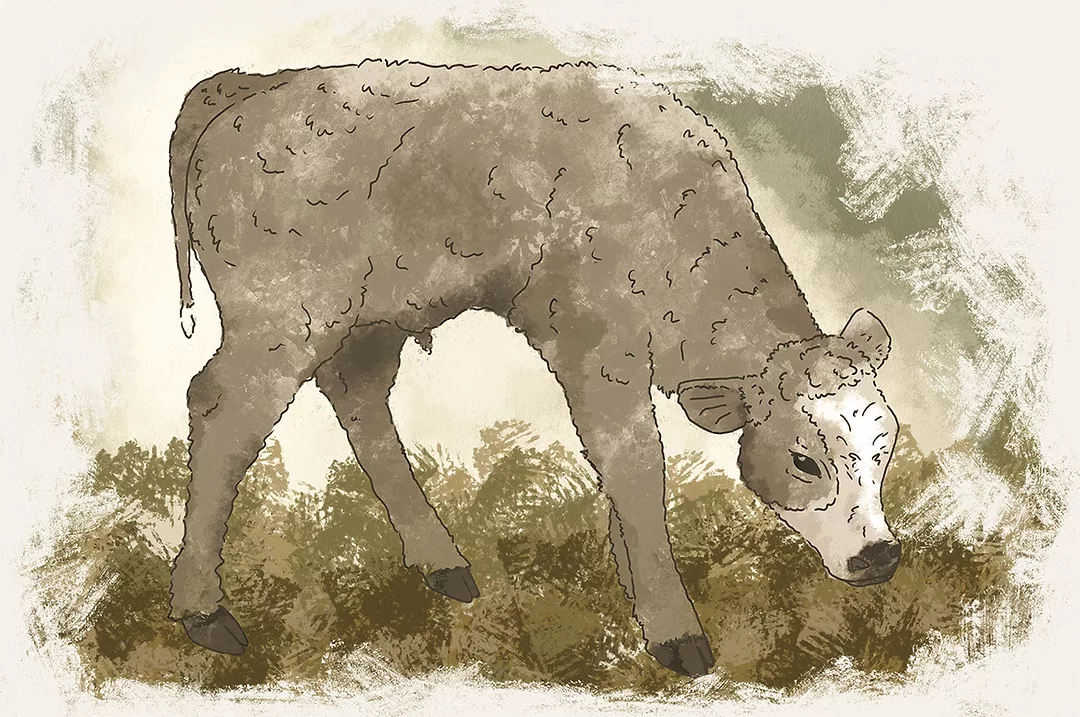
Rat-tailed calves are characterized by short, curly, malformed hair and an abnormal tail switch. In the 1960s and ’70s, ranchers started to notice what is now commonly known as rat-tailed calves. This was a result of the introduction of continental cattle breeds (including Charolais, Limousin, Simmental, Gelbvieh, Chianina and Maine-Anjou), which were crossed with black-hided/hair-coated cattle, initially observed when they were crossed with Angus or Holsteins.
A complex set of genetic factors influences the expression of RTS, which in turn affects the coat gene expression of black- or diluted-colored animals. In this case, recessive and dominant genes are at play, with some genes suppressed and others expressed. It's basically a genetic cascade that allows for dominant genes to be suppressed and recessive genes to be expressed. In RTS cattle, the hair coat issues are only in the black/gray areas. For example, if the calf has a white face, it will typically have a normal hair coat on that area. If nerdy genetics interests you, read the next paragraph; if you want to get to the meat and potatoes of the article, skip it!
There is an epistatic interaction (influences only a single trait, like coat color) between at least three independent genetic loci that expresses RTS in phenotype/appearance. In the case of RTS, gene expression at one locus is modified or suppressed by alleles at other loci. It is a result of a specific interaction between multiple gene locations, with the animal needing a dominant black coat gene and at least one dominant rat-tail allele on another gene location. The condition is very rare or absent in purebred cattle; it occurs in crossbred cattle, suggesting that two loci are required.
Research trial on performance of rat-tail calves
In the winter of 1991, researchers in Clay Center, Nebraska, looked at the impact of RTS on calf performance. In a group of 1,169 crossbred calves, 43 rat-tails were identified and then compared to 570 “normal” calves from the group (all steers). All the rat-tailed calves were sired by Simmental bulls and from cows with various percentages of Angus on the dam's side, managed within the same herd. All the calves were treated similarly, being weaned at 169 days, stockered and then taken to the feedyard as yearlings at 366 days. Data was used to compare the performance of RTS calves to normal calves of the same genetic lines.
Calves were weaned in the fall in Nebraska. From birth to weaning, there were no differences seen in the performance (205-day weights) of rat-tailed calves and their “normal” herdmates. However, from weaning to yearling weight (September to March), RTS calves had a significant decrease in average daily gain, being 43 pounds lighter. While there was no difference in daily gains and performance from yearling to slaughter, the rat-tailed steers were 78 pounds lighter and 13 days older at slaughter, meaning they were never able to overcome the lack of performance during the weaning to yearling phase.
Bottom line
From a performance standpoint, the issues lay in the cattle's ability to thermoregulate or control their body temperature. The coarse and thin nature of the hair does not allow it to insulate its body temperature the way a normal hair coat does. The amount of hair an animal has is not the only factor; the layers of still air trapped between and within the animal's hair structure amplify insulation. Additionally, hair length plays a role, with longer hair providing a deeper layer of insulation. With RTS cattle, the hair coat is short, thin and curly, really limiting the animal's ability to insulate during cold weather. This is why the Nebraska study showed that calf gains during summer and fall were similar, but during the winter months, RTS calves could not perform or gain at rates similar to those of their contemporary group and had a 43-pound decrease in gain over a 161-day period.
So at the end of the day, while hair coat is the only thing that is effectively wrong with a rat-tail syndrome calf, buyers must discount them, looking to their future performance. Additionally, discounts tend to be higher in colder regions and lower in areas like the Southeast.