Recently, I’ve had some deep conversations with producers around the concept that it’s not how much you can borrow but rather how much you can repay that matters. At the heart of the conversation is whether collateral or capacity to repay is more important. Both matter to your lender, so understanding them is critical to your planning process.

How much can you borrow?
This is often a collateral-centric conversation. Whether the security or asset a borrower pledges to a lender backs a loan or a line of credit, it’s the lender’s safety net – a tangible assurance that if the borrower cannot repay the debt, the lender has a claim on the collateral to recover the outstanding amount.
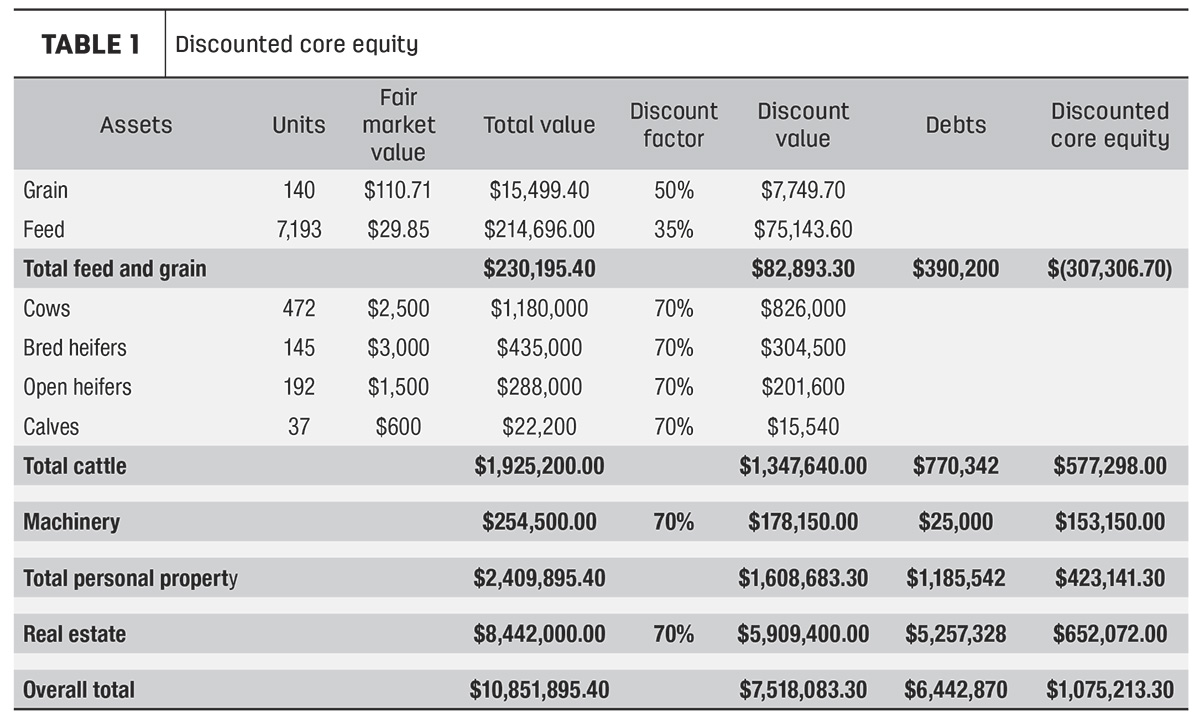
The amount of collateral required to secure a loan varies based on quality, how quickly it can be turned into cash and market volatility in the asset values. As a result of these factors, the amount you can borrow is a percentage of the appraised or market value of the asset. I used a similar thought process in a recent article on market volatility where I discussed discounted core equity. Discounted core equity is a great way for a farm manager to assess how much they can or want to borrow based on their farm’s market-based balance sheet values. The chart from that article appears in Table 1. It shows that, theoretically, the 472-cow dairy farm could support $7.5 million of debt. But should it? This is where the capacity to repay conversation begins.
Calculating what you can repay
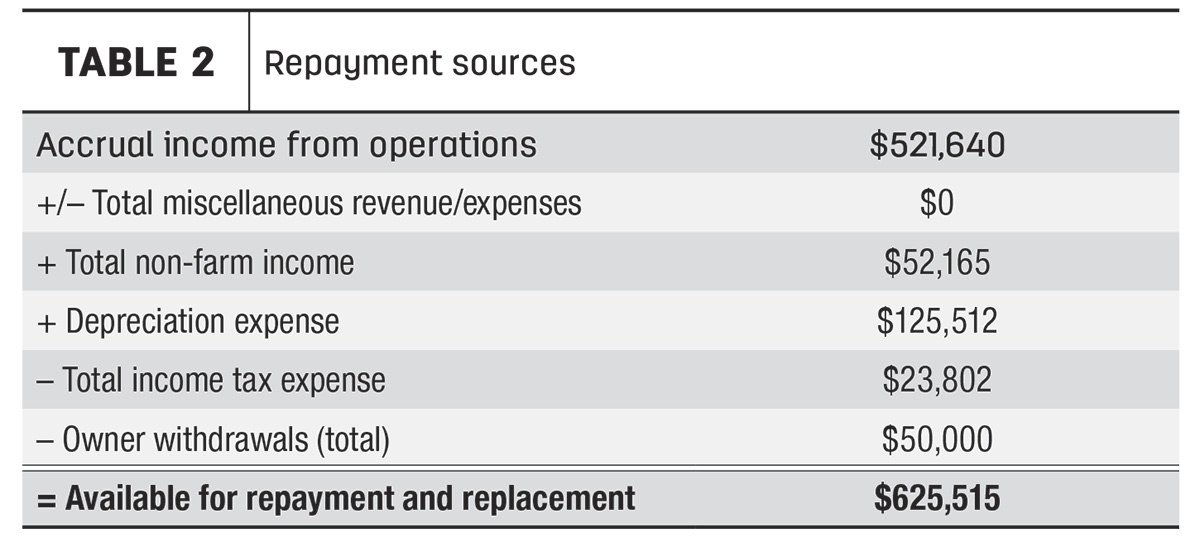
So, what is capacity to repay? It’s the operation’s ability to generate the funds necessary to amortize the outstanding obligations. The common calculation used is the debt coverage ratio (see the Farm Financial Standards Council’s Financial Guidelines for Agriculture for the full definition). To begin the analysis on what you can repay, you’ll first need to calculate how much you’re generating on an accrual basis. A sample calculation for our example farm is outlined in Table 2.
Next, calculate what payments are required. Simply put, add up all your principal and interest payments. For our example, let’s assume the farm is borrowing to its full discounted core equity level. With $1.16 million of the debt on a borrowing base revolving line of credit, using a 12-year amortization on the remaining debt, Table 3 shows what the repayment requirement would look like.
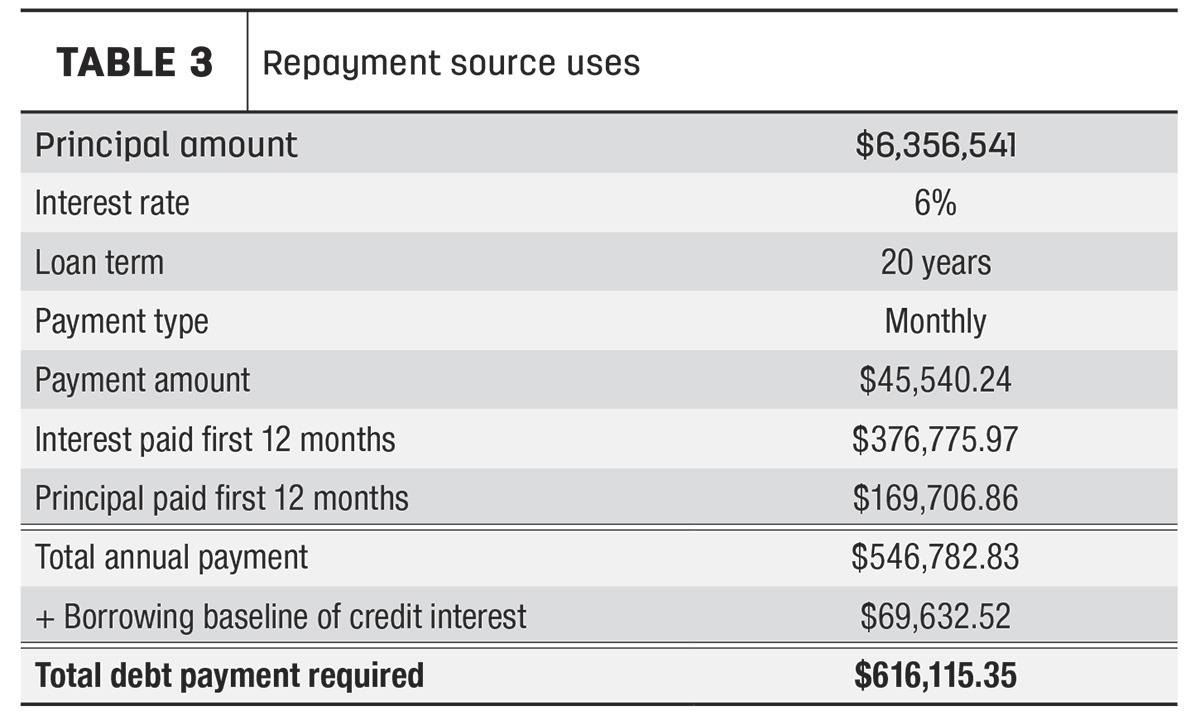
The debt coverage ratio would then be calculated by dividing the amount available for repayment of $625,515 by the repayment requirement of $616,115.35, resulting in a ratio of 1.01 to 1. Which means that for every dollar of debt payment required, our fictional farm only has $1.01 to make the payment. Not a good place to be. It’s significantly less than the goal of having $1.25 for every dollar of debt payment required.
Another red flag? Even at a 20-year amortization, the debt payment per hundredweight (cwt) is well above the desired $2.50 per cwt, indicating that in weak market conditions, the operation will likely struggle even more. And if they are already borrowed into that appreciated equity, they are at the end of the pier facing some pretty deep water.
Next-level managers take the repayment capacity conversation a step further. They add to the repayment side of the equation their unfunded capital purchase costs – the costs needed to maintain the operation. That is, what portion of the depreciable assets need to be replaced each year to keep the business running? The goal here is to be above 1.25 to 1.
Risk management ties into this conversation because without it, your ability to consistently reach acceptable levels of debt coverage becomes questionable. That is, even in down markets, can you maintain and sustain an acceptable debt coverage level? Consistent and proactive risk management practices result in financially sustainable operations.
So, in this example, should the operation borrow the full discounted amount? Probably not. Appreciation in values over recent years has outpaced those assets’ ability to generate revenue. This challenge is a reality in every farm business succession, expansion and startup conversation I’ve had in the last several years. I always appreciate the conversations with producers who understand these concepts and proactively address sustainable debt coverage in their planning process.
The bottom line: just because you can borrow money doesn’t mean you should. The best operators understand that to stay in business, repayment capacity is key.
This article is provided for information purposes only. Readers should consult their own professional advisers for specific advice tailored to their needs. Information contained in this article may be subject to change without notice.