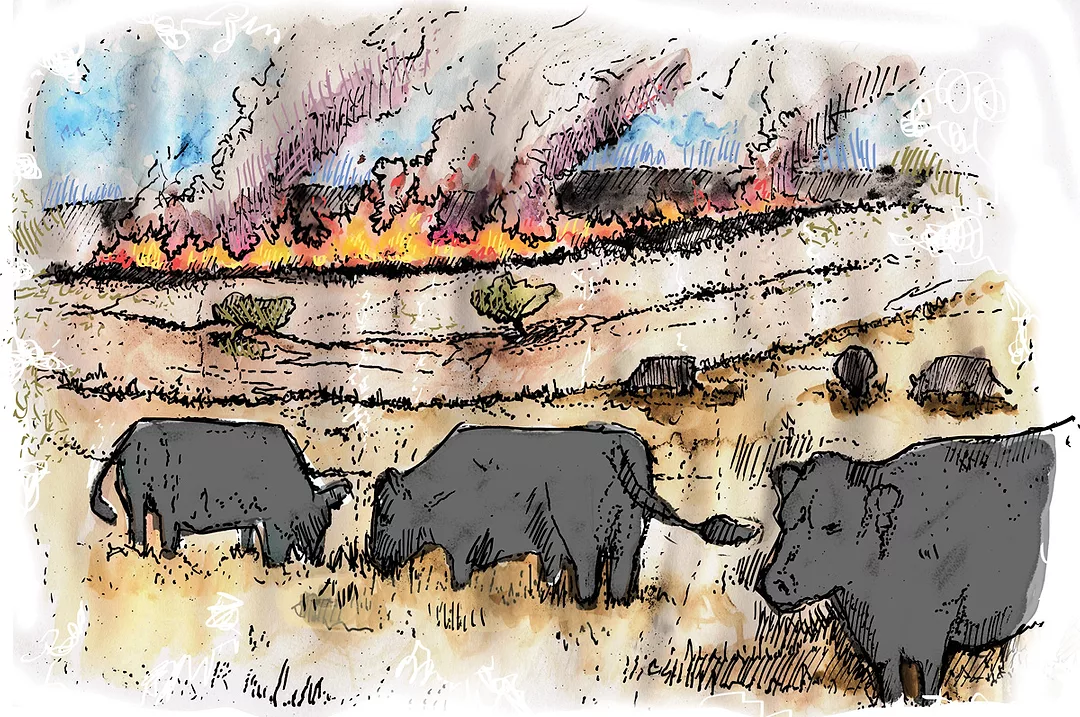
Most of us grew up learning about the dangers of wildfire from a cartoon bear in a ranger hat, saying, “Only YOU can prevent wildfires.”
Smokey is right – to a point. Wildfires may feel inevitable in regions where dry summers, heavy grass loads and high winds have made fire season a yearly reality. Ranchers who depend on outdoor conditions for their livelihood know all too well that Mother Nature always has her way. But while ranchers can’t control the weather, they can manage one of fire’s most important ingredients: fuel.
Dan Macon, a livestock and natural resources adviser with the University of California Extension, has spent the last several years helping producers in the Central Sierra region prepare for, respond to and recover from wildfire.
“One of the most important things is to be thinking about wildfire before fire season,” he says. “It’s easier to think clearly when you're not having to make snap decisions and you're not in a moment of crisis.”
Prevention: What can you do?
To burn, fires need three things: fuel, oxygen and heat. In the hot summer months, there’s not much anyone can do about heat and oxygen, but it is possible to manage the availability of fuel. On rangeland, fuel usually means one thing: grass, which is why grazing is one of the most powerful tools in wildfire prevention.
Macon explains it simply, saying, “Grazing by definition removes vegetation and, depending on the time of year, vegetation can be fuel.”
But not all grazing is the same. Macon describes it as a spectrum, with three main levels. On one end is conventional grazing, where production with minimal inputs is the goal. On the other is targeted grazing, where the goal is to manage vegetation or reduce fuel loads, with production being a secondary priority.
And in the middle is prescribed grazing, defined as grazing with a goal in mind. Macon says a good grazing plan is goal-oriented, removes fuels and is manageable for the producer, so it looks a little different for everyone.
“Prescribed grazing is really just thinking about the reason you have cows in this particular piece of rangeland is to do X, Y and Z. That may require rotational grazing; it may not,” Macon says. “I think it’s important to look at prescribed grazing in terms of all of the goals that a manager might have.”
Juliana Ranches, beef specialist at Oregon State University, agrees that reducing fuel load through methods such as grazing is key to wildfire prevention.
“Fires only happen if you have excessive biomass or fine fuels, and then you have an ignition,” she says.
Tools like the Rangeland Analysis Platform, she notes, can help producers identify where those fuels are accumulating and where grazing pressure can make the biggest difference. She also points out that combining that database with newer tools, like virtual fencing, is becoming part of the prevention conversation.
“We are doing some studies with virtual fencing and targeting those areas,” she says. “We identify those areas and create a virtual fence area within that specific area to have a little bit heavier or very targeted approach to reduce fuel in those fields. It’s definitely a tool worth thinking about.”
But ultimately, both agree that grazing for wildfire prevention is about doing what you can with the available resources.
Ranches sums it up like this: “At the end of the day, it's just about having a good, well-designed grazing management plan for your area to reduce that buildup of fine fuels and the biomass itself.”
Preparedness: Planning ahead
Even with good grazing management, wildfire risk is never zero. That’s why both experts emphasized that prevention has to go hand in hand with preparation.
For producers, that starts with having a comprehensive wildfire plan in place before the season begins.
Macon gives a few pieces of advice, saying, “Write the plan down, don’t keep it in your head. Involve everybody in your operation in that conversation. All of us see things a bit differently, and I think it's really helpful to talk to partners, spouses, employees, talk to everybody that's involved in the ranch about what you will do if there is a fire.”
Ranches are both businesses and homes, and they include livestock that can’t always be moved quickly. Macon encourages producers to include several key points in a plan:
- Defensible space around homes, barns, corrals and equipment
- Human and livestock safety, including evacuation routes
- Shelter‑in‑place options for cattle when evacuation isn’t possible
- Accurate livestock inventories in case animals are threatened or lost
- Protection of forage resources, especially dry fall feed vulnerable to fire
That might seem overwhelming, but there’s lots of resources to help ranchers get started.
“One of the real benefits of the extension system is that every producer just about has access to an extension person who can help them through this,” Macon explains.
Ranches agrees, saying many state land-grant universities have premade emergency and fire plan templates that ranches can fill out based on their specific needs. She stresses that every plan should be different because it must be tailored to each individual location and operation, but the templates are a good starting point.
“I wouldn't try to sit down by myself and develop that plan,” she says with a laugh. “We’re developing our own fire plan at the research center, and even with templates, it’s a lot of back and forth.”
Response: Smoke travels
Even when the ranch itself never burns, the effects of wildfires travel for thousands of miles.
Research currently being done by Ranches’ team at Oregon State is showing that smoke exposure triggers measurable stress responses in cattle.
“Smoke is an environmental stressor, like heat stress or dust,” she explains. “We saw more cortisol after smoke exposure and changes in the immune response.”
And the effects can last for years.
In his work with California ranchers, Macon says, “Sometimes that smoke problem doesn’t show up for two or three years. We've also talked to ranchers who kept heifers that survived fire, that when they had their first calf, they realized that they had scar tissue in their udders and were not able to produce milk.”
Ranches says she’s also seeing long-lasting negative results in their smoke exposure research.
“We are also seeing that those heifers that have been exposed to smoke seem to be gaining less weight,” Ranches says. “That’s something producers have said before, that they think whenever they have really poor years of air quality or a lot of smoke, they are seeing lighter weaning weights.”
Unfortunately, smoke doesn’t have boundaries. Fires in California can spread smoke to cattle ranchers in New York, which means this side effect of wildfires is something everyone should be thinking about. And while currently there’s not much that can be done to mitigate the effects of smoke exposure, Ranches says it’s important to avoid stacking stressors.
“What we've been recommending to producers is that if you are planning any other management in that period that you know can be stressful like vaccination, branding, weaning or transportation, postpone it if possible,” she says. “If there's smoke in the sky, don't do anything else with those animals because it's just double stress at the same time.”
At the end of the day, wildfire, like any natural disaster, is impossible to be fully prepared for. But cattle producers should know what they can do to help prevent wildfires, have a response plan in place and know how to manage cattle in the aftermath.
Unfortunately, ranchers can’t control the weather. But they can control how prepared their operation is when wildfire season arrives. As the summer months approach, remember those wise words from Smokey. Only you can prevent wildfires, and only you can make sure your operation is prepared for whatever the season brings.