You have probably heard, “It is tempting, if the only tool you have is a hammer, to treat everything as if it were a nail.” Wikipedia credits the quote to Abraham Maslow and calls it the law of the hammer – a cognitive bias that involves over-reliance on a familiar tool. What is your familiar tool for managing mastitis in your automated milking system? Conductivity? Somatic cell count (SCC)? California Mastitis Test (CMT)? Cultures? The list goes on.

Continuing with the tool analogy, my garage is filled with mechanic’s tools and woodworking tools. Some tools, like screwdrivers, are used for both mechanical projects and woodworking projects. But I have never used my table saw for a car repair, and I have never used my oil filter wrench to build furniture. That’s not what they are for. Similarly, we can categorize automated milking system data into tools for detecting new infections in individual cows and tools for monitoring the herd level of existing infection. The tools will be more valuable if we use them correctly.
Detecting new infections
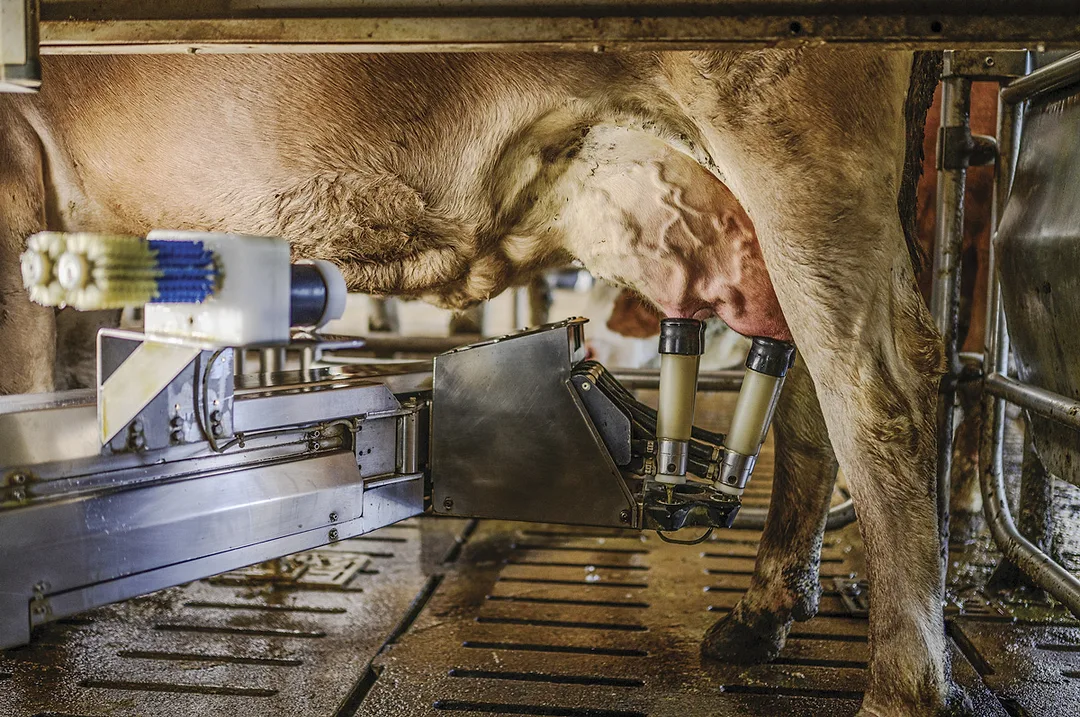
Most automated milking systems measure milk conductivity from each quarter at every milking. Conductivity is a measure of inflammation. When mastitis causes udder tissue to become inflamed, the cells release salt into the milk. That salt increases the electrical conductivity of the milk. Conductivity is measured by passing a very small electrical current through the milk as it flows through the meter. The units are millisiemens per centimeter. For reference, distilled water conducts nearly 0 millisiemens per centimeter, while seawater conducts 55 millisiemens per centimeter. The normal range for milk is 4 to 6 millisiemens per centimeter, but it is important to remember that every cow has her own normal. In automated milking system software, we not only compare each cow to herself, we also compare differences between quarters.
Conductivity is useful for detecting new infections because every quarter is automatically monitored at every milking. Changes are detected in real time. There are limitations. First, conductivity measures inflammation. A hot, swollen quarter has inflammation. When there is no inflammation, there is no change in conductivity. If a cow has an old infection that is walled off behind scar tissue in the udder, her SCC might be over 1 million. Her conductivity will not be elevated if there is no inflammation. Conductivity and SCC are not necessarily correlated. Second, a systemically ill cow might not come to the robot, or a severely inflamed quarter might not produce enough milk for conductivity to be measured. In either case, a toxic mastitis might be missed. Despite those limitations, conductivity does accurately and quickly detect many new infections.
There are a few other tools that complement conductivity in detecting new infections. Obviously, cows with lower-than-expected yields should be examined to find the cause. Animal monitoring systems can detect rumination and behavior deviations which can be indicators of mastitis. The California Mastitis Test is a cowside tool to evaluate whether yield, behavior and rumination deviations are mastitis-related. Finally, don’t overlook that new fetch cow. It is possible that she did not come to the robot today because of a health problem like mastitis. Put all of these tools together to detect new infections.
Monitoring existing infections
Somatic cell count has been used as an indicator of udder health for more than 40 years. On a herd level, it can impact milk production, milk price and even availability of milk markets. While quality premiums are less significant than they used to be, bulk tank SCCs over 200,000 still have an economic impact. Low SCC cows produce more, become pregnant more quickly and stay in the herd longer than high SCC cows. High SCC cows have potential to infect their herdmates, and that potential increases in automated milking systems because each machine touches more cows. You can’t solve a herd SCC problem without individual cow SCC data. You have to find the highest SCC cows and manage them. Management options include segregation, treatment and culling, but you can’t do any of those until you identify the problem cows. There is no indirect measurement that can reliably predict a cow’s SCC – not conductivity, not culture results, not milk production.
Many automated milking system units measure SCC during milking and summarize the data in the software. This is ideal because the data is complete and readily available. It does not require extra time and effort from the farmer, and it does not disrupt the cow’s routine. Sampling frequency can vary with different manufacturers and different owner preferences. DHI testing is the best option if your system does not include inline testing. Many testing organizations are willing to analyze SCC only, at lower cost than a full testing program. Some organizations have sampling equipment for customer use. Some farmers own sampling equipment and share it with their neighbors. You need individual cow SCCs to manage the herd SCC.
Cultures can also help to monitor existing infections in a herd. A monthly bulk tank culture is the minimum. The bulk tank culture tells you what organisms are affecting the cows in your herd. You can target management practices to address specific pathogens. Environmental organisms suggest focusing on stalls and prep procedures. Contagious organisms suggest identifying the cows that are carrying and spreading the infection. New organisms may demand a new approach. Arrange for your hauler or plant to collect a monthly sample. Your hauler might run the culture, or you may need to send it to another lab.
The next step is to culture clinical cows. Start with cows that you have sorted for mastitis evaluation. They are easy to work with because they are already restrained. When in doubt, take the sample. Once you have the sample, you can decide whether to process it immediately or freeze if for future reference. It’s better to have it and not need it than to need it and not have it. You can use individual cow culture results to choose the right treatment. Results also add clarity and focus to the big picture from your bulk tank culture. You can begin to tell whether a specific pathogen is affecting one pen, lactation group or stage of lactation more than others.
There is no doubt that data adds value to automated milking systems, and mastitis data is no exception. It is important to use the data correctly. Use conductivity, yield, activity, rumination and behavior to detect new infections. Use somatic cell count and culture results to monitor the status of existing infections. All of these tools can help you build a better herd if you use them correctly.