When it comes to feeding mineral, producers have ample opportunity to customize a program that fits their unique needs while also being economical. There is a wide variety of minerals on the market, but reading the labels to compare products can be a bit daunting.

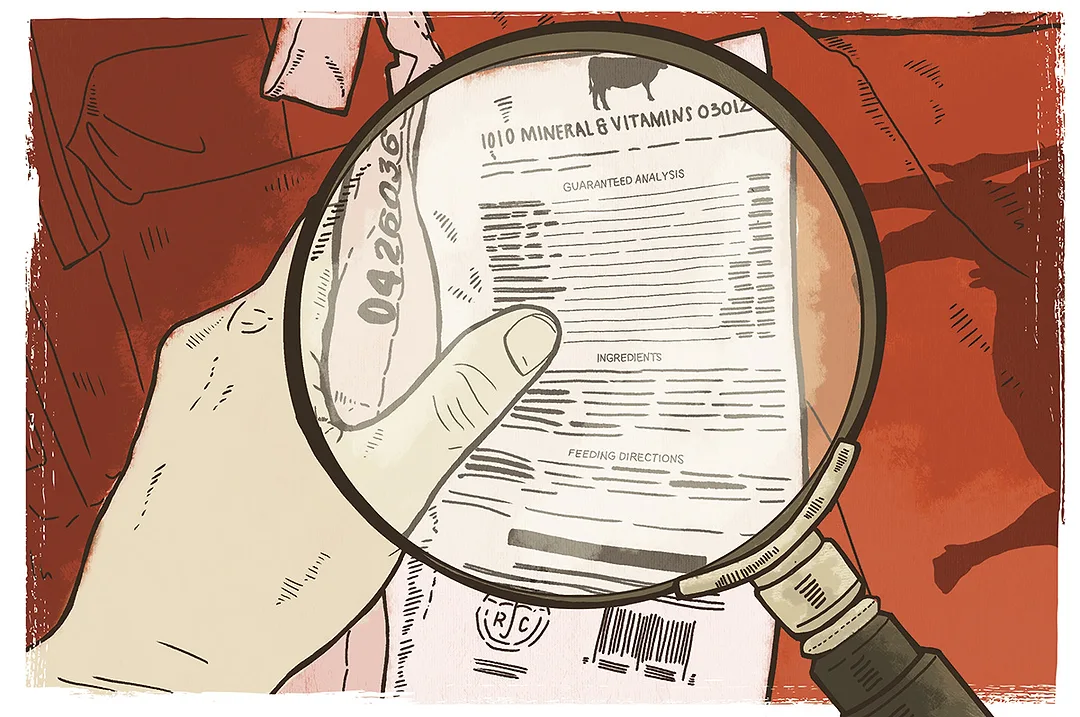
Mineral tags on commercial products are legally required and regulated. This helps both the feed company and producer. Understanding what is reported on a tag is a good first step to understanding which products meet your needs. All commercially available mineral tags will include:
- Product name and manufacturer: Often, the name will also indicate if this mineral was developed for a particular season.
- Intended use: This statement typically specifies what species, production stage or time of year the mineral was formulated for.
- Medications and/or active ingredients: This will include the concentration and intended use, along with any regulatory statements for each product. Medications like CTC (chlortetracycline) require a Veterinary Feed Directive (VFD) from your veterinarian. Other commonly included active ingredients such as methoprene for fly control or ionophores like monensin do not require a VFD.
- Guaranteed analysis: This specifies the concentration of each nutrient included in the package. Some are listed with ranges, while others are just a single value. These are reported as a percentage or parts per million (ppm) concentration and generally in an as-fed basis.
- Ingredient list: Like a grocery store label, ingredients are listed from highest to lowest inclusion. This is where you can tell if a mix is using only inorganic sources or a mix of organic and inorganic. While nearly all contain both, the general rule is organic (and chelated) sources are more bioavailable than inorganic. Words ending in “-ine” like methionine, glycine or other amino acids are organic, while “-ates” or “-ides” are often inorganic (sulfates, oxides, etc.).
- Feeding directions: Always check feeding directions! First note the intended feeding method (free-choice, etc.), feeding instructions and feeding amount. Most free-choice minerals are formulated for a 4- or 8-ounce per head, per day intake. However, no one tells the cows this. A crucial step to controlling mineral costs and attaining the desired performance is to track consumption. If consumption is logged, producers can determine if cows are overeating or undereating mineral as a herd, then utilize salt, feeder placement or other strategies to achieve the desired intake. It is valuable to note that each cow has variable intake, and older calves are probably contributing to some mineral disappearance.
- Cautions and warnings: All safety precautions will be listed on the label in this section, including if there are livestock species that the mix is particularly dangerous for. All products should be used for the intent they were formulated for.
- Additional information: There may be a section with additional information that does not fit in the other areas. The title of this section may say, “Important” or something similar.
Understanding these basic components is essential when beginning to compare products. Products really begin to differentiate when comparing the guaranteed analysis. For example, how much of a 10 ppm copper requirement for a cow is met by a mineral supplement providing 1,200 ppm copper?
First, the cow’s daily intake needs to be estimated. If she’s a 1,400-pound cow with a calf at side, eating 2.5% of her bodyweight, that’s 35 pounds of dry matter intake (DMI) per day. A mineral targeting 4 ounces of intake per day is 0.25 pound of mineral per day. To keep it simple, we can estimate her copper ppm intake with this formula:
(1,200 ppm copper × 0.25 pound of mineral)/35 pounds DMI = 8.6 ppm of copper
Beyond the calculated amount, remember that the guaranteed analysis simply specifies the amount of each nutrient included. It does not account for bioavailability. That means reading the ingredient list is needed to understand how much further ppm of copper needs to be discounted in order to identify the actual amount available to the animal.
On the flip side, keep in mind that forage, feed and water all include some micro- and macronutrients that contribute to meeting a cow’s dietary requirements. Getting an understanding of what the diet provides is really important to understand what supplemental support cattle need.
Submitting feed samples is one option to get to the mineral content provided in the diet. Alternatively, a nutritionist or beef extension specialist can help you find and identify historical values reported for various feeds and forages. Regional differences, seasonality, growing conditions and forage composition are all huge considerations. Again, like the nutrients provided in a supplemental mineral, the nutrients in the base diet are not 100% available. To further complicate things, antagonisms further prevent actual absorption into the animal.
If interested to learn more, I recommend a YouTube series called Mineral Matters from the University of Nebraska – Lincoln beef team. And as always, reach out to your local extension specialist or nutritionist with questions. Mineral nutrition is complicated. Fortunately, there are many mixes available that will get the job done. The more you know and understand what the diet provides and what the cattle need, the more you can tailor a program to provide what you need and not what you don’t, keeping costs reined in.