June marks the halfway mark for 2026, but it is already time to start thinking about risk management coverage for 2027 as the new crop year is on the horizon.

The USDA Risk Management Agency (RMA) released a series of improvements to risk management programs for dairy producers for the upcoming 2027 crop year, which begins July 1. The improvements uniformly effect coverage options for Livestock Risk Protection (LRP), Livestock Gross Margin for Dairy (LGM-Dairy) and Dairy Revenue Protection (Dairy-RP) insurance programs.
“These enhancements are another way we are putting farmers first,” said RMA Administrator Pat Swanson in a press release. “We want to ensure that livestock and dairy operations across the country have the best tools available to manage risk.”
The most notable change is the ability for dairy producers to use Dairy-RP and LGM-Dairy, and LRP and LGM-Cattle concurrently in the same coverage period as long as they meet certain criteria. Previously, only one insurance program could be used for a single coverage period.
“The intent was to prevent double-dipping on indemnity payments, but in practice, it left producers unable to fill legitimate coverage gaps using the tools available to them,” says Alex Gambonini of HighGround Dairy. “This rule change will enable producers to cover a portion of their production under multiple programs, giving them greater flexibility in their risk management toolkit.”
Key stipulations of the concurrent coverage change include:
- Both policies must be held with the same approved insurance provider.
- Aggregate insured production coverage will be compared to a producer’s actual production.
- Indemnities will be collected on actual production to prevent overinsurance.
Additionally, the insurance programs will implement tiered beginning farmer and rancher subsidies across the first five years of operation, beginning with 15% in years one and two and reducing to the 10% by year five.
Individual program changes will also go into effect, most notably:
- Dairy-RP: Weekend and holiday deadlines will close the next calendar day at 9 a.m. CST.
- LRP: Cull cow coverage will extend to 52 weeks out; maximum weight raised for steers and heifers will be raised to 18 hundredweight (cwt), and 17 cwt for cull cows; a new weight class for unborn bulls and heifers and dairy calves will include 6 to 9 cwt; and sales will be closed on the biannual USDA Cattle Inventory report release days.
- LGM: Maximum weight will raise to 1,800 pounds; maximum target weight will raise to 18 cwt for yearlings and 16 cwt for calves; feeder maximum target weight will raise to 12 cwt, and live feeder spread will be capped at 6 cwt for yearlings and 10 cwt for calves; sales will be suspended on the biannual USDA Cattle Inventory report release days.
Remember, these new rules only apply to coverage purchased on or after July 1.
“2026 has truly proven how quickly dairy markets can move, as this year has been quite volatile on many fronts,” Gambonini says. “Times like these remind us how important it is to be proactive and consistent in managing margins through various risk management tools, and these upcoming changes should help producers be more flexible in finding the right coverage for their operations.”
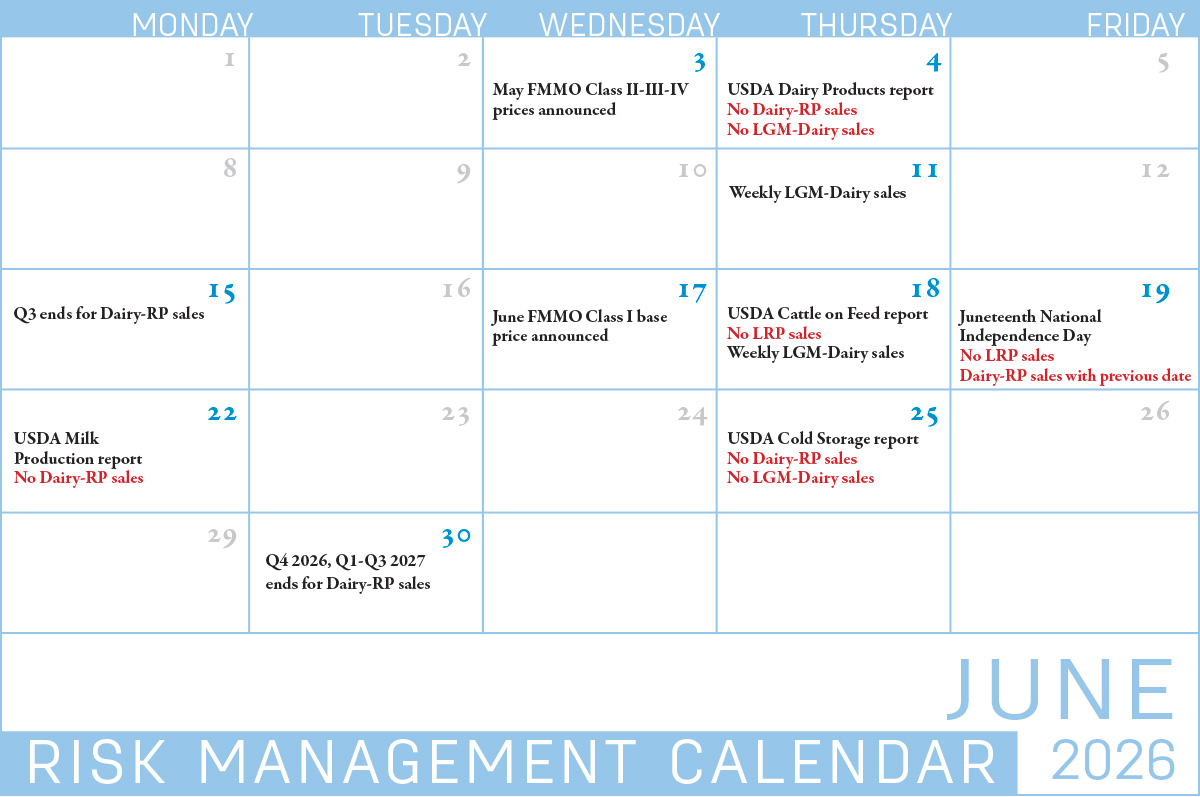
Here’s Progressive Dairy’s look at important dates, reports and advice affect risk management decisions yet in June.
Dairy Margin Coverage (DMC)
Both milk prices and feed costs rallied enough in March for the DMC program margin to climb out of the depths of indemnity payments. As milk prices firmed and feed costs remained steady, the March DMC margin came to $9.57 per cwt, just 7 cents above the highest coverage selection in Tier I. (Read: March DMC skates above payment threshold at $9.57 per cwt)
April forecasts carry the momentum built in the previous month with milk prices predicted to rise nearly $1 to $20.65 per cwt and feed costs climbing 12 cents to $10.25 per cwt at the time of this writing. Looking at individual feedstuffs used in calculating a dairy farm’s feed costs, the price per bushel of corn is anticipated to climb to $4.43, and the price of soybean meal is already calculated at $330.28 per ton. However, the forecast for alfalfa hay falls $6 to land at $224 per ton. If the forecasts remain, a realized DMC margin should be $10.40 per cwt with no indemnity payments issued. The actual April DMC margin will be announced May 29 following the release of the USDA Agricultural Prices report.
Forecasted margins mostly remain in the $10 to $11 per cwt range for the remainder of the year. Current market conditions are indicating a slight fall in the DMC margin for July and August, but not falling below the indemnity trigger point. Although, it’s too early to say as markets do change.
Dairy-RP
Dairy producers managing risk through Dairy-RP are eligible to cover revenue quarterly, up to five nearby quarters. In June, Dairy-RP coverage is available for the third quarter of 2026 (July through September) and will close June 15. Additionally, because of the insurance program improvements set to take effect July 1, the remaining available coverage for the fourth quarter of 2026 (October through December) and subsequent three quarters in 2027 (January-September 2027) will close June 30.
The market changes daily and Dairy-RP endorsements must be purchased between the Chicago Mercantile Exchange (CME) market closing and the next CME opening. Dairy-RP is also not available on days when applicable futures contracts move limit-up or limit-down, or on days when CME trading s closed due to holidays.
Also, typically Dairy-RP coverage cannot be purchased on days when major USDA dairy reports that could impact markets are released. This includes Milk Production, Cold Storage and Dairy Products reports (see Calendar).
LGM-Dairy
LGM-Dairy provides protection when feed costs rise or milk prices drop, and can be tailored to any size farm. The program uses futures prices for corn, soybean meal and milk to determine the expected gross margin and the actual gross margin. LGM-Dairy is similar to buying both a call option to limit higher feed costs and a put option to set a floor on milk prices.
Coverage for LGM-Dairy can be purchased on expected milk marketing over a rolling 11-month insurance period. So the coverage period during June includes the months of July 2026 through May 2027. Sales periods for the LGM-Dairy program are open on a weekly basis except when Milk Production and Cold Storage reports are released on the same day.
LRP
This program is a valuable tool for dairy producers as beef-on-dairy and strategic culling decisions are key parts of herd management and business decisions. For dairy producers, LRP coverage is available as LRP-Feeder Cattle (beef-on-dairy calves) and LRP-Fed Cattle (cull cows) with four additional options to select the appropriate coverage, including head count, targeted marketing weight, and coverage length and level. No more than 12,000 head can be covered in a specific coverage endorsement with an annual limit of 25,000 head per farmer, per crop year (July 1 to June 30).
The sales period for LRP coverage is open each afternoon after futures prices are settled and closes the following morning. Similar to Dairy-RP, LRP is not available on days when CME trading is closed due to holiday or when major USDA reports impacting prices are released, such as Cattle on Feed. The RMA also has the right to close sales at their discretion.
Production and price outlooks
- USDA’s May World Ag Supply and Demand Estimates (WASDE) report raised milk production on expectations of a larger cow herd but a slower growth rate in output per cow. (Read: USDA adds 3.7 billion pounds to 2026 milk outlook)
- Quarterly average prices for dairy replacement cows increased to $3,130 per head according to USDA estimates in April. (Read: Replacement dairy cow prices hit new record high)
- The Federal Milk Marketing Order (FMMO) uniform milk prices rose an average of $1.48 per cwt from March to April for an average price of $20.03 per cwt across the 11 orders. (Read: April uniform milk prices, PPDs rise)
To learn more about the critical updates on dairy and cattle insurance program changes taking effect this July and other practical strategies for protecting your operation from downside margin risk, register for the Dairy Market Update webinar with Progressive Dairy and Ever.Ag on June 3.