The USDA confirmed the discovery of New World screwworm (NWS) in a calf in Texas on June 3, 2026. Subsequently, additional cases have been identified in livestock and pets within the U.S. In response to these NWS cases, the USDA and local state officials have implemented actions to contain and monitor the movement of the pest, including quarantines and movement controls of livestock in affected areas. Forecasts in this report reflect cases known and policies implemented at the time of publication of the World Agricultural Supply and Demand Estimates (WASDE) report.
If identified and treated properly, animals can often recover from NWS infections. Premises within an approximately 12-mile radius of a suspected case of NWS will be placed under a hold order or quarantine and will not be allowed to move animals until they are examined by approved personnel for NWS. Animals that have recovered from NWS infestation are eligible for marketing if they meet all regulatory requirements, including release from on-farm quarantine and absence of residues from any treatments. Those animals must also pass inspection by the USDA Food Safety and Inspection Service (FSIS) that ensures humane handling of animals and food safety requirements are met.
Slaughter pattern shift drives modest production changes
Compared to last month, minor adjustments are made to the 2026 and 2027 production forecasts. The discovery of NWS in the U.S. has not altered the underlying cattle supply situation, which remains characterized by tight supplies. Cattle producers along the southern border will likely incur additional financial and time‑related costs because of on‑farm surveillance and prevention measures, treatment of any infected animals and compliance with any associated regulatory requirements for the movement of animals. Given the number and locations of the known cases at the time of the WASDE publication, the volume and timing of cattle moving from the farm to the feedlot are not expected to be greatly impacted at the national level. The changes to the forecast this month are primarily due to the recent pace of cattle moving from the feedlot to the packing house, as well as heavier carcass weights than previously expected.
The projection for 2026 beef production is lowered 110 million pounds from last month to 25.438 billion pounds. The decrease in second-quarter production reflects slaughter data through early June that suggests a slower pace of cattle slaughter. The slow pace is notable because the estimated number of cattle on feed over 150 days for April 1, and then May 1 was the highest on record. In the third quarter, production is projected marginally lower as the slower pace of cattle slaughter is carried over from the second quarter. The fourth quarter is forecast to have fractionally more production, as more fed cattle slaughter are expected at that time. Further, based on slaughter data through early June, anticipated carcass weights are raised.
The 2027 beef production forecast is raised from last month by 75 million pounds to 25.385 billion pounds. This slight change reflects further evaluation on the timing of marketings next year, resulting in a net increase in cattle slaughter. Additionally, the increase in expected carcass weights in 2026 is carried over to next year.
Cattle prices still robust and hinge on supply fundamentals
The number of reported NWS cases in the U.S. remains relatively small and geographically concentrated. Current data do not indicate meaningful disruption to cattle movements across the Southern Plains. Current price forecasts are largely unchanged from last month, and cattle prices are expected to stay robust, though volatility may remain.
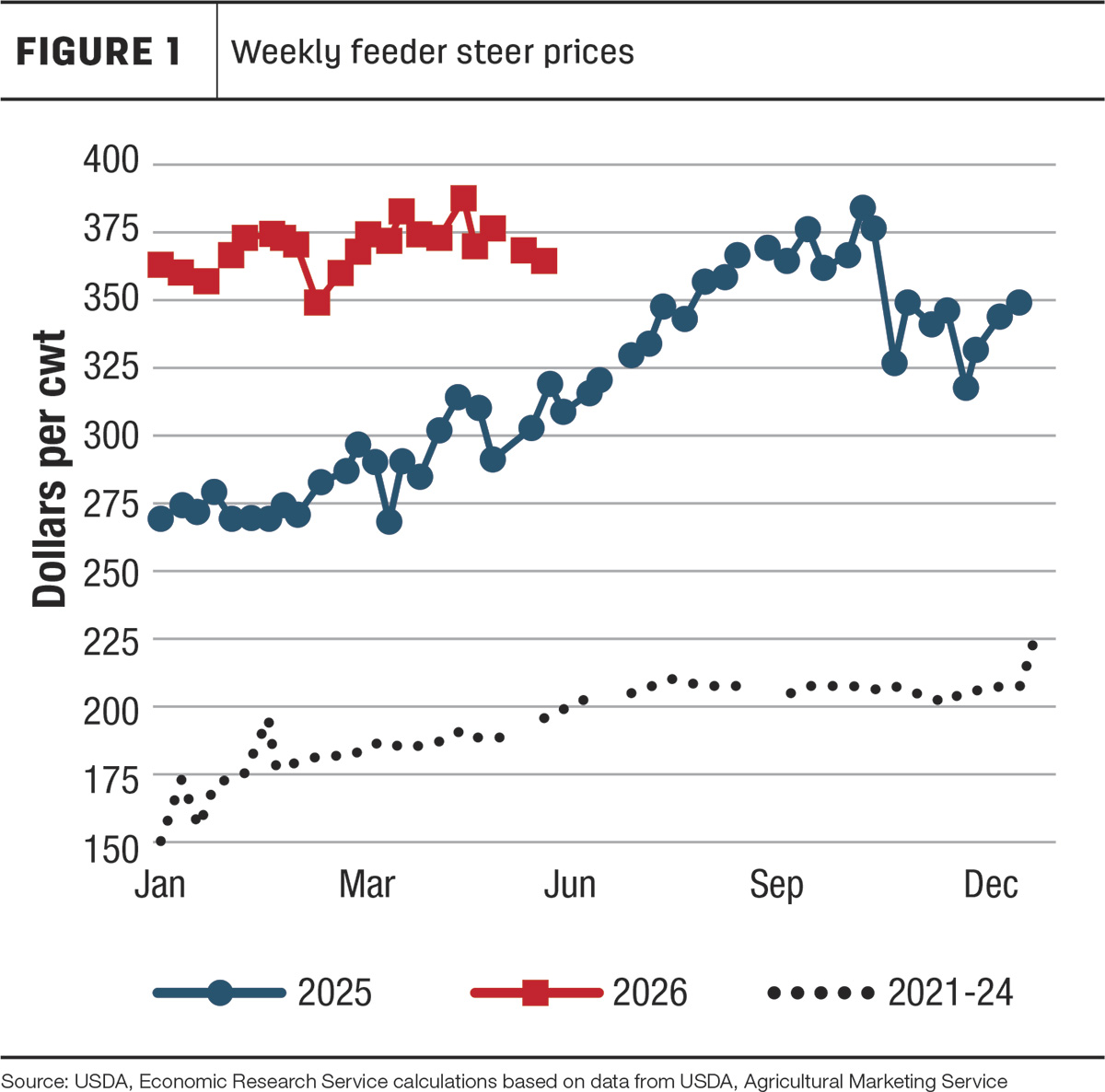
Feeder steers weighing 750 to 800 pounds at the Oklahoma City National Stockyards averaged $378.38 per hundredweight (cwt) in May (Figure 1). In the first two weeks of June, prices have declined to a weighted average price of $366.36 per cwt. Based on June price data, the 2026 second-quarter price forecast is lowered $4 from the previous month’s forecast to $375 per cwt. Further, the third- and fourth-quarter 2026 forecasts are reduced $2 each from last month to $378 and $382, respectively. The outlook for 2027 feeder steer prices is unchanged from last month at $382 per cwt.
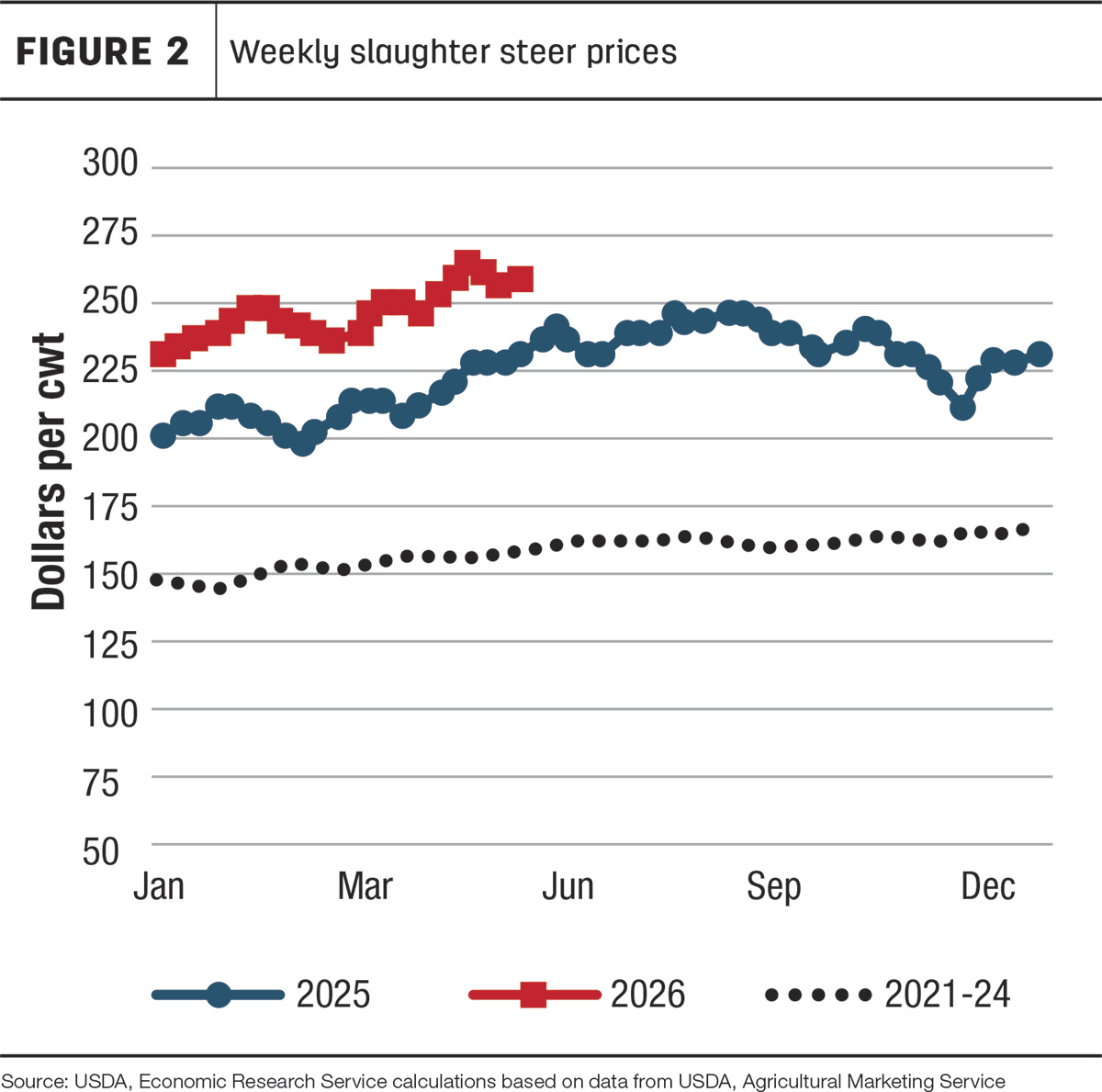
Weekly slaughter steer prices in the 5-area marketing region have maintained historic levels, with an all-time high set in the week ending May 15 at $262.85 per cwt (Figure 2). The monthly weighted average price for slaughter steers in May was $259.99 per cwt, $10.94 above the record set in April. Based on price data through early June, the second-quarter 2026 slaughter steer price forecast is raised $2 to $255 per cwt. The third and fourth quarters are unchanged from last month at $252 and $255, respectively. The outlook for 2027 slaughter steer prices is unchanged from last month at $253.75 per cwt.
Beef exports
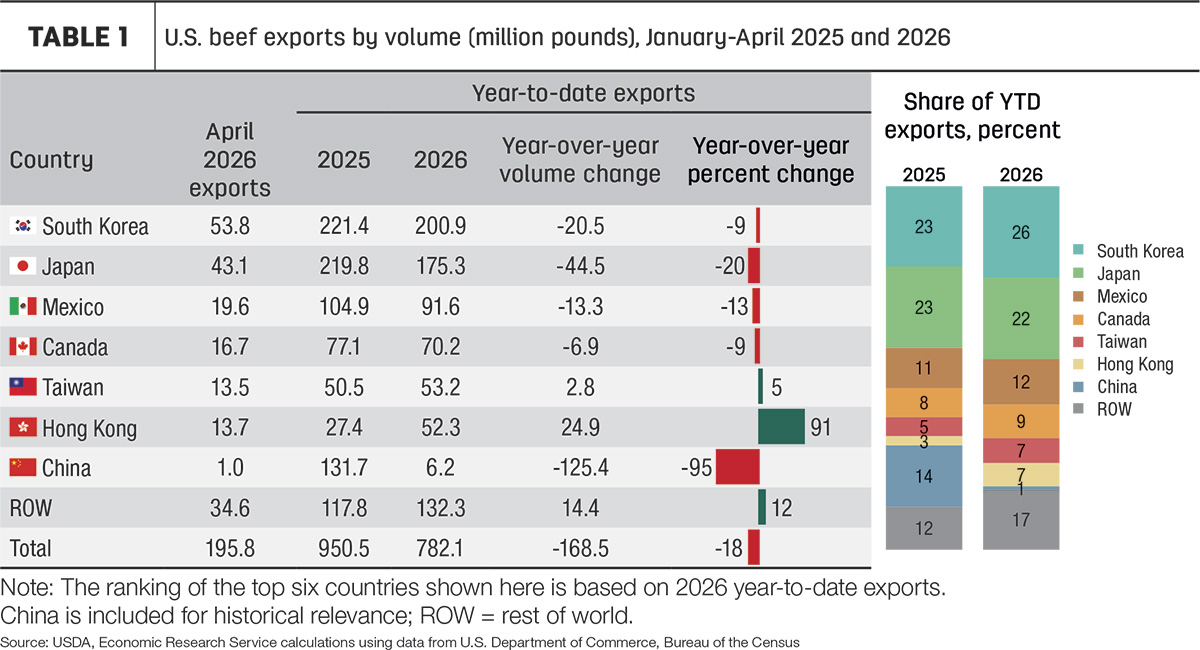
U.S. beef exports in April totaled 196 million pounds, 17% lower year over year. Lower exports to Japan, China, South Korea and Mexico accounted for a majority of the year-over-year decrease. Exports to Hong Kong were 51% (5 million pounds) higher year over year. Exports to countries outside the top six U.S. beef destinations were also slightly higher year over year. Table 1 shows year-to-date exports as well as the share of exports to each of the major markets. Most markets have gained share in 2026 as exports to China, the third-largest market at this point in 2025, have been minimal since export registrations from the General Administration of Customs of China (GACC) expired in March 2025. Hong Kong’s share has increased from 3% to 7% this year with year-to-date exports through April 2026 nearly doubling last year’s level since the export restrictions to China took effect.
In May, some of the export registrations for certain U.S. beef production facilities were renewed on the GACC website. However, several facilities still remain ineligible to export to China due to other restrictions. Additionally, while exports of muscle cuts to China may increase in the coming months, there will likely be redistribution of product that has been directed to other markets over the past year, including Hong Kong.
Based on the pace of exports in April, the export forecast for second-quarter 2026 is lowered 20 million pounds to 600 million. The annual forecast for 2026 is 2.341 billion pounds, a year-over-year decrease of 9%. The export forecast for 2027 is also lowered slightly by 10 million pounds to 2.325 billion pounds.
Beef imports
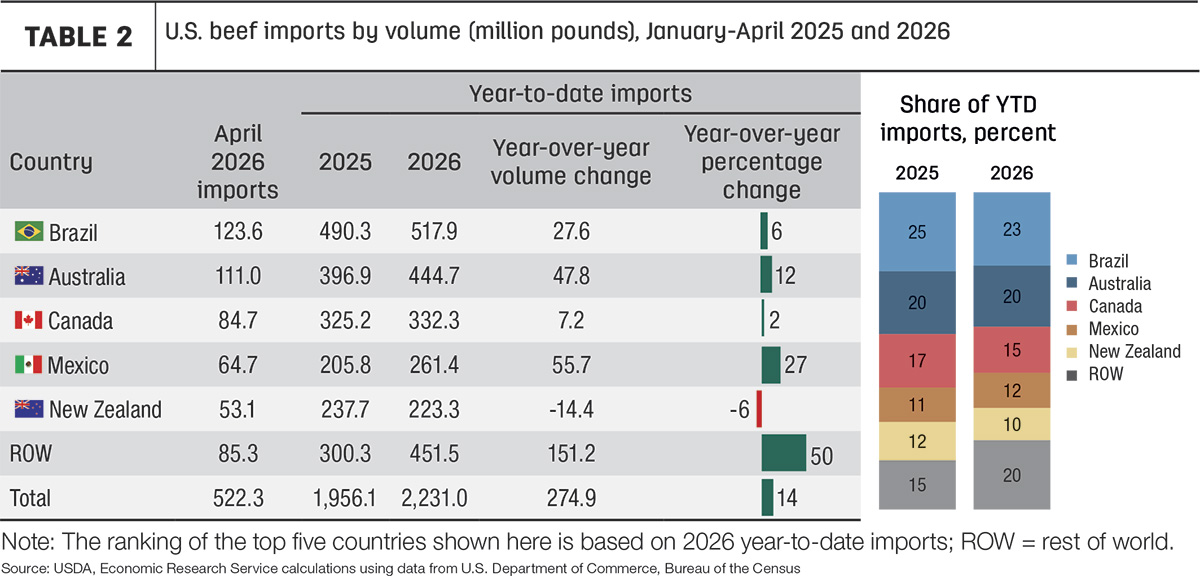
U.S. beef imports in April totaled 522 million pounds, a year-over-year increase of 10% (Table 2). Higher imports from Mexico, Canada and Australia accounted for the majority of the year-over-year increase. Monthly imports from New Zealand were 18% lower, while imports from Brazil were about 1% lower year over year. Imports from Argentina continue to be strong, with year-to-date imports through April up over 90% compared to the same period last year.
The import forecasts for 2026 and 2027 remain unchanged from last month. Continued strong demand for imported lean trimmings will keep total beef import volumes elevated with the annual forecast for 2026 at 6.109 billion pounds, a year-over-year increase of nearly 12%. The forecast for 2027 is 6 billion pounds.